

Students bump shoulders with architects at STEAM Studio
August 3, 2017 | Meghan LeVota
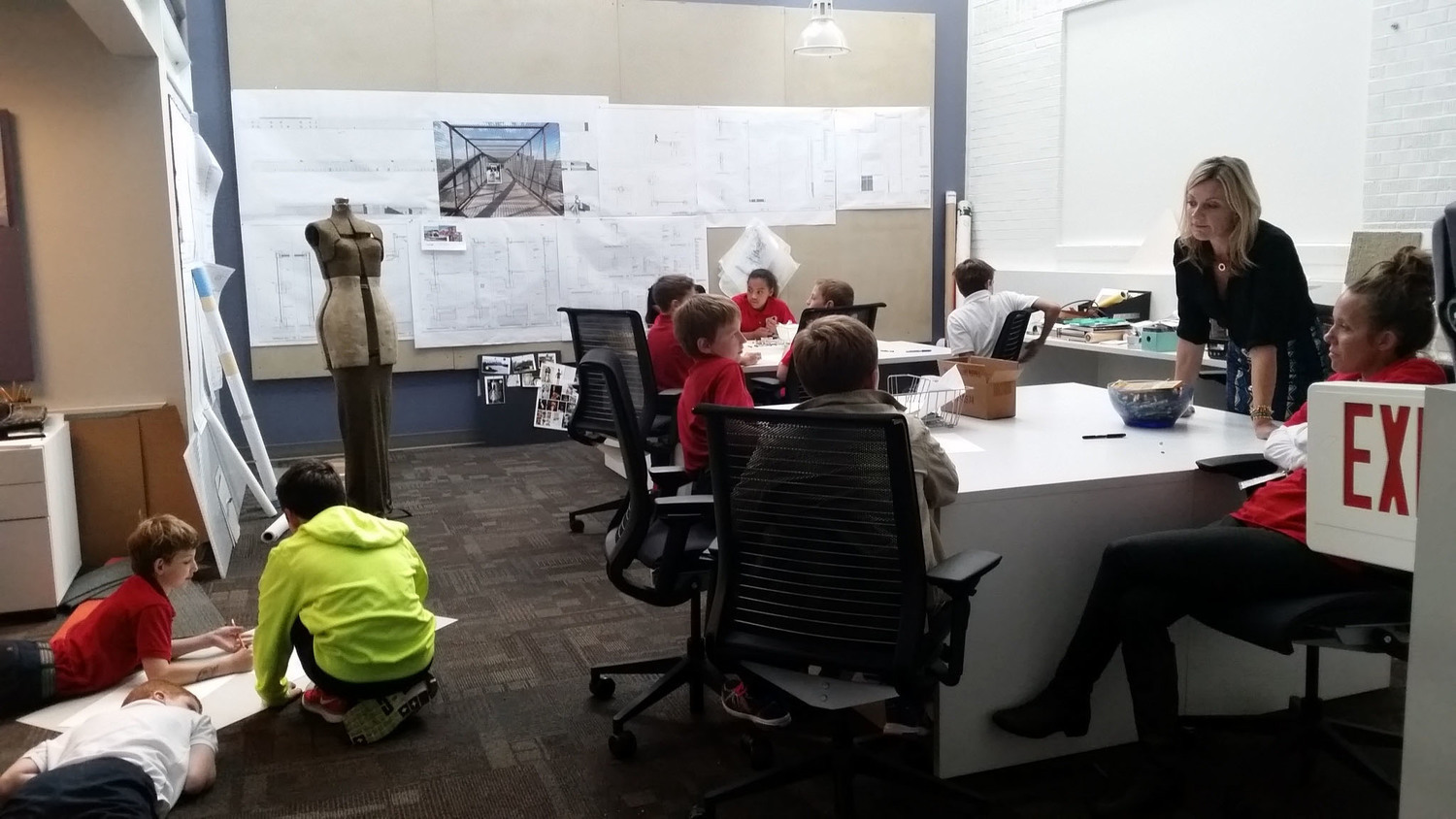
Most children won’t have experience working in a professional environment until they land their first job or internship, Mandi Sonnenberg said.
“Some kids may have popped into their mom or dad’s work and have gone to a professional space at least a couple times in their life,” Sonnenberg said. “But for kids in the urban core or for kids of different backgrounds, they just don’t have that exposure of being around professionals. They don’t get to practice.”
An education professor at Rockhurst University, Sonnenberg said that exposure to professionals is vital for student growth and equal opportunity. That’s why she co-founded the “anti-classroom” STEAM Studio in 2014.

Principal at Gould Evans and co-founder of STEAM Studio Dr. Mandi Sonnenberg
Located within the Kansas City architectural office of Gould Evans, STEAM Studio offers after-school programs and field trip packages to students all around the Kansas City metro. The program pulls from such organizations as Park Hill School District, charter school Citizens of the World, St. Teresa’s Academy, Boy and Girl Scouts and more.
The studio aims to boost a broken education system, Sonnenberg said.
“We provide opportunities for kids that can’t be provided in schools,” Sonnenberg said. “We know that teachers have to teach kids to be successful at standardized testing in a constructed format. What we want to do is create a balance for kids where they can be creative and explore and we offer a lot of design thinking processes.”
STEAM, which stands for science, technology, engineering, art and math, is not a new concept. Within the past decade, Kansas City has seen a rise in innovative educational spaces that offer project-based learning and design thinking, such as the CAPS network, LEAD Innovation Studio, DREAMS KC and others.
The STEAM Studio is the first program in the area to welcome kids to a holistic professional workspace, Sonnenberg said. Throughout each class, students share tools and bump shoulders with architects, designers, marketers and administrative assistants and Gould Evans.
“Research has shown that kids take bigger risks when they are not at school, which is why we decided to go with the daytime field trip and after-school program model,” Sonnenberg said. “I think when you offer kids the freedom to self-regulate and learn to control themselves they will rise to expectations, and I think that’s why this program is unique.”
Since the STEAM Studio’s launch, the program has seen 1,156 students from elementary, middle and high schools across the metro. The classes target suburban and intercity students equally, Sonnenberg said.
Working in a professional environment teaches kids social norms they otherwise wouldn’t learn in a traditional classroom, she added.
“At the beginning they will be like, ‘I need a stapler, I need a pen, I need a marker,’” Sonnenberg said. “And the coaches will turn around and say, ‘Well, where could you find that? I am not here to give it to you. If you really need something I will help you but we have shown you where everything is and when you are finished, you put it away.’ … We teach them to respect the space and understand that they are sharing the materials.”
More than 75 mentors and volunteers, as well as more than 350 coaches, have participated in with the program, Sonnenberg said, with organizers continually looking for community partners and grant opportunities.
Sonnenberg is confident in the Kansas City community’s ability to take STEAM Studio where it needs to go next, she said.
“Kansas City is open to change and growth. The people really want to grow and change for the better,” Sonnenberg said. “They want to empower youth, entrepreneurs and people from all walks of life. It’s nice to be surrounded by people who are excited to help you and who I am excited to help. I don’t feel like the STEAM Studio is in competition with any other nonprofit or education system. I don’t think that is the case in most cities.”
In May, Sonnenberg and David Reid, principal at Gould Evans, published a book, “Unleashing Creative Genius: STEAM Studio’s Impact on Learning,” that highlights the design thinking research done at STEAM Studio. The book is available on Amazon and at Barnes & Noble.


2017 Startups to Watch
stats here
Related Posts on Startland News

Bobby Burch: ‘The mountains are calling, and I must go’ — farewell and thank you
Editor’s Note: Startland News co-founder and editor-in-chief Bobby Burch will depart the storytelling organization at the end of July. Tommy Felts will assume leadership of Startland effective immediately. It was three-and-a-half years ago when Kansas City Startup Foundation CEO Adam Arredondo approached me with a “what if” scheme to start a publication focused on entrepreneurship.…

WATCH: No reason for ‘lone wolfing’ the startup grind, LaunchKC past winners say as application window narrows
Editor’s note: This article is sponsored by LaunchKC but was independently produced by Startland News. With a July 11 application deadline nearing, LaunchKC past winners emphasized the popular, high-profile grants contest is about much more than chasing a payday. “There’s the community piece. There’s the exposure piece. But once you win — or even once…

Accelerate Tech Learning targets the (urban) core of KC’s programmer shortage
Training would-be programmers from Kansas City’s urban core isn’t about getting rich, said Joshua Clark, co-founder of Accelerate Tech Learning. But unfortunately that means it can be tricky to get underestimated students the costly education to become a certified developer in the world of information technology, added Mauri Trent, Accelerate Tech’s executive vice president of…

With Hy-vee Arena, KC Star project, southward expansion, KC Crew plans to double its players
Where KC Crew plays, growth and development follow, said founder Luke Wade. The adult sports and event company filled Kansas City’s Parade Park every night before the Urban Youth Academy broke ground on East 17th Terrace, for example, Wade said. “So it’s kind of that economic development. The same thing happened with the riverfront when…