

How the Kansas City Chiefs became the No. 1 NFL team in social engagement
July 27, 2017 | Meghan LeVota
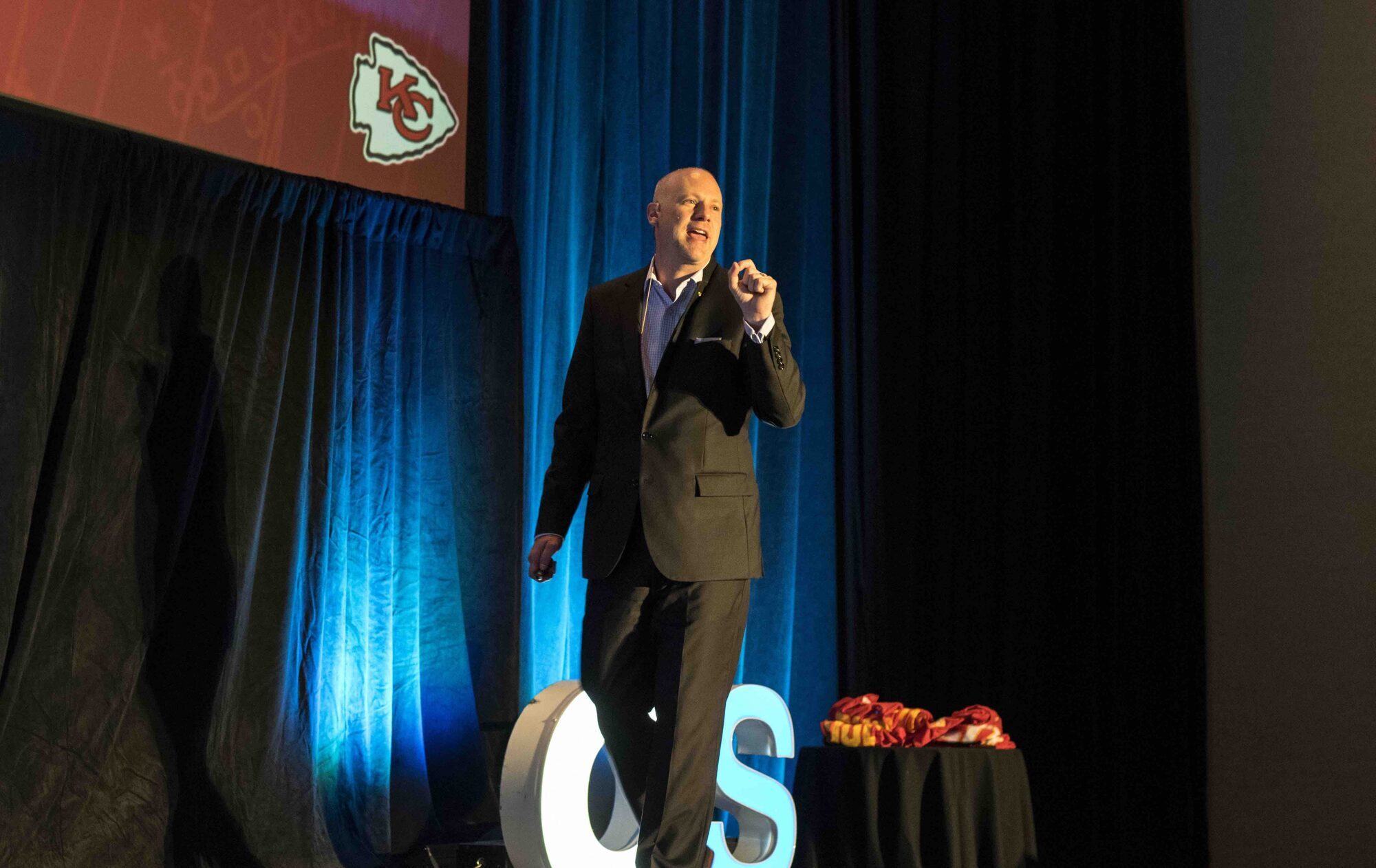
Most Kansas City Chiefs fans are likely aware that they hold the Guinness World Record for the “loudest crowd roar at a sports stadium.”
But what fans may not know is how that same enthusiasm and energy translates to the Kansas City Chiefs’ social media engagement. Using a variety of platforms, the team’s social media engagement is currently ranked No. 1 in the National Football League according to James Royer, director of digital media and strategy for the Kansas City Chiefs.
Royer offered some tools of the trade on Wednesday during Digital Summit: Kansas City. The two-day digital marketing conference is taking place at the Overland Park Convention Center.
“We have one of the biggest and most passionate fan bases on social media platforms,” Royer said. “We routinely reach more people than who follow us, and with a staff of two.”
In 2016, Royer said the Chiefs’ social media engagement increased by over 100 percent for Instagram and over 200 percent for Facebook and Twitter.
“This wasn’t an accident,” Royer said. “We specifically put new strategies in place last year and we’re anxious to see what it looks like this year.”
Here are three keys to the Chiefs’ social media success, according to Royer.
Prioritize video
Royer said that Facebook rewards video posts over text, therefore it is key to the Chiefs’ social strategy.
Since 2012, the Chiefs has been transforming their video content from television first to digital first. Now Chiefs’ videos are crafted with digital media in mind, aiming to grab attention in under three seconds.
“We know our content has to grab attention,” Royer said. “If we don’t stop the thumb scroll, they’re not going to interact with our content. So we put out premium content that is prioritized for social media.”
Royer added that Facebook video tends to include highlighted action shots as well as subtitles. He said that Twitter and Instagram are also good video platforms that should not be overlooked.
Make sure there’s context
Royer said that before sharing a post, the team makes sure the content is a combination of compelling, educational, entertaining and informative.
But quality content is nothing without context, he added.
“We’re always thinking about the context,” Royer said. “We ask ourselves, ‘how do we make that leap in a user’s head so that understand what we’re saying and how it fits with them?’”
For example, the Chiefs shared a Facebook post in December about the multi-million dollar heating system that was installed under the playing surface at Arrowhead Stadium.
“If we were to share this same article in July, it would not have the same engagement,” Royer said. “The context is off.”
Analyze user behavior
The Chiefs’ social team pulls analytics on user behavior from over a dozen different data sources, Royer said.
“We’re always looking to understand how are our fans are interacting to what we’re doing and how can we get better at it,” Royer said.
This is what lead the social strategy team to make more informed decisions. They learned to prefer more close up photos that show emotion, to include simple graphics and the optimal time of day to post.
“When we were struggling, we were posting at three or four,” Royer said. “But, we learned that our audience is more likely to be on Instagram or Facebook in the evenings and much more likely to interact. Now we post as late as 10 o’clock at night.”
Royer added that analytics also helped the team decide to increase their use of emojis and to participate in national hashtags.
“They say that organic reach is dead,” Royer said. “But I don’t believe this is possible, because of what we are doing with the Kansas City Chiefs.”


2017 Startups to Watch
stats here
Related Posts on Startland News

Want a globally competitive KC? Look beyond smart city ‘bling,’ Digi.City founder says
The U.S. has a lot of catching up to do, said Chelsea Collier, founder of Digi.City. It’s not quite doomsday, but Collier wanted to express a sense of urgency, she said Friday during a Smart Metro Summit at Plexpod Westport Commons. Cities need to get smart — fast — or the United States will continue to…

VideoFizz adapts greeting card app for real estate listings, closes $500K deal
Don’t miss your customers’ cues, said Laura Steward, founder of VideoFizz. Though the Kansas City-based startup originally developed its mobile app as a tool to help individuals create video compilations of their personal photos and videos, Steward and her team noticed a growing number of real estate agents using the technology to stitch together video…

Smart KCMO takes holistic approach to digital-physical infrastructure, city manager says
Kansas City’s downtown streetcar project showcases the KC smart community’s ability to tackle multiple infrastructure projects at once, said Troy Schulte, city manager. But it isn’t the only example, he told Chelsea Collier, founder of Digi.City, Friday during a Smart Metro Summit at Plexpod Westport Commons. The event was coordinated by Digi.City, the Enterprise Center…

With big KC hiring plans, Aussie-born SafetyCulture prioritizes community engagement
Though SafetyCulture is headquartered 9,000 miles away, its new North American hub in Kansas City is being intentional about driving positive local change — particularly in education, said Ross Reed. “We really want to get into the community to make an impact,” said Reed, SafetyCulture’s North American president. “We’re going to continue to get out…