

Kansas City ranks as top U.S. tech, entrepreneurship hub
June 9, 2017 | Meghan LeVota

Kansas City’s emerging tech hub and entrepreneurial ecosystem continue to attract national attention.
On Thursday, Kansas City ranked among the top tech cities in the U.S., according to the Tech Cities 1.0 report by Cushman & Wakefield. The report showcased the nation’s top 25 cities, with Kansas City nabbing the No. 22 spot on the list. The cities were determined by factors such as access to talent, investment capital and growth opportunity.
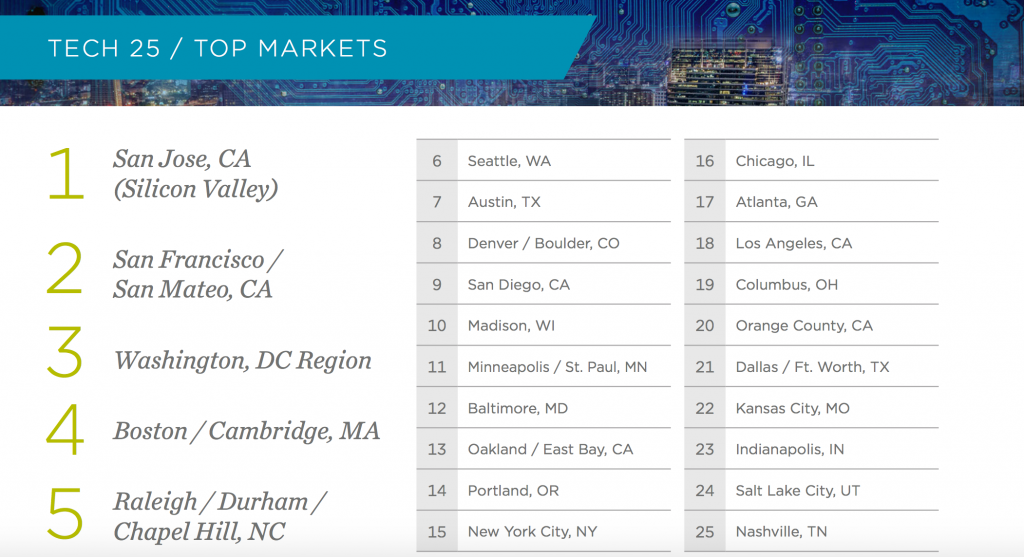
Cushman & Wakefield Tech Cities 1.0 report
Although it’s no surprise that cities like San Jose and San Francisco outranked Kansas City, The City of Fountains’ performance is still noteworthy. Kansas City fared better than New York City and Los Angeles in metrics such as tech workers per capita, share of workers with a Bachelor’s degree or higher, entrepreneurial growth and share of “knowledge” workers, defined as those in occupations such as architecture, social science, health care and education.
In preparing the report, Cushman & Wakefield found six qualities as essential ingredients for a tech hub: Institutions of higher learning; capital; tech workers; knowledge workers; educated workers; and growth entrepreneurship.
Kansas City ranked No. 18 on percentage of tech workers and No. 16 for entrepreneurial growth. In both areas, the metro is rated above the national average.
To calculate entrepreneurial growth, Cushman & Wakefield tapped the Ewing Marion Kauffman Foundation’s Index of Growth Entrepreneurship. The index is calculated by the rate of startup growth, share of scale-ups and high-growth company density.
Although these statistics are promising, Kansas City is nowhere close to Silicon Valley with venture capital and deal flow.
In 2016, the combination of venture capital capital activity from San Francisco, San Mateo and San Jose reached $35.2 billion. In Kansas City, that number is less than $2 billion.
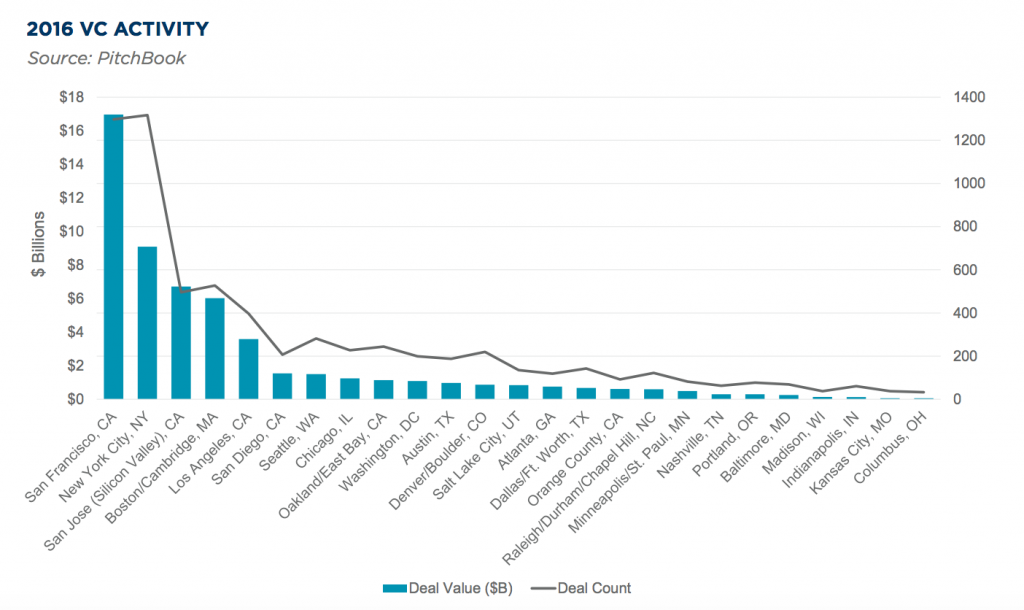
Cushman & Wakefield Tech Cities 1.0 report
Ken McCarthy, principal economist at Cushman & Wakefield, said that “tech is everything.”
“Basically every company today is a tech company in one way or another. We’re all using it, we’re using various aspects of tech companies to do various things,” McCarthy said in a release. “Whether it’s Salesforce as customer relationship management, or Workday for HR, and various other database programs, the old way of doing business just doesn’t work anymore.”
Cushman & Wakefield is a global real estate services firm. 2017 marks the first year the firm has released a Tech Cities 1.0 report.

Featured Business

2017 Startups to Watch
stats here
Related Posts on Startland News

DevOpsDays brings two-day grassroots tech conference back to Kansas City
DevOpsDays KC is returning this week with an open spaces concept wherein audience members at the two-day conference vote on the topics to cover in real time, said Ryan McNair. Topics with the most votes create zones in the space in which the audience can flow freely from each area. “If you don’t like it,…

Privacy in practice: Responding to daily cyber threats sharpens Polsinelli tech team
Editor’s note: The following content is sponsored by Polsinelli PC but independently produced by Startland News. We see the fallout nearly every day. Another company, government or celebrity that’s been technologically compromised, prompting officials to scramble on how to best calm customers, citizens and stakeholders. And when you lead one of the nation’s top cybersecurity…

Pint-sized perspective: KC’s Little Hoots takes nostalgia-capturing tech to MIT
From the cute and comedic to the whimsical and wise, every parent can pinpoint a Little Hoots moment that relates to their personal adventure in child-rearing, said Lacey Ellis, founder and CEO of the Kansas City-birthed mobile app that recently turned heads at MIT. “If a picture is worth a thousand words, a hoot is…

LaunchKC winner bringing cryptocurrency into the investment game with Liquifi
A blockchain-enabled solution from Venture360, called Liquifi, aims to unfreeze startups paralyzed by a lack of access to capital, Rachael Qualls said with excitement. “The main reason more people don’t invest in private companies is there is no way to get money out,” said Qualls, CEO of Venture360. “On average money is tied up for…