

Kansas City ranks as top U.S. tech, entrepreneurship hub
June 9, 2017 | Meghan LeVota

Kansas City’s emerging tech hub and entrepreneurial ecosystem continue to attract national attention.
On Thursday, Kansas City ranked among the top tech cities in the U.S., according to the Tech Cities 1.0 report by Cushman & Wakefield. The report showcased the nation’s top 25 cities, with Kansas City nabbing the No. 22 spot on the list. The cities were determined by factors such as access to talent, investment capital and growth opportunity.
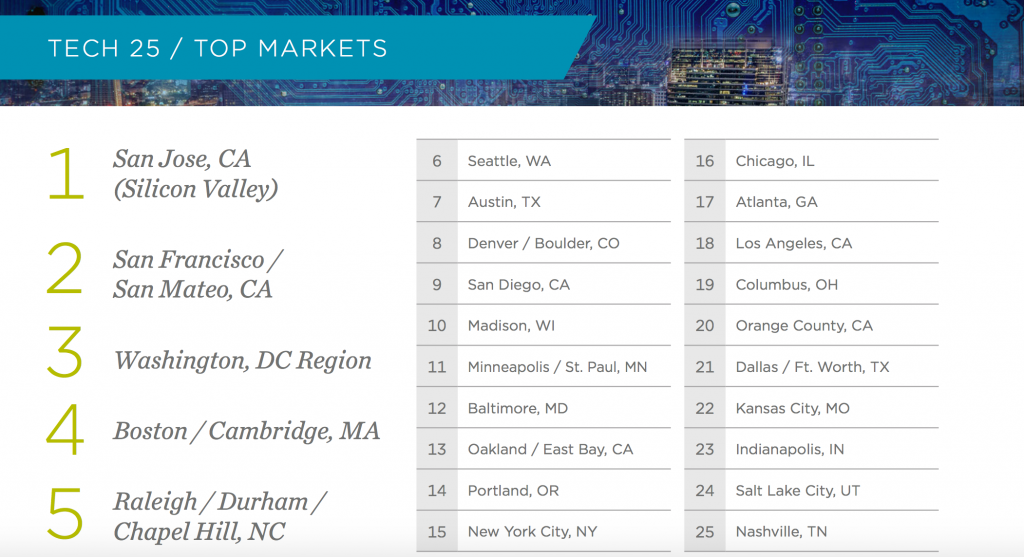
Cushman & Wakefield Tech Cities 1.0 report
Although it’s no surprise that cities like San Jose and San Francisco outranked Kansas City, The City of Fountains’ performance is still noteworthy. Kansas City fared better than New York City and Los Angeles in metrics such as tech workers per capita, share of workers with a Bachelor’s degree or higher, entrepreneurial growth and share of “knowledge” workers, defined as those in occupations such as architecture, social science, health care and education.
In preparing the report, Cushman & Wakefield found six qualities as essential ingredients for a tech hub: Institutions of higher learning; capital; tech workers; knowledge workers; educated workers; and growth entrepreneurship.
Kansas City ranked No. 18 on percentage of tech workers and No. 16 for entrepreneurial growth. In both areas, the metro is rated above the national average.
To calculate entrepreneurial growth, Cushman & Wakefield tapped the Ewing Marion Kauffman Foundation’s Index of Growth Entrepreneurship. The index is calculated by the rate of startup growth, share of scale-ups and high-growth company density.
Although these statistics are promising, Kansas City is nowhere close to Silicon Valley with venture capital and deal flow.
In 2016, the combination of venture capital capital activity from San Francisco, San Mateo and San Jose reached $35.2 billion. In Kansas City, that number is less than $2 billion.
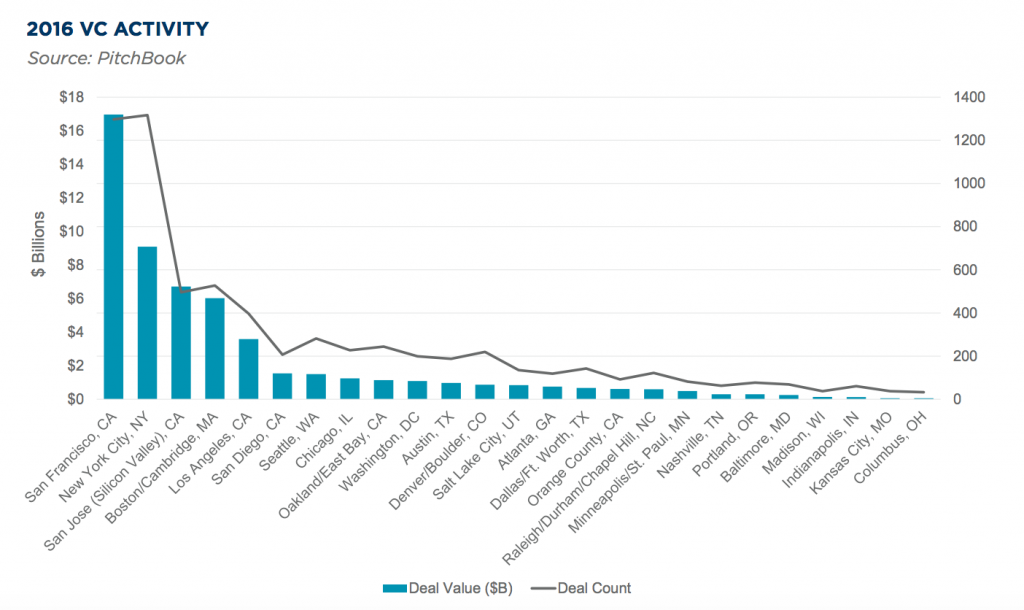
Cushman & Wakefield Tech Cities 1.0 report
Ken McCarthy, principal economist at Cushman & Wakefield, said that “tech is everything.”
“Basically every company today is a tech company in one way or another. We’re all using it, we’re using various aspects of tech companies to do various things,” McCarthy said in a release. “Whether it’s Salesforce as customer relationship management, or Workday for HR, and various other database programs, the old way of doing business just doesn’t work anymore.”
Cushman & Wakefield is a global real estate services firm. 2017 marks the first year the firm has released a Tech Cities 1.0 report.

Featured Business

2017 Startups to Watch
stats here
Related Posts on Startland News

WonderWe launches faith-based crowdfunding platform
Kansas City-based software startup WonderWe hopes to tap a specific market for its new faith-based crowdfunding platform. Launched in early June, WonderWe combines faith-based values, the latest in crowdfunding tech and new proprietary features to “be one of the leading names” in crowdfunding, said Dominic Ismert, founder of WonderWe. The platform currently accepts fundraisers for…
The Lean Lab will award $100K to education entrepreneurs
Local efforts to inject innovation into education received a boost Friday as The Lean Lab announced fellows in its incubator program will earn seed capital for their projects aimed at disrupting traditional learning. Founded in 2013, The Lean Lab welcomed five new teams of fellows from around the nation for its incubator, which develops…

‘Kansas City Startup House’ aims to be smart home incubator
A local tech founder is transforming his Kansas City, Kan., home to eventually become the area’s next incubator program. Sports Photos founder Brandon Schatz recently launched the “Kansas City Startup Home” to host entrepreneurs and innovators from around the world. While it’s now serving as an Airbnb destination for techies, Schatz said in the next…

Kauffman Foundation analyzes Kansas City’s startup growth
What does startup community success look like? Often one hears buzzwords like “vibrant,” “supportive” and “close-knit” — standards by which nearly any community can label itself successful. But since it’s nearly impossible to objectively measure those terms, a startup community’s success is instead frequently evaluated through funding and exits. That ignores the fact that most…