

Kansas City ranks as top U.S. tech, entrepreneurship hub
June 9, 2017 | Meghan LeVota

Kansas City’s emerging tech hub and entrepreneurial ecosystem continue to attract national attention.
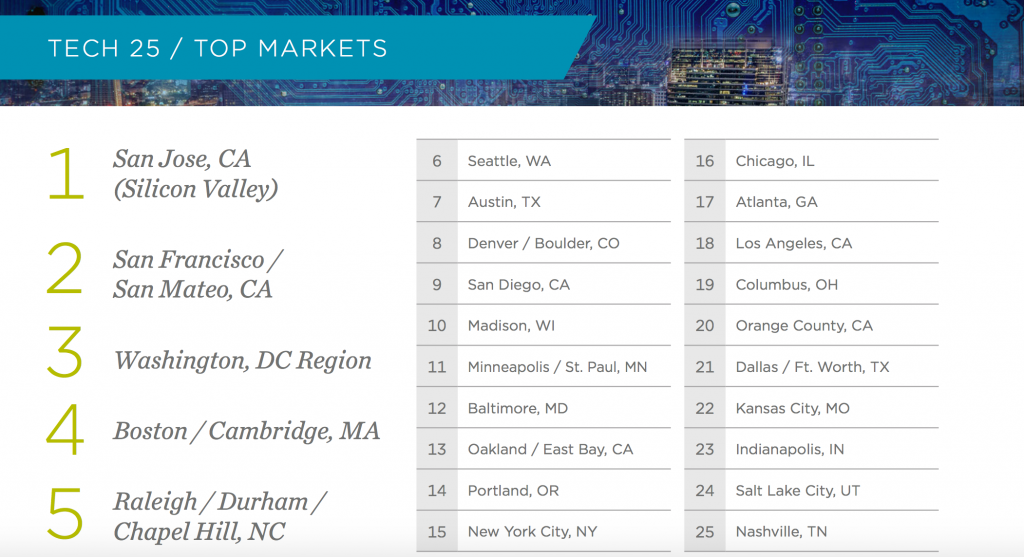
On Thursday, Kansas City ranked among the top tech cities in the U.S., according to the Tech Cities 1.0 report by Cushman & Wakefield. The report showcased the nation’s top 25 cities, with Kansas City nabbing the No. 22 spot on the list. The cities were determined by factors such as access to talent, investment capital and growth opportunity.
Cushman & Wakefield Tech Cities 1.0 report
Although it’s no surprise that cities like San Jose and San Francisco outranked Kansas City, The City of Fountains’ performance is still noteworthy. Kansas City fared better than New York City and Los Angeles in metrics such as tech workers per capita, share of workers with a Bachelor’s degree or higher, entrepreneurial growth and share of “knowledge” workers, defined as those in occupations such as architecture, social science, health care and education.
In preparing the report, Cushman & Wakefield found six qualities as essential ingredients for a tech hub: Institutions of higher learning; capital; tech workers; knowledge workers; educated workers; and growth entrepreneurship.
Kansas City ranked No. 18 on percentage of tech workers and No. 16 for entrepreneurial growth. In both areas, the metro is rated above the national average.
To calculate entrepreneurial growth, Cushman & Wakefield tapped the Ewing Marion Kauffman Foundation’s Index of Growth Entrepreneurship. The index is calculated by the rate of startup growth, share of scale-ups and high-growth company density.
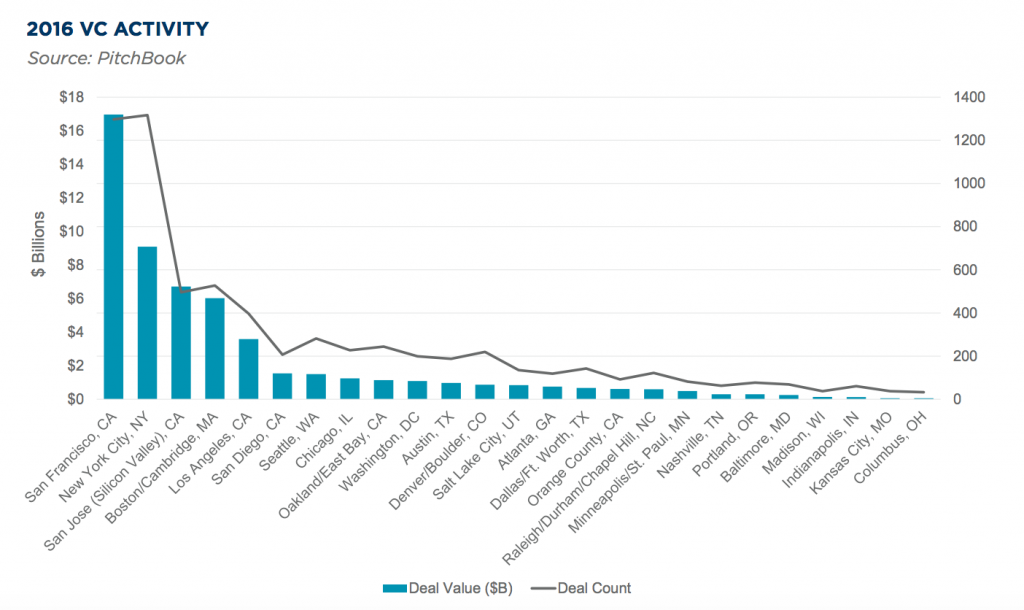
Although these statistics are promising, Kansas City is nowhere close to Silicon Valley with venture capital and deal flow.
In 2016, the combination of venture capital capital activity from San Francisco, San Mateo and San Jose reached $35.2 billion. In Kansas City, that number is less than $2 billion.
Cushman & Wakefield Tech Cities 1.0 report
Ken McCarthy, principal economist at Cushman & Wakefield, said that “tech is everything.”
“Basically every company today is a tech company in one way or another. We’re all using it, we’re using various aspects of tech companies to do various things,” McCarthy said in a release. “Whether it’s Salesforce as customer relationship management, or Workday for HR, and various other database programs, the old way of doing business just doesn’t work anymore.”
Cushman & Wakefield is a global real estate services firm. 2017 marks the first year the firm has released a Tech Cities 1.0 report.

Featured Business

2017 Startups to Watch
stats here
Related Posts on Startland News

Events Preview: Conquer for Good, TEDxUMKC
There are a plethora of entrepreneurial events hosted in Kansas City on a weekly basis. Whether you’re an entrepreneur, investor, supporter, or curious community member — we recommend these upcoming events for you. Are you hosting a relevant community event? Feel free to add it to the FWD/KC calendar for increased exposure. Once your event…

Jaguar Land Rover invests in artificial intelligence startup Mycroft
Mycroft has received a significant boost in horsepower. Only a few weeks after entering 500 Startups, Mycroft has landed a strategic partnership with Jaguar Land Rover. The Kansas City-based artificial intelligence startup is among the first startups to enter the Portland-based Jaguar Land Rover Tech Incubator, which will provide Mycroft with a $110,000 investment and…

KC-based OYO Fitness closes a historically successful Kickstarter
To say that OYO Fitness has a successful Kickstarter campaign would be an understatement. The Kansas City-based fitness firm folded up and then crushed its recent crowdfunding effort, which raised a stunning $659,000 for its collapsible and compact exercise device. OYO’s DoubleFlex Black campaign — which snagged pre-orders from 4,200 backers — was the second…
Survivor, innovator Kim Gandy rewards patients for sticking to treatments
In her 20 years working as a transplantation clinician, Kim Gandy found it baffling that a seemingly simple problem had such a difficult time finding a solution. Transplant patients consistently struggled to adhere to their health regimens, resulting not only in significant costs for care providers but also death. “We were literally losing patients,” Gandy…