

Altruistic underwear maker MADI Apparel grows with chic, empathic approach
June 16, 2017 | Meghan LeVota
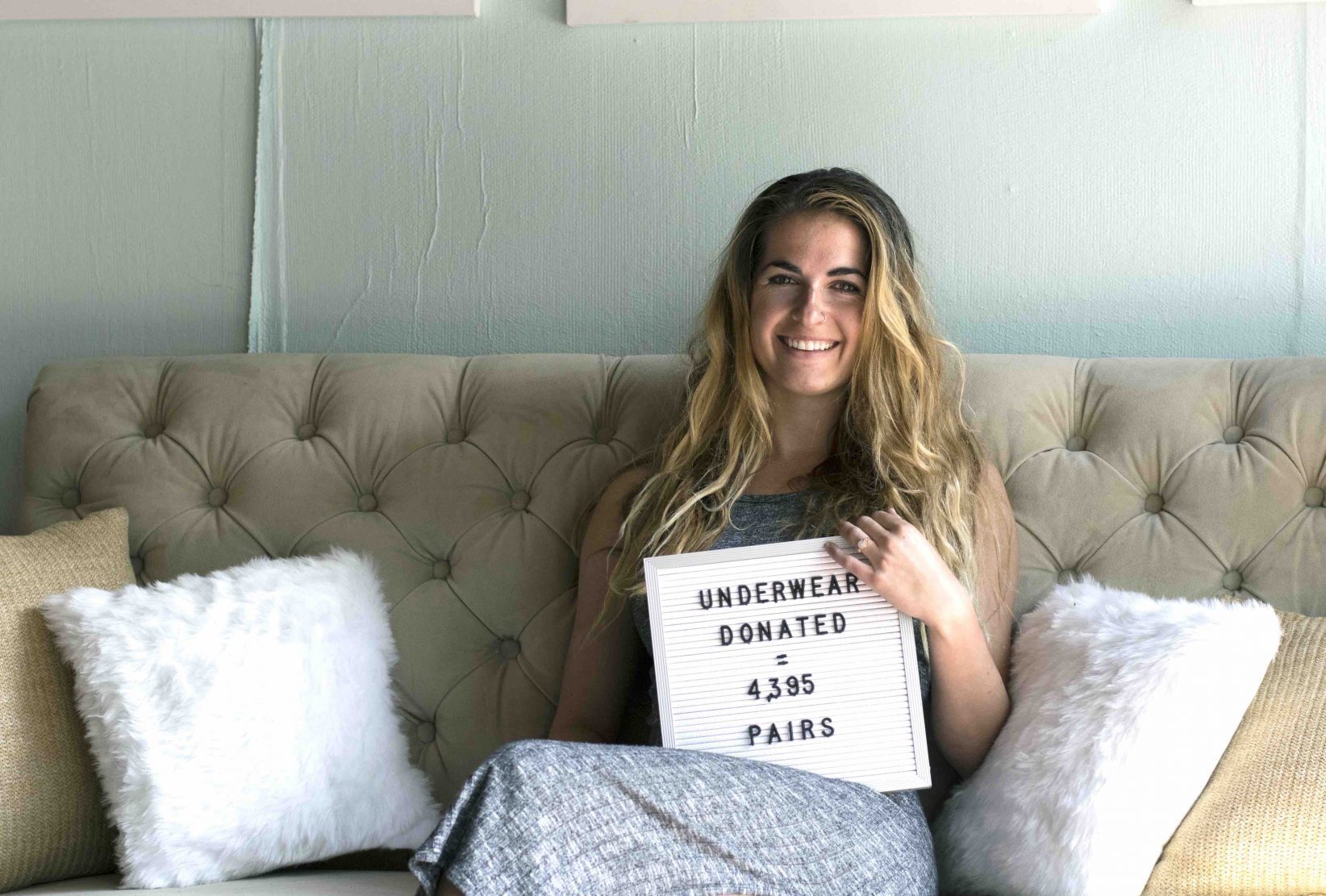
Hayley Besheer always considered herself to be a passionate and empathetic person.
But what she initially struggled with was to figure out how to best contribute those skills to the world.
“If you bring positive energy into the world, then you get it back,” Besheer said. “When you bring trust to the table, you get it back. I believe in that 100 percent.”
When Besheer first began developing her business in 2012, she didn’t have to try too hard. When the pieces fell into place, it was her heart that carried her through with the idea to combine her benevolent nature with her love for fashion design.

MADI Apparel products
Her passion eventually manifested in the form of MADI Apparel, a Kansas City-based social venture that’s helping provide underwear to women in need.
“I just feel lucky that this was put on my plate,” Besheer said. “People are always asking me like ‘How did you plan this?’ and the answer is no, I didn’t plan it. … I was in my ‘hot spot’ or my ‘flow’ and I just figured it out.”
MADI Apparel is like the TOMS shoes for underwear. Selling high-quality intimates — made in Kansas City with bamboo fabric — MADI Apparel donates a pair of underwear to a woman in need for every item sold. Since the firm’s launch in 2014, Besheer has donated more than 4,300 pairs of underwear. MADI is an acronym that stands for “Make a Difference Intimates.”
“First, I thought we’d just donate a portion of the proceeds,” Besheer said. “But that wasn’t a wow factor enough. We decided to be the most impactful intimates company that there is.”
Underwear may not be the first item that comes to mind with donations, however, the need is significant. Underwear is, in fact, the most under-donated item of clothing in the U.S. and abroad, Besheer said.
And if that isn’t enough, Besheer also learned that at risk women are more vulnerable to sexual abuse if they do not have a pair of underwear.
“(Underwear) is a social and wealth standard,” Besheer said. “in many third world communities outside of the U.S., if you had underwear you were not as targeted because you are looked at as if you had more money, or a husband or a brother looking out for you. If you didn’t have underwear, it puts a target on your back.”
MADI Apparel doesn’t donate just any underwear — the women receive a MADI Apparel product made with top-quality materials.
“When we do our drop offs we set it up kind of like a pop-up boutique,” Besheer said. “Women can come up and pick their favorite style, and we’ll write them a handwritten note. We really want to get to know the women we serve.”
When Besheer chose the fabric for the products, she did so with these women in mind — not the customers. Viscose from bamboo is not only one of the most comfortable and sustainable fabrics, but it is super long lasting and fast drying.
“That way, if the women we donate to only have a single pair of underwear, it can dry overnight,” Besheer said. “We want the women to feel comfortable, it’s a dignity thing.”
Underwear, sexual abuse and poverty are not the most “comfortable” topics to chat about, Besheer said. But with her 1,450 square-foot flagship store in Kansas City’s Westside neighborhood, Besheer said she hopes to create a relaxed atmosphere where customers feel safe and comfortable.
“The cool thing is that if our team feels comfortable about the topic and about underwear, then I think we can emulate that it is not actually uncomfortable,” Besheer said. “Our store is so comfy in general that it is way different than a typical intimates story. We want it to look more welcoming and less super sexy.”
MADI Apparel has seen a 25 percent increase in sales each quarter since 2014, Besheer said. The firm now has donated underwear in eight countries and has donated to 35 total U.S. non-profit organizations.
The products are sold in dozens of boutiques in Kansas City and across the U.S. In May, the firm established its first partnership with a department store, Von Maur. Von Maur stores in Minneapolis, Chicago and Omaha are all carrying MADI products.
This summer, MADI Apparel is launching a new program that will employ at risk Kansas City women called MADI Makes.
“This will help us because we have a way higher volume of orders than we did a year ago and our current cut and sew teams cannot keep up,” Besheer said. “Not only will we be employing local women to sew our products, we’ll be employing at-risk women who need the job and the opportunity.”
MADI Makes is made possible through a partnership with Hope Faith Ministries, a Kansas City-based nonprofit that serves homeless and at-risk individuals.
Alfredo Palacol, grants coordinator at Hope Faith Ministries, said the donated underwear has been much needed for the organization.
“MADI Apparel has been a great resource in not only donating high-quality women’s underwear but by advocating and informing the broader community of the needs of women at-risk,” Palacol said. “We’re especially excited about the pilot program, through MADI Makes, that will begin to address the economic root causes that trap women in cycles of homelessness and poverty.”
As MADI Apparel continues to grow, Besheer plans trust her gut instincts and adhere to her values. She credits her success thus far to doing the right thing.
“I want to stand behind every decision I make completely, or else I cannot move forward,” Besheer said. “My personal values will always outweigh any kind of money possibility.”


2017 Startups to Watch
stats here
Related Posts on Startland News

Stripping Missouri’s supplier diversity goals stifles state’s prosperity potential, says women’s business advocate
Ending nearly a decade of benchmarks that helped ensure greater equity in state contracts for businesses owned by minorities and women is a move in the wrong direction for Missouri, said Jennifer Brungardt, emphasizing the coming impact of lost opportunities for underrepresented entrepreneurs. “Diversity and economic growth will be stifled without proper support from our…
Capital connector’s message to women: Your investor pool isn’t just sharks; dive in and learn to swim
When it comes to navigating the waters of capital and equity, Women’s Capital Connection angel investment network and the Women’s Business Center serve as a guide to both entrepreneurs and investors, Kelly Sievers shared. “All the education that we do and all the connections that we make, I would say that’s really the key,” explained…

Entrepreneur behind Soul of Santa aims to create Rockefeller Plaza holiday experience on KC’s east side
Tucker Lott hopes an outdoor ice skating rink at 2000 Vine — the home of Vine Street Brewing — will help solidify a new holiday tradition in the 18th and Vine entertainment district, the veteran entrepreneur said. “We wanted to create a holiday atmosphere where families could gather and have fun,” said Lott. “The entire…

Proptech startup Particle Space acquired by LA real estate marketing software firm
The acquisition of a Kansas City proptech startup by one of its first — and biggest — customers offers founder David Biga the opportunity to pivot back to his entrepreneurial roadmap, he said, reflecting on next steps once Particle Space’s technology is fully integrated into its new home. “Build, give back, build, give back,” Biga…