

Altruistic underwear maker MADI Apparel grows with chic, empathic approach
June 16, 2017 | Meghan LeVota
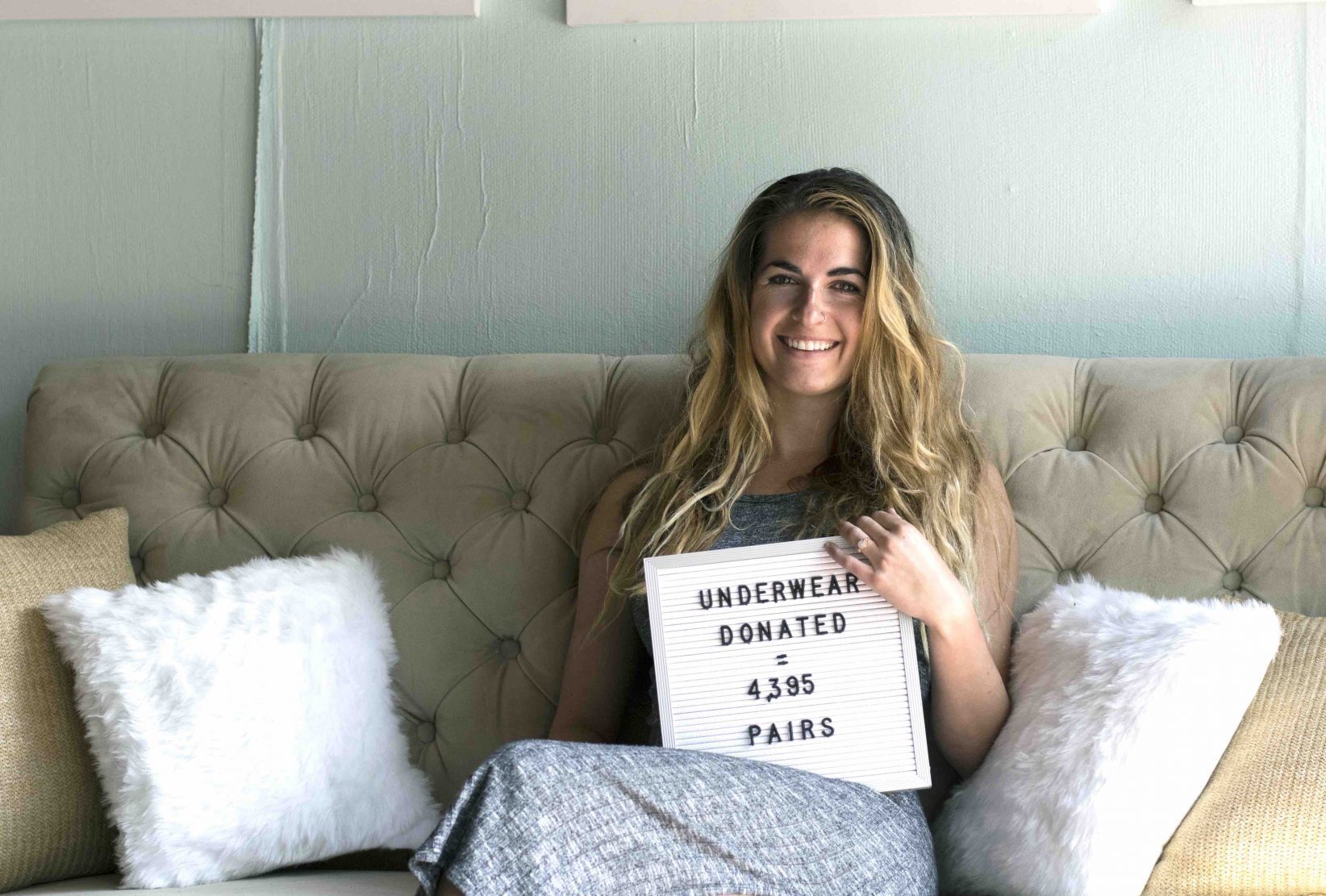
Hayley Besheer always considered herself to be a passionate and empathetic person.
But what she initially struggled with was to figure out how to best contribute those skills to the world.
“If you bring positive energy into the world, then you get it back,” Besheer said. “When you bring trust to the table, you get it back. I believe in that 100 percent.”
When Besheer first began developing her business in 2012, she didn’t have to try too hard. When the pieces fell into place, it was her heart that carried her through with the idea to combine her benevolent nature with her love for fashion design.

MADI Apparel products
Her passion eventually manifested in the form of MADI Apparel, a Kansas City-based social venture that’s helping provide underwear to women in need.
“I just feel lucky that this was put on my plate,” Besheer said. “People are always asking me like ‘How did you plan this?’ and the answer is no, I didn’t plan it. … I was in my ‘hot spot’ or my ‘flow’ and I just figured it out.”
MADI Apparel is like the TOMS shoes for underwear. Selling high-quality intimates — made in Kansas City with bamboo fabric — MADI Apparel donates a pair of underwear to a woman in need for every item sold. Since the firm’s launch in 2014, Besheer has donated more than 4,300 pairs of underwear. MADI is an acronym that stands for “Make a Difference Intimates.”
“First, I thought we’d just donate a portion of the proceeds,” Besheer said. “But that wasn’t a wow factor enough. We decided to be the most impactful intimates company that there is.”
Underwear may not be the first item that comes to mind with donations, however, the need is significant. Underwear is, in fact, the most under-donated item of clothing in the U.S. and abroad, Besheer said.
And if that isn’t enough, Besheer also learned that at risk women are more vulnerable to sexual abuse if they do not have a pair of underwear.
“(Underwear) is a social and wealth standard,” Besheer said. “in many third world communities outside of the U.S., if you had underwear you were not as targeted because you are looked at as if you had more money, or a husband or a brother looking out for you. If you didn’t have underwear, it puts a target on your back.”
MADI Apparel doesn’t donate just any underwear — the women receive a MADI Apparel product made with top-quality materials.
“When we do our drop offs we set it up kind of like a pop-up boutique,” Besheer said. “Women can come up and pick their favorite style, and we’ll write them a handwritten note. We really want to get to know the women we serve.”
When Besheer chose the fabric for the products, she did so with these women in mind — not the customers. Viscose from bamboo is not only one of the most comfortable and sustainable fabrics, but it is super long lasting and fast drying.
“That way, if the women we donate to only have a single pair of underwear, it can dry overnight,” Besheer said. “We want the women to feel comfortable, it’s a dignity thing.”
Underwear, sexual abuse and poverty are not the most “comfortable” topics to chat about, Besheer said. But with her 1,450 square-foot flagship store in Kansas City’s Westside neighborhood, Besheer said she hopes to create a relaxed atmosphere where customers feel safe and comfortable.
“The cool thing is that if our team feels comfortable about the topic and about underwear, then I think we can emulate that it is not actually uncomfortable,” Besheer said. “Our store is so comfy in general that it is way different than a typical intimates story. We want it to look more welcoming and less super sexy.”
MADI Apparel has seen a 25 percent increase in sales each quarter since 2014, Besheer said. The firm now has donated underwear in eight countries and has donated to 35 total U.S. non-profit organizations.
The products are sold in dozens of boutiques in Kansas City and across the U.S. In May, the firm established its first partnership with a department store, Von Maur. Von Maur stores in Minneapolis, Chicago and Omaha are all carrying MADI products.
This summer, MADI Apparel is launching a new program that will employ at risk Kansas City women called MADI Makes.
“This will help us because we have a way higher volume of orders than we did a year ago and our current cut and sew teams cannot keep up,” Besheer said. “Not only will we be employing local women to sew our products, we’ll be employing at-risk women who need the job and the opportunity.”
MADI Makes is made possible through a partnership with Hope Faith Ministries, a Kansas City-based nonprofit that serves homeless and at-risk individuals.
Alfredo Palacol, grants coordinator at Hope Faith Ministries, said the donated underwear has been much needed for the organization.
“MADI Apparel has been a great resource in not only donating high-quality women’s underwear but by advocating and informing the broader community of the needs of women at-risk,” Palacol said. “We’re especially excited about the pilot program, through MADI Makes, that will begin to address the economic root causes that trap women in cycles of homelessness and poverty.”
As MADI Apparel continues to grow, Besheer plans trust her gut instincts and adhere to her values. She credits her success thus far to doing the right thing.
“I want to stand behind every decision I make completely, or else I cannot move forward,” Besheer said. “My personal values will always outweigh any kind of money possibility.”


2017 Startups to Watch
stats here
Related Posts on Startland News
Random origins, but no fluke: MADE grinds to grand expansion
The MADE Mobb is getting used to risk taking. “We know what it’s like to walk into something blind,” laughed Mark Launiu, co-founder at MADE Urban Apparel. Launiu, along with co-founders Vu Radley and Jonathan “JP” Platz, launched MADE in 2012 with the streetwear apparel line selling in just a few pop-up shops. Early partnerships…

Smart city leader: Can technology predict deadly shooters before it’s too late?
A smart city is a safe city, Herb Sih said. And technology can help. “If you don’t have safety, you don’t have anything,” said Sih, managing partner at Think Big Partners, one of the key collaborators in Kansas City’s $15.7 million public-private Smart City initiative. Having grown up in St. Louis, Sih said he has…
T-shirt printer GOEX hopes to clad workers in dignity
A Kansas City T-shirt screen printer has a lofty mission: Turn local purchases into global impact. “Your dollar has value in how it’s treating others across the world,” said Ryan Hudnall, engagement director at the Global Orphan Project. Tucked away near Wyandotte and 31st streets, GOEX serves as an offshoot of the Global Orphan Project,…
Looping back? Missouri partners with Hyperloop to study 23-minute KC-St Louis route
Missouri’s prospects for landing a Hyperloop route apparently aren’t off the rails after all. Despite the company revealing four U.S. finalist routes in September — which did not include a proposed route through the Show Me State – Hyperloop One announced Tuesday it has entered into a public-private partnership with the State of Missouri to conduct…