

Report: KC is a tech hub but labor shortage is hampering growth
May 11, 2017 | Meghan LeVota

Each day, Kansas City is better positioning itself to be the Midwest’s tech hub.
But for Kansas City to realize its full potential, tech leaders, policymakers and the community need to do more to cultivate homegrown talent, KC Tech Council president Ryan Weber said.
“Attracting talent from another city is a very small game — and often a losing game,” Weber said. “But the ability to train and grow talent that’s already here is the land of opportunity.”
On Friday, the KC Tech Council released a detailed report analyzing the area’s tech industry, including a focus on how to increase area tech talent. The report found that the current labor force is insufficient to fill the expected demand for tech jobs in the area.
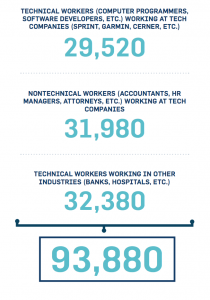
source: KC Tech Council
Kansas City’s tech industry is directly responsible for 93,880 jobs, according to the report. That total is comprised of tech workers at tech companies, non-tech workers working at tech companies and tech workers working at non-tech companies.
“The numbers don’t lie,” Weber said. “In general, we know there’s roughly 1 million workers in Kansas City, and if roughly 100,000 of them are working in tech you can round those numbers to say that almost 1 in 10 Kansas Citians directly contribute to the tech industry — that’s pretty huge.”
But despite growth of the industry, the report found that at the end of 2016 there were 4,699 open tech jobs in the Kansas City area.
That labor shortage is holding Kansas and Missouri back, Weber said, who recommends a shift in education to fill the gap.
“The most immediate thing that policymakers could do is to change the education policy to move computer science to be not an elective but required learning,” Weber said. “Until we do that, we are not a player. We are so far behind in that regard.”
The report was produced in partnership with Kansas City-based VML, who gathered government statistics in combination with independent research. Weber said that this will be the first of many annual reports to come from KC Tech Council, to document the trends in the industry.
“The thing that I want people to understand is that when we talk about the tech industry, we’re not talking about people who just sit down on a computer and write code all day,” Weber said. “Tech is scattered throughout every business and industry. There are 3,700 tech employers in Kansas City and that is a big part of our economy.”
Weber unveiled the details of the report at the KC Tech Council’s inaugural CEO retreat. The retreat gathered nearly 70 Kansas City-based tech CEOs to share industry knowledge and develop connections.
Happy with the event’s turnout, Weber expects more retreats in the future.
“We really wanted these CEOs to know each other and it’s was pretty surprising to us how few of them have ever engaged before,” Weber said. “Density is important. People, companies and policymakers need to know each other — hopefully beyond name — and one of the key outcomes of the retreat is that now they do.”
Weber said that Kansas City is just as attractive as any other market, and that it’s about time residents add “technology” as a talking point, along with barbeque and jazz.
“The one city we’re actually competing with is Minneapolis,” Weber said. “It is time for Kansas Citians to start believing that we are a tech hub. There’s no reason in telling the rest of the country we are, until the people locally actually believe it.”


2017 Startups to Watch
stats here
Related Posts on Startland News

Meta promises local jobs, impact; How its $800M plan could post growth (and disruption) to KC’s story
There’s more to Meta’s $800 million upload into Kansas City’s Northland than face value, company officials said Thursday, outlining plans for community impact that extends well beyond anticipated tech jobs. “We have programs that help to equip people, schools, and organizations with the resources to build skills and increase the use of technology,” Darcy Nothnagle,…
Facebook coming to Kansas City; Meta selects KCMO for massive, $800M data center
A new hyperscale data center is expected to be operational in Kansas City by 2024 — bringing global social media and tech giant Meta to the metro and making good on promises that a Northland development could be the next great national technology hub. The Kansas City Area Development Council and its partners announced the…

New K-State president joins KC startup’s board, bringing expertise on food science, academic collaboration
The president of Kansas State University has joined the board of directors of TechAccel, an Overland Park startup focused on scientific breakthroughs to produce healthier plants, animals and foods. Dr. Richard H. Linton, who assumed the leadership of K-State following the Feb. 11 retirement of former Richard Myers, comes with an array of experience expected…

$4M dream childcare center opened on Prospect as planned; why the 24/7 KD Academy is struggling to fill its beds
Penny Dale-McCant built a childcare model — and a $4 million expansion of her KD Academy brand with her husband, Myron McCant — unlike anything else in the region, she said. Today, however, the center serves only a third of its intended capacity: a product of pandemic trends that have limited staffing. “I’m just proud…