

Gooding: Your customers don’t care about you
April 4, 2017 | Grant Gooding

Editor’s note: The opinions expressed in this commentary are the author’s alone. Check out more from Grant Gooding here.
It’s true.
The moment you start talking about yourself is the moment you start losing.

Grant Gooding
There is no doubt that as human beings we have a natural affinity to talk about ourselves; self-promotion is hard-wired into our DNA as a survival mechanism. However, when it comes to our businesses it seems that all we do is talk about ourselves. At least in most personal conversations there is some give and take. But whether it is on our website, in our client presentations or in a sales pitch all we do is talk about our capabilities, longevity, happy clients, experience with a little bit of the client peppered in so we don’t look too selfish.
Personally, I am just as guilty as the next guy when it comes to this, it’s challenging not to engage in self-gratifying communication. Like most, I am passionate about what I do and I want the person across from me to be confident that I am able to deliver on our company promise.
We have had several clients ask how much they should be talking about themselves to their customers so we started digging into our data to find some answers.
For reference, our company, PROOF, uses customer insights and data to help companies identify the most effective messages and communication to differentiate themselves and drive sales. So we have mountains of data around what kinds of messages are most effective across a litany of industries.
Out of the last 100 studies we have run we tested an average of 15 communication concepts per study. On many of these studies we tested communication concepts that were about the client (i.e. “We have won several industry awards,” “Our company has worked in your industry for XX years” and “We have a proprietary process that does XYZ”) and then tested how important those communications were when considering whether to hire them.
Here are the 5 most commonly used self-important communications used by companies, what percent of the time we tested those communications and where they ranked (out of 15) in importance to their customers and prospects:
| Communication tested | % of the time | How important (out of 15) |
| Industry expertise |
74 percent |
12th |
| Awards | 71 percent | 15th |
| Experience / Other clients | 65 percent | 9th |
| Proprietary IP / Method |
59 percent | 11th |
| Exclusive partnerships | 42 percent | 14th |
What this means is that there is an average of 11 different communications that are more important to your customers than something about you.
So, if you are talking about yourself you are losing the battle to win over customers and losing big. Think about your elevator pitch, the content on your website, your collateral, etc. How much of it is about you or your company?
Here is a quick exercise:
- Write down 10 things that you think will win over your customers and you can’t talk about yourself.
- Which one of those things do you think is most important?
- How many times do you talk about that vs. yourself in your communications?
Although talking about yourself may feel right, your customers don’t care as much as you think. Let me know your thoughts in the comments below.
Grant Gooding is a brand strategist & CEO of Lenexa-based Proof Positioning, a firm that uses consumer insights to show business owners how to build a powerful brand by knowing, not guessing. Grant is passionate about educating in the areas of entrepreneurship and brand philosophy.


2017 Startups to Watch
stats here
Related Posts on Startland News

Kauffman CEO: Foundation’s reset aligns Mr. K’s intent with KC’s needs of the moment
A recently announced strategy refresh for the Ewing Marion Kauffman Foundation will drive the organization’s collective impact in the community — honoring the vision of its namesake while recognizing the challenges Kansas City faces today, said Dr. DeAngela Burns-Wallace. “Mr. K had very distinct philosophies and ideas around how he wanted this work done,” explained…

Block by block: Prototype builds startup’s housing vision where everyone can afford their own castle
A mock home facade project on the grounds of Kansas City’s historic Workhouse Castle serves as a proof point for Godfrey Riddle’s rebooted Civic Saint — a social venture built on compressed earth blocks as its key to affordable, sustainable housing. “CEBs (compressed earth blocks) are great for Kansas City, because non-expansive sandy clay soil…

Resource revival: Digital Inclusion Fund relaunches with initial grants focused on devices
Kansas Citians can’t upgrade skills or devices they don’t already have, said organizers of a newly relaunched Digital Inclusion Fund — emphasizing a need to attack the metro’s digital divide at the infrastructure level. The fund is set to award up to $250,000 to 501(c)(3) public charities (including schools and churches) or governmental entities across…
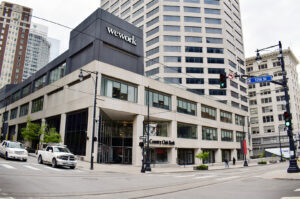
New deal with lightwell keeps WeWork in Kansas City after closing Corrigan Station space
A freshly negotiated lease agreement with the developer behind the lightwell building in downtown Kansas City means WeWork will continue its two-floor coworking and flexible office space operation in the heart of the city’s central business district. WeWork has officially completed its lease rationalization with the assumption of its lightwell location contract, the company said…