

Kauffman honoree examines impact of accelerators on an ecosystem
March 20, 2017 | Meghan LeVota
Over the years, Kansas City has found itself home to several business accelerator programs.
From BetaBlox to the Sprint Accelerator, these programs have increased the vibrancy of the area entrepreneurial community in many ways. But recently Kansas Citians had the chance to learn first hand just how much their local network of accelerators have helped grow the area economy.
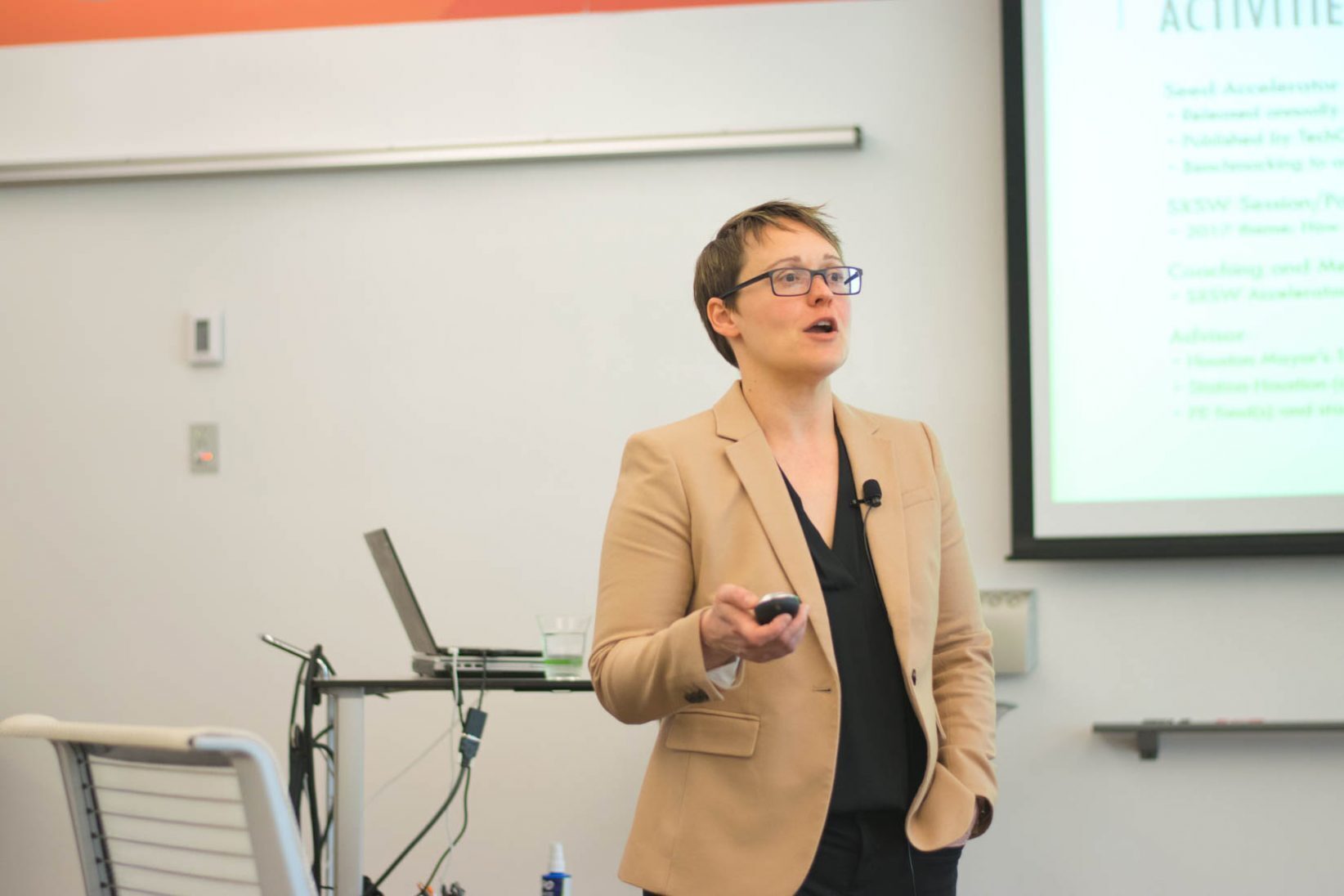
Accelerator researcher and scholar Yael Hochberg visited the Ewing Marion Kauffman Foundation on Friday to dissect the impact that accelerators have on a metro’s startup community.
The recipient of the 2016 Kauffman Prize award, Hochberg has immersed herself in entrepreneurship since she moved to Silicon Valley in 1997. Currently an entrepreneurship professor at Rice University, Hochberg is also the managing director of the annual U.S. Seed Accelerator Rankings.
Hochberg defines accelerator as a fixed term, cowork-based program with an education and mentorship component that culminates in a public pitch day. In her research, Hochberg found that an accelerator creates tremendous impact in a city’s economy — particularly when it comes to venture capital.
“When the first accelerator comes to a city, cities see a 107 percent increase in the number of deals, a 97 percent increase in number of unique funders in the area and a 1,800 percent increase in dollars that flow into the area,” Hochberg said. “It brings more deals, but also much bigger deals.”
Many local entrepreneurial community leaders asked Hochberg how they could best apply her research to Kansas City. Here’s what she had to say:
Regardless of an accelerator’s quality, does having it still help the entrepreneurial ecosystem?
“Yes, absolutely. Studies show that there is no difference between the high-quality and low-quality accelerators in terms of what they did for the ecosystem. When you look at the results, we see that what it’s doing is galvanizing a blatant interest in entrepreneurship in the region. It’s telling startups that ‘Yes, you can be an entrepreneur here. There are places to go to find resources.’ It’s telling investors that, ‘Yes there are startups in your community to invest in, so if you get involved it will help your regional economy.’ That’s how it kicks off.”
Do angel groups compete with accelerators?
“I don’t anecdotally see it. I think that they’re much more in the way of synergy. The accelerator curates, prepares and exposes the startup and gets them ready to go out into the real world so that the angel groups, the micro-venture capitalists and seed-stage funds can ultimately make better investments going forward. … The best thing you can do as an angel group is get involved with the accelerators, go mentor the teams, invest in the accelerators and give them a little backing to help them with their financial situation and then get that first look at the startups. The key thing is you have to be a great resource for your startups in order to get them to make money.”
Where is the best location for an accelerator or coworking space?
“The denser you can build things and the more you can put in one location really seems to work. I’m hoping to find better proof for this, but seems like those are the spaces that are really working. We’re trying to get cities to understand that they have to locate these things in attractive places. Just because you’ve built a coworking space does not mean entrepreneurs have no choice but to come to work there. You want the investors walking around those hallways. You want cafes and restaurants where people are able to run into each other. Social capital and where you are located is also really important. By social capital, I mean the tendency to run into other people — that serendipitous stuff really matters and really helps. You don’t want to plop an accelerator in an abandoned warehouse that takes 15 minutes to drive to because you’re not going to get those interactions.”

Featured Business

Related Posts on Startland News
Pride outside: How the outdoor industry is missing out with a $1 trillion LGBTQ+ blind spot
“You can’t be what you can’t see,” said adventurer and speaker Mikah Meyer, quoting activist Marian Wright Edelman last week in Kansas City. Representation of LGBTQ+ consumers and entrepreneurs formed a thematic trail throughout the recent Mid-America Gay & Lesbian Chamber of Commerce awards luncheon where Meyer made keynote remarks. His borrowed quote also reflected…
nbkc launches Entrepreneur in Residence incubator: ‘I have a whole company behind me’
Less than a year after its inaugural Fountain City Fintech accelerator debuted, nbkc bank has launched a new incubator program designed to tackle common banking industry problems with start-up-style ideation, problem solving, and tenacity, said Megan Darnell. The goal: building new companies along the way, the nbkc program manager said. “Kansas City has every single…

Investors, students find potential and power in High School eSports League
Benjie Lewis saw potential in eSports from the beginning — first as a mentor, then an investor, he said. Rapidly evolving from recreational pastime to official leagues and high school sports programs, the competitive multiplayer gaming concept has created a new space for startup opportunity, he said. “When I was growing up … they weren’t…
Startup advocates to next mayor: Make KC more attractive to tech talent, women, innovation
Months of candidate forums are complete. The door bells have been rung. Selfies taken. As the Kansas City mayor’s race heads to the polls Tuesday, the candidates are all business when it comes to courting the startup community’s vote. Jolie Justus — who has branded herself as the next “neighborhood mayor” — and Quinton Lucas…