

Kauffman honoree examines impact of accelerators on an ecosystem
March 20, 2017 | Meghan LeVota
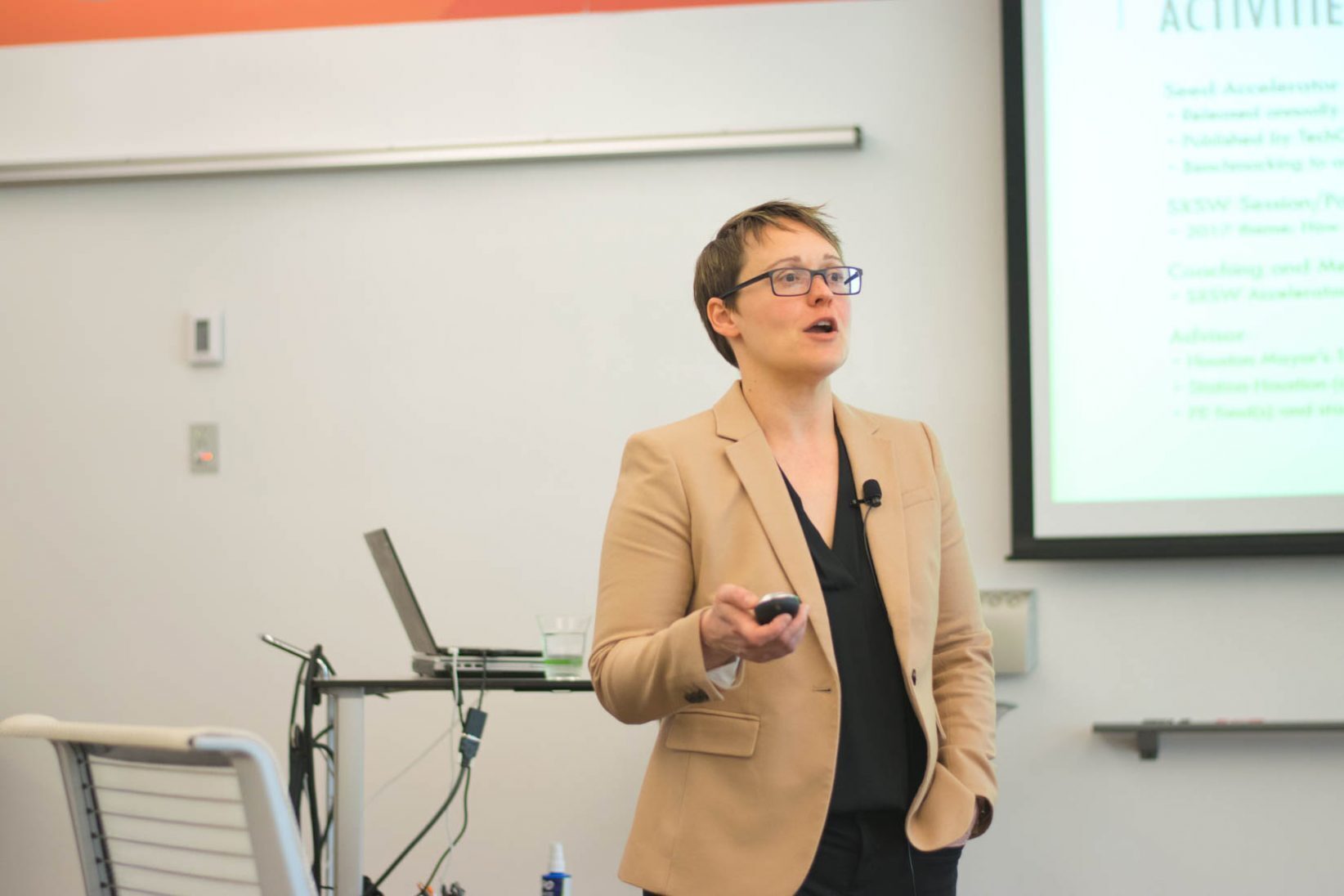
Over the years, Kansas City has found itself home to several business accelerator programs.
From BetaBlox to the Sprint Accelerator, these programs have increased the vibrancy of the area entrepreneurial community in many ways. But recently Kansas Citians had the chance to learn first hand just how much their local network of accelerators have helped grow the area economy.
Accelerator researcher and scholar Yael Hochberg visited the Ewing Marion Kauffman Foundation on Friday to dissect the impact that accelerators have on a metro’s startup community.
The recipient of the 2016 Kauffman Prize award, Hochberg has immersed herself in entrepreneurship since she moved to Silicon Valley in 1997. Currently an entrepreneurship professor at Rice University, Hochberg is also the managing director of the annual U.S. Seed Accelerator Rankings.
Hochberg defines accelerator as a fixed term, cowork-based program with an education and mentorship component that culminates in a public pitch day. In her research, Hochberg found that an accelerator creates tremendous impact in a city’s economy — particularly when it comes to venture capital.
“When the first accelerator comes to a city, cities see a 107 percent increase in the number of deals, a 97 percent increase in number of unique funders in the area and a 1,800 percent increase in dollars that flow into the area,” Hochberg said. “It brings more deals, but also much bigger deals.”
Many local entrepreneurial community leaders asked Hochberg how they could best apply her research to Kansas City. Here’s what she had to say:
Regardless of an accelerator’s quality, does having it still help the entrepreneurial ecosystem?
“Yes, absolutely. Studies show that there is no difference between the high-quality and low-quality accelerators in terms of what they did for the ecosystem. When you look at the results, we see that what it’s doing is galvanizing a blatant interest in entrepreneurship in the region. It’s telling startups that ‘Yes, you can be an entrepreneur here. There are places to go to find resources.’ It’s telling investors that, ‘Yes there are startups in your community to invest in, so if you get involved it will help your regional economy.’ That’s how it kicks off.”
Do angel groups compete with accelerators?
“I don’t anecdotally see it. I think that they’re much more in the way of synergy. The accelerator curates, prepares and exposes the startup and gets them ready to go out into the real world so that the angel groups, the micro-venture capitalists and seed-stage funds can ultimately make better investments going forward. … The best thing you can do as an angel group is get involved with the accelerators, go mentor the teams, invest in the accelerators and give them a little backing to help them with their financial situation and then get that first look at the startups. The key thing is you have to be a great resource for your startups in order to get them to make money.”
Where is the best location for an accelerator or coworking space?
“The denser you can build things and the more you can put in one location really seems to work. I’m hoping to find better proof for this, but seems like those are the spaces that are really working. We’re trying to get cities to understand that they have to locate these things in attractive places. Just because you’ve built a coworking space does not mean entrepreneurs have no choice but to come to work there. You want the investors walking around those hallways. You want cafes and restaurants where people are able to run into each other. Social capital and where you are located is also really important. By social capital, I mean the tendency to run into other people — that serendipitous stuff really matters and really helps. You don’t want to plop an accelerator in an abandoned warehouse that takes 15 minutes to drive to because you’re not going to get those interactions.”

Featured Business

2017 Startups to Watch
stats here
Related Posts on Startland News
Procrastinating? Eat the frog, don’t chase the squirrels
On the metal wall in front of my desk, I’ve magnetically fastened a famous recommendation from Mark Twain. “Eat a live frog first thing in the morning and nothing worse will happen to you the rest of the day,” the humorist from Missouri wrote. Though it can become an aspiration rather than a rule,…

KCultivator Q&A: ‘Fashionpreneur’ Jordan Williams on starting with nothing but his smile
Editor’s note: KCultivators is a lighthearted profile series to highlight people who are meaningfully enriching Kansas City’s entrepreneurial ecosystem. Check out our features on Plexpod founder Gerald Smith, innovation coach Diana Kander, Victor & Penny’s Erin McGrane, SEED Law’s Adrienne Haynes, Code Koalas’ Robert Manigold, Prep-KC CEO Susan Wally and community builder Donald Carter. Jordan…

KC designers put streetwear innovation, culture on Kritiq runway (Photos)
Fashion entrepreneurs at Sunday night’s Kritiq fashion show shared many of the same struggles on their ways to the runway, Mark Launiu said. “One of our designers here was asked, ‘What’s your inspiration?’ And I think a lot of us can relate,” said Launiu, co-founder at MADE Urban Apparel and lead organizer of the event.…

Tax bill guts historic tax credits used to rehab Westport Commons, Kemper, lofts
Plexpod Westport Commons wouldn’t exist without the historic tax credits used to make the massive renovation and preservation project financially feasible, said developer Butch Rigby. A GOP-led tax reform bill introduced this month to simplify the tax code, however, would eliminate the Reagan-era tax credit program, which provides a 20 percent federal tax credit for…