

Jeff Shackelford: Here’s how to land Digital Sandbox funding
March 8, 2017 | Meghan LeVota
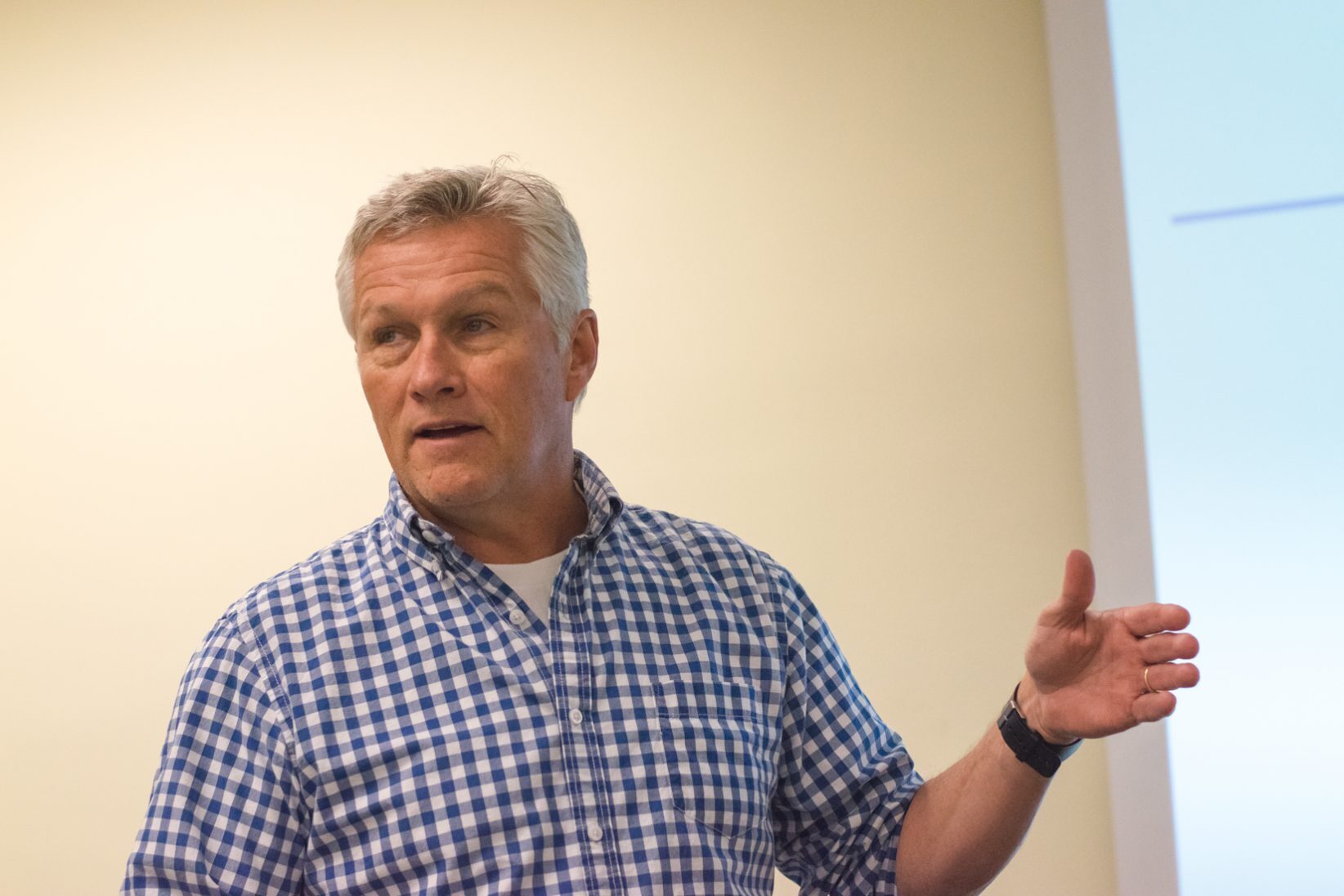
When it comes to pitching their startups, most Kansas Citians err on the side of selling themselves short.
At least that’s what the Digital Sandbox KC’s Jeff Shackelford told a crowd Tuesday at an event helping community members who are interested in pitching to the incubator-style program.
Launched in 2013, Digital Sandbox has supported a total 79 proof-of-concept projects and helped them raise almost $30 million in investment capital since its inception. The organization helps early stage entrepreneurs bridge the gap between idea and prototype and offers up to $25,000 per project
Digital Sandbox welcomes a new cohort quarterly, and it’s safe to say that Shackelford has heard a lot of pitches — the good, the bad and the ugly.
And the most common mistake he encounters? Shackelford said it’s common for area entrepreneurs to say their projected numbers are small because they’re being “conservative” or showing the “worst case scenario.”
“Why would anyone put up the worst case scenario?” Shackelford asked, befuddled. “You’re never going to have more optimism about your business than right now, before you’ve done anything. If you come in and say you’re just being conservative, that just tells me that you aren’t thinking big enough.”
As a community, Kansas City prides itself on its friendliness, humility and give-first mentality. As Digital Sandbox aims to create high-growth, scaleable businesses and create jobs, Shackelford warns aspiring entrepreneurs to not set the bar too low.
“I think there’s the idea that people don’t want to put anything up here (on a presentation) that might not come true,” Shackelford said. “And I’ll tell you right now, none of this is coming true. All of this (growing a business) is a work in progress.”
Shackelford said a pitch to Digital Sandbox will train young firms to succeed when speaking to potential investors. Setting the bar too low may give the idea that you are not serious enough about an investor getting a hefty return, he said.
“Be optimistic and be positive,” Shackelford said. “Come in and tell us you’ve got something that could change the world.”
But of course, don’t go overboard, Shackelford said. While this isn’t as much of a problem in Kansas City, it is equivalently in poor taste to over exaggerate what your firm can provide.
“Please don’t create a slide that says that everything that you do is un-freaking-believable and those other guys suck,” Shackelford said. “If you’re telling me that there is an enormous market opportunity but nobody is in it, I’m going to say that there is a reason. There’s a reason nobody is in it, if there truly isn’t anybody in it.”
Shackelford insinuated that there are no new ideas, just new applications of ideas. He encouraged presenting firms to do a quick Google search of their idea before making any bold claims.
“It’s rare that we see someone who’s thought of something where we go ‘Wow, the world needs it and nobody’s thought of that,’” Shackelford said. “Not to say that none of you in this room could do that, but it’s just tough. They say that the pioneers get slaughtered and the settlers get rich.”
More practically, Shackelford told the crowd of aspiring entrepreneurs to focus more on concise content and less on trying to make your presentation look pretty. When pitching to Digital Sandbox, firms only get 10 minutes. Shackelford suggests using 30 point font on 10 slides — one slide per minute.
Shackelford said you’ll need a “wow statement,” problem, solution, market opportunity, sales model, analysis of competition, business model, team, financial projections and the final ask. Throughout your presentation, check off those the boxes.
Digital Sandbox prefers firms who have a clear ask on what they plan to use the $25,000 for. The funds should be used to build a prototype, product or application — not for marketing efforts, Shackelford said.
Above all, Digital Sandbox wants Kansas City entrepreneurs to succeed. Shackelford said they are investing in the person just as much as an idea.
“We’re trying to evaluate you as an entrepreneur,” Shackelford said. “Can they take feedback, are they flexible, will they stick with it? The idea is the easy part.”
Shackelford said that whether or not a firm receives funding, they will receive valuable feedback. He encouraged all entrepreneurs who didn’t make the cut the first time to continue to try Digital Sandbox again until they do.
To learn more about the application process, click here.


2017 Startups to Watch
stats here
Related Posts on Startland News
Lenexa-based Aloe soothes health insurance enrollment pains with human touch
A patient’s “wow” moment shouldn’t be when he or she opens a medical bill and discovers procedures that unexpectedly aren’t covered by insurance, said Andrew Belt, co-founder of Aloe. “People are frustrated — frustrated because they don’t understand how their coverage works or what’s included, and it doesn’t seem like anyone they talk to understands,”…

LendingStandard plans innovation upgrade with $2.5M investment from Flyover Capital
An investment in innovation has landed Kansas City-based LendingStandard $2.5 million in investment funds following the close of a Series A funding round led by Flyover Capital, CEO Andy Kallenbach said. “These are folks that are well-known in Kansas City and have had software businesses in the past, and that’s a really rare combination,” Kallenbach…

Don’t just play the game: MECA Challenge urges students to innovate ‘school of the future’
Challenging Kansas City students to envision “the school of the future” will usher in a paradigm shift wherein teens can see themselves as customers of school, said Katie Kimbrell optimistically. “[Students] don’t even think, ‘Oh, I could rethink this whole thing that I’m experiencing,’ and choose — or even demand — something different,” said Kimbrell,…

KCultivator Q&A: Kyle J Smith talks serious work, socks with sandals, pickled pig brains
Editor’s note: KCultivators is a lighthearted profile series to highlight people who are meaningfully enriching Kansas City’s entrepreneurial ecosystem. The KCultivator Series is sponsored by WeWork Corrigan Station, a modern twist on Kansas City office space. A place to live, work, and play — three ingredients for a new life, said Kyle J. Smith, founder…