

Kauffman Foundation launches initiative to topple startup barriers
February 16, 2017 | Bobby Burch
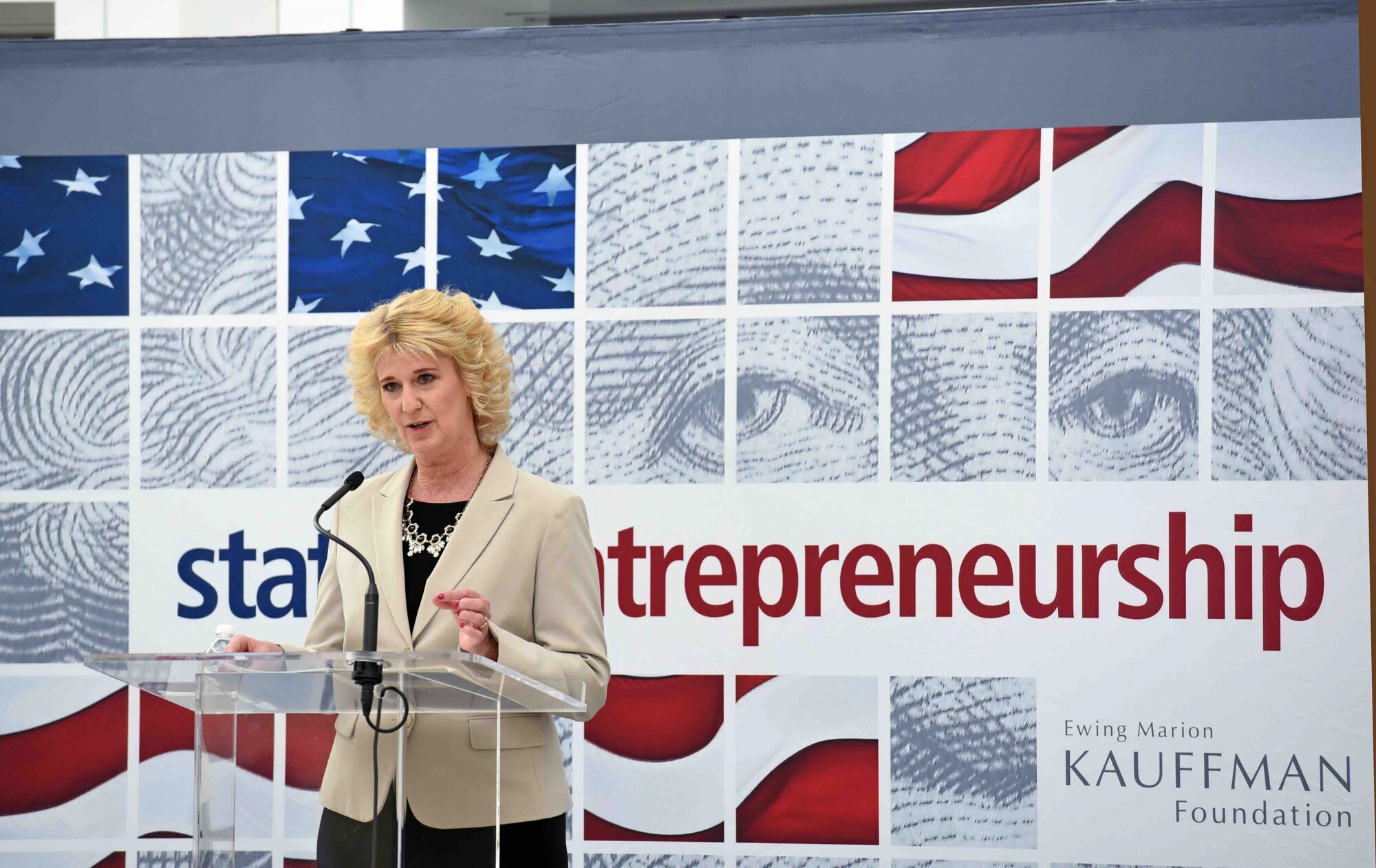
During an annual trip to Washington D.C., Ewing Marion Kauffman Foundation CEO Wendy Guillies urged the U.S. Congress to take action to eliminate barriers for entrepreneurs to launch new businesses.
In her 2017 State of Entrepreneurship address, Guillies said that millions of Americans are being left out the U.S. economy and that trends of dwindling business growth must be reversed for the nation to enjoy pervasive prosperity.
“Put simply – fewer startups mean a lower quality of life for Americans,” she said. “We need to reverse that long-term trend now. It’s a national wakeup call, and it’s eating away at America’s spirit and competitiveness.”
Speaking to members of Congress and many entrepreneurs, Guillies highlighted three trends that have grabbed the foundation’s attention and informed some of its forthcoming efforts. These “megatrends” are dramatically reshaping American entrepreneurship and explain why “so many are feeling left out,” she said.
In a new report by the foundation, the three trends reveal demographic, geographic and technological shifts in the United States. Here’s a bit more on each from the foundation:
New demographics of entrepreneurship: The U.S. is becoming more racially diverse, but entrepreneurs – 80.2 percent white and 64.5 percent male – do not reflect the changing population. Underrepresentation of minority groups and women hurts the economy by reducing the number of businesses and jobs they would create. For example, if minorities started and owned companies at the same rate as whites, the U.S. would have over one million more businesses and up to an extra 9.5 million jobs.
“Breaking down the entrenched barriers for minorities and women isn’t only the right thing to do,” Guillies said. “It will add millions of jobs to our economy.”
New map of entrepreneurship: Entrepreneurship is an increasingly urban phenomenon, and it is taking place in mid-sized metros and outside traditional hubs like Boston and Silicon Valley. People have migrated to cities, contributing to a decline in rural entrepreneurship. As a percentage, startup activity in rural areas now is even lower than the percent of the country’s rural population.
“Entrepreneurs often seek money first from local investors. They first hire from the local market. They usually found companies with the people who live in the same area,” Guillies said. “In many ways, all entrepreneurship starts local. Our work, therefore, must understand and reflect these changing local conditions, even as we work to combat the inequalities reflected in them.”
New nature of entrepreneurship: In the past, as companies grew their revenue, jobs would scale at almost the same pace. That’s no longer true. Technology has made it possible for startups to grow revenue without as much hiring, and high-growth companies by revenue are not creating as many jobs as they did in the past. New and young companies have been the biggest job creators for decades, and continue to be, but technology may change that. For example, in 1962, when Kodak sales first surpassed $1 billion (the equivalent of $8 billion today) the company employed 75,000 people. When Facebook reached similar revenue, it employed 6,300.
Guillies also introduced to the crowd a new initiative being led by the foundation called Zero Barriers to Startup. Hoping to buck the fact that startup rate is now roughly half what it was in 1980, the nationwide initiative aims to identify large and small barriers to new business creation. Along with entrepreneurs and policymakers, Zero Barriers to Startup plans to develop solutions that empower more entrepreneurs to pursue their ambitions.
“As a nation, we must re-create the conditions in which optimism can thrive,” Guillies said. “We must increase support not only for entrepreneurship but also for the key ingredients of its success. We must remove the barriers that have been erected and develop communities that will encourage, guide, and reinforce startups.”

Featured Business

2017 Startups to Watch
stats here
Related Posts on Startland News

Amazon’s drones won’t be alone over KC: Federal rule change opens skies to greater tech buzz
As the nation prepares for large-scale commercial drone deployments — thanks in part to newly rolled-back federal regulations — pilots, businesses, and agencies using the tech must skillfully balance opportunity with public trust and privacy concerns, industry experts said. “I’ve had people say to me, it kind of creeps me out … but in 30…

Garmin survived the smartphone revolution; now it wears digital health innovation on its wrist
Garmin might not have survived cellular carriers putting free navigation and mapping apps on every smartphone if the Olathe-based GPS tech leader wasn’t constantly innovating, said Scott Burgett, touring a group of digital health entrepreneurs and investors through the Johnson County headquarters. “It’s what keeps a company vibrant,” said Burgett, senior director of Garmin Health…

High-profile digital innovators, investors bringing blockchain finance leaders to Kansas City
As Kansas City’s rise as a Midwest blockchain hub continues, a new investor-focused summit is set to bring global blockchain and digital finance leaders to the region next month. The aim: Connect major players in the rapidly maturing sector with Heartland-based investors. The inaugural Heartland Digital Asset Exchange, or HDAX, is planned for Sept. 9…
LISTEN: How this startup helps brands ditch plastic without disrupting manufacturing
On this episode of Startland News’ new Plug and Play Topeka founder podcast series, we sit down with Anthony Musumeci — CEO of Earthodic — to explore the future of sustainable packaging. Discover how Earthodic’s flagship product, Biobarc, delivers water-resistant, recyclable paper coatings made entirely from bio-based ingredients — closing the loop on waste without sacrificing…