

Report: Kansas City’s VC funding rank improves among Midwest cities
January 18, 2017 | Brian Matthews

Editor’s note: Brian Matthews is a guest author to Startland News and co-founded Cultivation Capital. Opinions expressed in this commentary are the author’s alone.
When assessing the vitality of an entrepreneurial ecosystem, an important factor to consider is the Total Venture Funds Raised by the startups within that city or region. This metric provides an unbiased reflection of how the market values each of the companies within an ecosystem. This “market value” is particularly impartial for Midwestern startups that look outside of their hometown to raise capital from results-driven venture capital firms.
This is arguably a better measure than the more subjective variables often used by media companies and nonprofits that rank cities’ startup ecosystems.
From 2015 to 2016, venture funding declined – both in terms of number of deals and total capital invested. Nationwide, venture funding was down 15%. Although the Midwest mirrored this nationwide trend, with a 21% decrease in venture funding, a few cities in the central corridor saw increases in total funds raised last year.
Utilizing Crunchbase data, we look at how much venture funding startups in the top 15 Midwestern regions raised.
The only regions that bucked the YoY fundraising trend and saw an increase in funds raised from 2015 to 2016 were: St. Louis (+11.5%), Cincinnati (+4.9%), Milwaukee (+145.7%), Kansas City (+25.7%), Louisville (+204.4%), and Little Rock (+10.5%).
Number of Startups and Percent of Startups Funded in 2016
Another potential indicator of success is the number of startups that have received funding within a region and the percent that has received funding within the last year. These numbers should be an indicator of increasing growth within the community. A region must have several early stage companies receive funding to increase the opportunity for success at later stage “A”, “B”, and “C” funding rounds. Let’s take a look at the number of startup companies found within CrunchBase by region and the percentage of companies that have received funding within the last year.
* Registered startups is the number of companies listed in CrunchBase. Typically they have all raised money previously to be on the list. Milwaukee and Louisville did not have complete data so they are not included on the list.
While the Total Venture Funds Raised statistic mentioned previously is largely comprised of a few high-dollar financings that took place that year, the Percent of Startups Funded in 2016 accounts for all financing events, large or small, equally. Thus, this statistic reveals more information about the number of deals throughout the entire ecosystem, including everything from angel seed funding to later-stage institutional investment.
Additionally, the Total Number of Funded Startups is highly correlated with the total 2016 Funds Raised (R-squared value of .9731). This may indicate that having a critical mass of early-stage companies increases the potential for successful fundraising.
2016 Funds Raised per 2010 MSA Population Count
Possibly the most accurate way to rank each region’s fundraising success is by dividing Total Venture Funds Raised by Total Population.
*Metropolitan Statistical Area (MSA) Population numbers are from the 2010 US Census
Using the Total Venture Funds Raised divided by MSA Population method, Minneapolis and Chicago remain 1st and 2nd on the list, although their positions flipped from 2015 to 2016. Nashville, St. Louis, and Cleveland rounded out the top 5. It appears that population size, which contributes to a region’s human capital resources and overall economic strength, enhances a region’s ability to deliver venture-backable companies.
The MSA population of the regions in this study is highly correlated with both the Total Number of Funded Startups and the Total Number of Startups that Received Funding in 2016 (with R-squared values of .9423 and .9428, respectively). Thus, MSA Population a good proxy for the number of fundable startups in a region. The more fundable startups a region has, the more “shots on goal” it has to generate companies that reach later-stage funding rounds and successfully exit.
More “shots on goal” can be accomplished by developing more accelerators per capita than competing regions. That said, the accelerators must succeed in developing venture-backable companies. I am of the opinion that a region should develop accelerators that can leverage the expertise of local corporations and universities. For instance, St. Louis’ expertise lies in Agriculture Technology, Financial Services Technology, Cybersecurity, and Life Sciences/Biotechnology. St. Louis has accelerators which support each of these industries: The Yield Lab, SixThirty FinTech, SixThirty Cyber, and BioGenerator, which make investments in over 30 new companies each year.
Conclusions
Here are the conclusions that I gleaned from the numbers:
- Chicago, Minneapolis, St. Louis, Detroit, and Nashville ecosystems seem to be above the rest when comparing the numbers over the last few years.
- Milwaukee, Cincinnati, and Indianapolis are knocking on the door.
- The number of startups within the ecosystem matter, as it increases the potential for successful fundraising.
- The percent of startups securing capital – at all stages – in an ecosystem can be seen as a barometer of success for that region, and signal a more complete fundraising community.
For a deeper look at St. Louis’ venture capital investments of 2016, read our earlier report on EQ.
Data gathering, statistical analysis and editing assistance by fellow authors Yvette Rodriguez and Elise Miller Hoffman of Cultivation Capital.

Featured Business

2017 Startups to Watch
stats here
Related Posts on Startland News

TechAccel hops in $3.2M round for Lincoln-based ag tech firm
Kansas City-based TechAccel is joining an investment round in a Nebraska agriculture tech firm that aims to improve crop yields. The area venture firm is among a group of investors in Lincoln-based Epicrop Technologies Inc., which raised a total of $3.2 million in its Series A round, which was led by North Forty Ventures. TechAccel…
Jeff Shackelford: Here’s how to land Digital Sandbox funding
When it comes to pitching their startups, most Kansas Citians err on the side of selling themselves short. At least that’s what the Digital Sandbox KC’s Jeff Shackelford told a crowd Tuesday at an event helping community members who are interested in pitching to the incubator-style program. Launched in 2013, Digital Sandbox has supported a…

What’s Kansas City doing at SXSW 2017 this year?
March is about to get weird. Startland News is once again returning to the weirdness of Austin, Texas, for the annual insanity that is the SXSW Conference. Like last year, we’ll be venturing to the Lone Star State to report on the Kansas City contingent at arguably the nation’s top conference for innovative ideas: South-by-Southwest…
Olathe-based Flow Forward raises $1M for vascular device
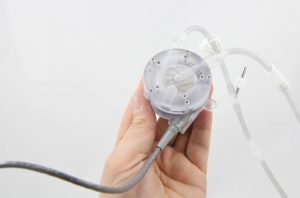
After completing a preclinical study, Olathe-based Flow Forward Medical nabbed another round of capital for its vascular device. The firm raised another $1 million from a group of unnamed, individual investors, bringing the firm’s total raised to $7 million. Flow Forward created the AFE blood pump system, which is designed for temporary use to quickly…