

Seven local tech startups bring their innovations to KCMO
December 15, 2016 | Meghan LeVota

After 12 weeks of civic innovation, Kansas City’s Innovation Partnership Program culminated Tuesday with a demo day showcasing its seven participating startups.
Launched in 2015, IPP pairs area startups with a department in the City of Kansas City, Mo. to not only identify new efficiencies but also offer the firm a chance to earn business with the city. Though in its second year, 2016 marks time startup partners entered an accelerator-like experience with the city.
After paired with a department, the startup is provided city data and access to its infrastructure. Startup partners worked closely with the Office of Innovation and received part-time office space in city hall.
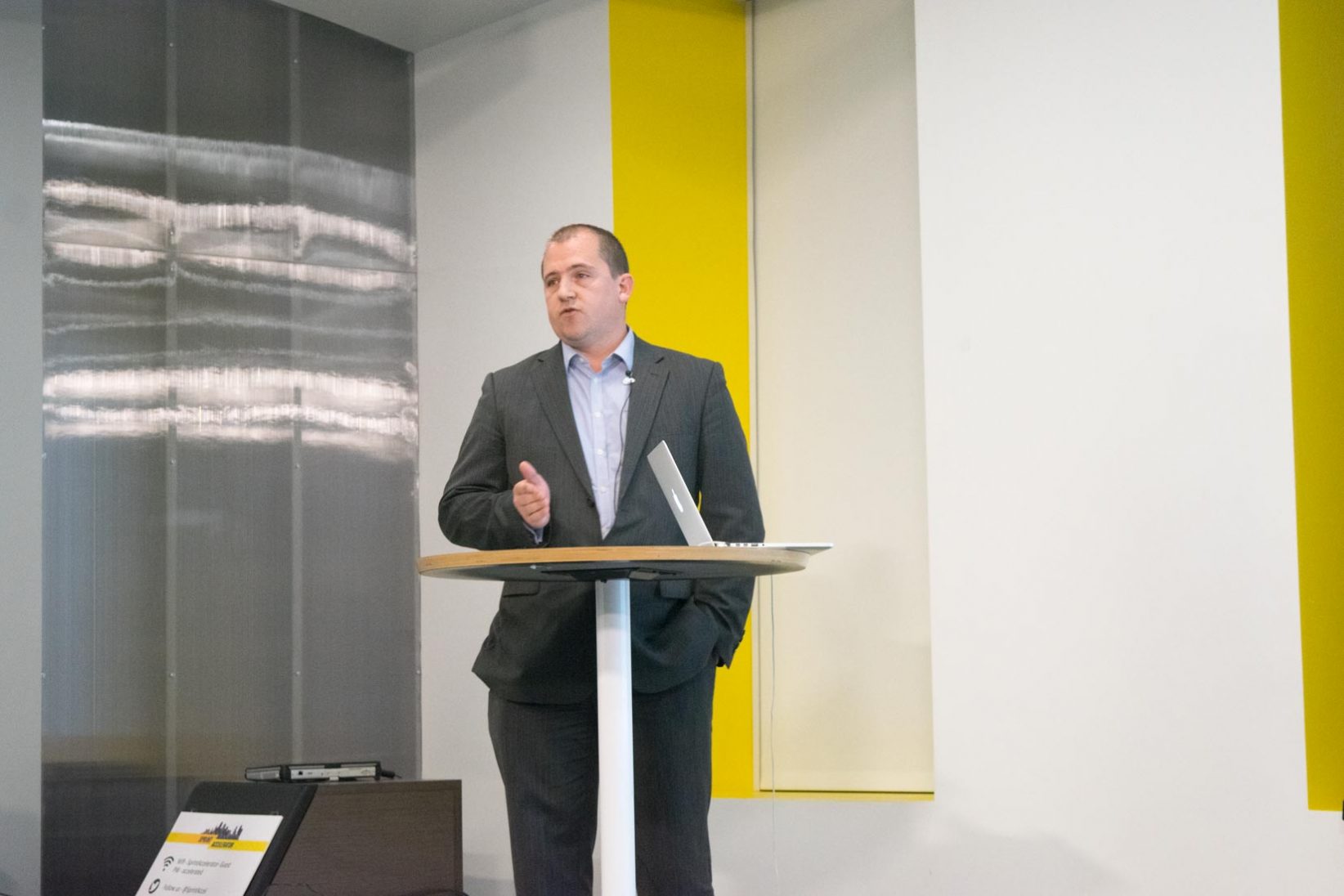
“I found this experience absolutely fascinating,” City Manager Troy Schulte said. “I want to thank all of the partners. It looks like I’ve got a lot of work to do to figure out how we can gather the funding to proceed on all seven of these projects — because I am ready to go.”
KCMO innovation analyst Kate Garman said each company “blew her mind” and that she hopes the demo day presentations could open the city’s eyes to more innovation. Garman added that, if the city doesn’t end up working with the startup, she hopes its collaboration would provide a valuable use case of the firm’s technology that it can show to potential clients or investors.
Here is more about each partner and their experience.
Big Bang is a platform that specializes in the Internet of Things and cloud space, assisting clients in the process of ensuring that their product is a connected devices. The cloud services platform helps developers create applications that communicate with IoT devices in real-time by connecting with their hardware and providing the software to enable its integration. The solution, which eliminates the need for servers or other infrastructure, is available for Android and iOS developers.
When CEO Jonathan Wagner first proposed his innovation project, he hoped to make city transportation data available to allow software developers to create applications.
“We quickly ran into a problem,” Wagner said. “The most interesting data that we wanted, the location of all of these vehicles — our buses, the streetcar — the information we really wanted didn’t actually exist currently.”
Thus, Wagner leveraged the Smart City network that already exists in downtown Kansas City and created sensors to transmit the location of the city’s vehicles. He deployed the devices on the streetcar which then connected with the Smart City’s public Wi-Fi around downtown. While the project is still incomplete, Wagner was able to accurately and affordably provide real-time location data on public transit options.
Roads in Kansas City aren’t always in great condition or well funded. Integrated Roadways CEO Tim Sylvester said this isn’t just a Kansas City problem, but rather a nationwide issue
Integrated Roadways created patented smart pavement with embedded IoT technology that creates longer-lasting roads and reduces roadway expenses.
You may think that high-tech roads would be more expensive than asphalt. But on the contrary, Sylvester said his techie roads “pay for themselves” by offering the community value they wouldn’t otherwise have — Internet connectivity. And to show that the technology works, Sylvester proposed doing a pilot with the city.
“What does the city get out of this? The city gets billions of dollars of road improvements that otherwise could not be afforded in any kind of realistic time frame,” Sylvester said. “By turning the road into an asset that generates its own revenue to pay for its own existence, we stop this problem (poor roads) for good.”
Hailing from Great Britain, Pomerol Partners is a consulting company that specializes in bringing business and data analytics to medium and large companies. CEO Fred Hefer said the city gave him the challenge to make the city’s 311 data more actionable. His solution was an analytical platform that allowed users to view data by district and department.
Hefer said that the 311 data is only scratching the surface — the platform can be used for police, population and income data as well. Pomerol Partners aims to emphasize the power of data-driven decision making, he said.
“Unless data is embraced at the executive level, it won’t be utilized,” Hefer said. “Data needs to be used on a daily basis at the top. Once that happens, people can start to benefit from it.”
Cloud-based compliance management provider Reality Technology helped the city in its procurement process — a process that is currently paper intensive.
CEO Ivan Drinks said this paper-filled process requires three file folders each time. His solution gives contractors the ability to upload required documents and circulates automatic status updates when documents are received.
“This allows the ability for the city to track key performance indicators within the procurement process,” Drinks said. “What I mean by that is, our technology knows when documents are received, accepted, and finish — which tracks timing.”
Redivus Health created a mobile app that aim to reduce medical error, particularly in cardiac arrest. During the partnership program, co-founder Jeff Dunn got the opportunity to ride along with dispatchers and pilot their app – ultimately saving someone’s life.
“Cardiac arrest is one of the most stressful scenarios that a patient or a physician can go through,” Dunn said. “Being able to ride along with first responders was an invaluable experience.”
Instead of training employees to detect hackers’ phishing techniques, Spideroak created a secure, encrypted platform that will allow city staff to safely communicate.
“We fought hard against the idea that when it comes to the Internet, we should just expect that things will never be as secure as in the real world,” said Chris Cooley, SpiderOak’s director of business development. “Security should be a high priority in the early stages of product design.”
The communication platform — called Semaphor — enables team members to communicate while protecting information from leaks and spam. SpiderOak is also one the first portfolio companies of the KC Rise fund.
Stratex Solutions is moving strategic planning to the cloud.
“With the city, there are so many departments and you’ve got documents that are everywhere,” co-founder Raina Knox said. “Every time you put together a measurement report or status report, there is a manual effort – you deploy these plans in excel documents.
Knox was thrilled at how engaged the city employees were with using her product, which provided each department access to the master city plan, thereby cutting down on the time spent on planning. Founded in 2015, Stratex Solutions grew tremendously from this experience, Knox said.
“This experience far exceeded what I expected,” Knox said. “Being able to work with the city of Kansas City proved the concept, which has helped us with outside sales. We’re ready and excited to grow.”







Featured Business

2016 Startups to Watch
stats here
Related Posts on Startland News
Raven’s return-to-earth science is complete, founder says; a new space accelerator will help get the KCK-built tech off the ground
A KCK startup that could revolutionize space transportation is among 14 companies selected this week for an accelerator program from Amazon Web Services that focus on “transforming the future of space for all of humanity.” Kansas City-based Raven Space Systems — led by co-founders Ryan Cowdrey and Blake Herren — is building entirely 3D printed reentry…

Tesseract earns $1.25M contract to help Space Force, military ‘predict the future’
Industry-defining tools built by Kansas City’s Tesseract Ventures will help the U.S. Space Force accurately track machines, people and objects on base, and create a clearer understanding of launch conditions through next generation data visualization, said John Boucard. Tesseract announced Tuesday that the company has been awarded a direct-to-Phase II Small Business Innovation (SBIR) contract…

AI Hub builds creative space in River Market, giving artists access to business tech, tools
The Midwest needs more resources to help creatives start their own businesses and keep them thriving, said Taylor Burris and James Spikes, who designed a one-stop art incubator to give artists’ innovation a fresh canvas. The husband-and-wife team opened AI Hub — powered by IRIS Creative Projects Agency and with funding from The Porter House…

Why this serial entrepreneur bought ‘a giant beach in Kansas’ (and how he plans to make it KC’s next outdoor hot spot)
Lance Windholz is already digging his new position on Shawnee’s sand volleyball courts: owner. “This deal was about six years in the making,” said Windholz, a serial entrepreneur and small business owner. “I had been playing volleyball out at Shawnee Mission Beach Volleyball three, four times a week — and just thought, ‘Why not own…