

KC founders share their stories of building a great Midwest company
October 24, 2016 | Meghan LeVota
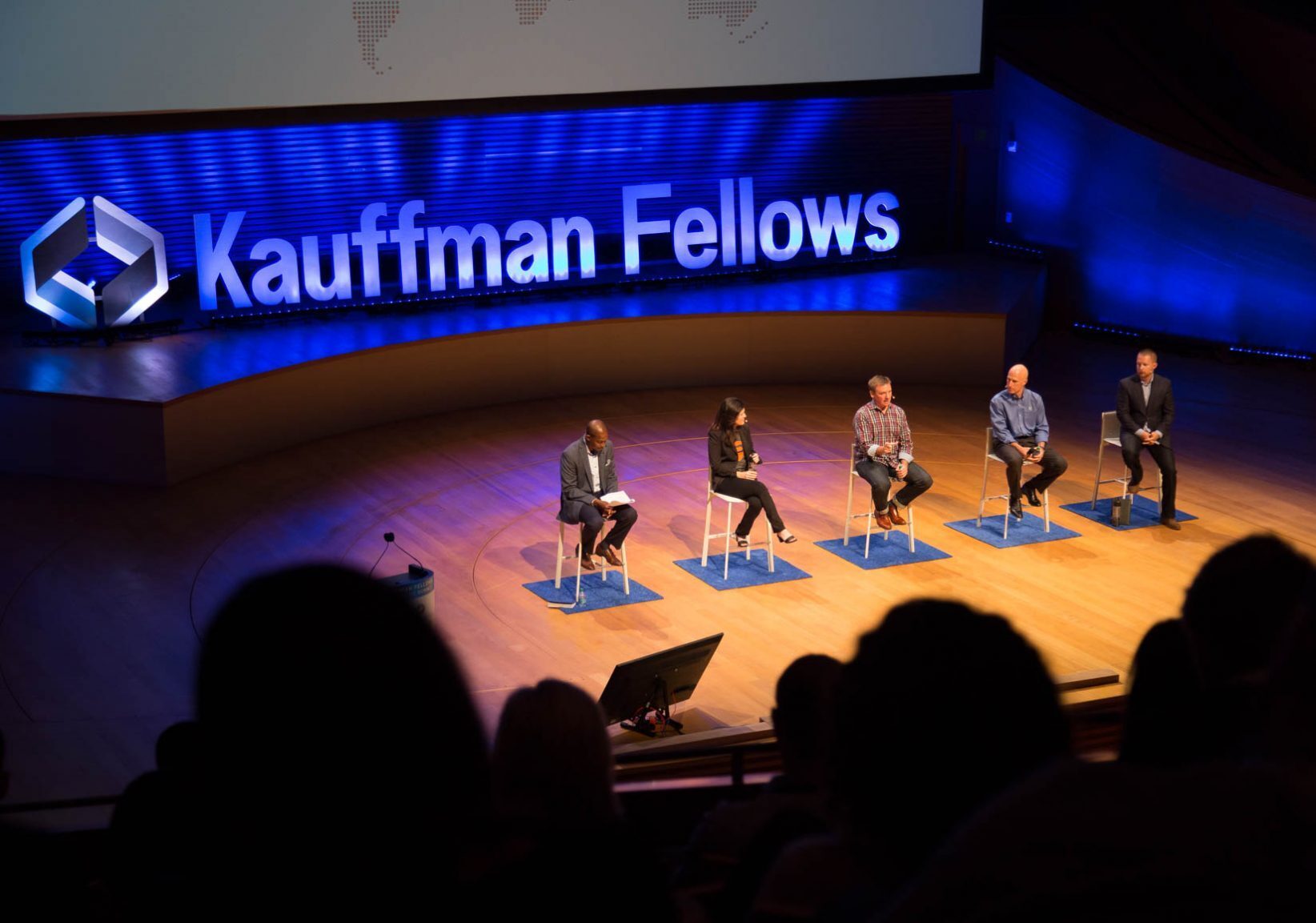
It’s not the flashiest locale, but the Midwest is a ripe area in which to grow a global business, a group Kansas City entrepreneurs argued Monday.
During the Kauffman Fellows summit, four Kansas City business leaders made the case that you don’t have to be on the coasts to build a thriving company.
The entrepreneurs — including EyeVerify CEO Toby Rush, Blooom CEO Chris Costello, Pipeline CEO Joni Cobb and BATS Global Markets founder Joe Ratterman — shared with a crowd of about 300 people how they’ve built their ventures over the years. The conversation was preceded by a large scholarship announcement by Ewing Marion Kauffman Foundation CEO Wendy Guillies.
Here are a few of the panelists’ thoughts on how to build a company in the Midwest.
Look international for growth.
Before selling his company to a subsidiary of Alibaba, EyeVerify CEO Toby Rush said several venture capitalists told him that they would only fund his company if he moved to the east or west coast.
While raising funds was a challenge in the Midwest, Rush said that his international vision and success helped topple those obstacles. Rush said it was important for his company to “think globally.” Half of EyeVerify customers are from outside the United States and the company has been funded by investors in China, Korea and Japan.
“I would like to say that it was really easy to say no (to moving to the East or West coast), but in reality it wasn’t,” Rush said. “We realized that when you get international. They care a lot less about whether you’re in Kansas City or New York or Silicon Valley.”
Pipeline CEO Joni Cobb echoes the importance of a global vision and encouraged entrepreneurs to build trusted connections abroad.
“Since we are in an area that is not typically known as the sexy place for scaling companies, how do we make it that way?” Cobb said. “The answer is we do that by opening up the portfolio of national and international networks.”
Grow a network of trusted peers.
A community builder herself, Cobb said that while business leaders were already building Kansas City’s entrepreneurial ecosystem, national attention from Google Fiber helped further their efforts.
Accelerator programs, entrepreneur fellowship groups and early-stage venture capital funds have been critical to further the momentum, Cobb said. Her organization, Pipeline, helps foster the regional entrepreneurial community via a fellowship program, which she hopes will bring a spotlight to the opportunities that exist in the region.
Rush affirmed Cobb’s sentiments in the value of building a network and often looks to his fellow alums in Pipeline.
“When I’m having a really hard day, these are the guys I wanna hang out with,” Rush said. “When I have a mountaintop experience and I want to go celebrate, these are the guys I want to go celebrate with because I know that they are on that journey with me.”
Pipeline seeks to create and enhance connections in the community, which is one of the things that attracted Rush to the program. Although he expected mentorship, he never could have predicted the impact those connections have made on his life.
He said that efforts like Pipeline highlight the importance of developing a vibrant community of entrepreneurs.
“Ecosystems don’t just pop up, they’re created,” Rush said. “We’re not going to be the next San Francisco. We’re going to be our own version of a healthy ecosystem, and it takes a lot of effort for that to happen.”
Develop mission-based approach to attract talent.
Blooom CEO Chris Costello said that despite the perceptions that tech talent is limited in Midwest, his firm hasn’t experienced many challenges.
Costello said that his tech firm’s mission-based approach has helped attract a deep pool of talented people wanting to make a difference.
For example, Costello said he’s had to educate many on his team about stock options. This indicates that his team has come to his company for genuine reasons and are not just hoping to make a quick exit, he said.
“At Blooom, we really believe we have a shot at impacting someone’s life,” Costello said. “We could give people a couple extra years of retirement they wouldn’t have had if they’d not been helped by Blooom, and I think my team knows they have a genuine opportunity to change people’s lives.”

Featured Business

2016 Startups to Watch
stats here
Related Posts on Startland News

Married puppeteers had a hand in reviving iconic Mr. Rogers characters for film; now they’ve returned to KC (with their studio)
Puppeteers are often anonymous, but Spencer Lott — and his wife and business partner, Grace Townley — are stepping into the spotlight to start their own creative studio, they shared. The Lawrence-based couple — who built the puppets used in the Tom Hanks film “A Beautiful Day in the Neighborhood” about the life of TV’s…
Show-Me Honeywell: How this high-security KC tech campus became a one-day classroom for Missouri school leaders
A group of Missouri educators, counselors and administrators took a summer trip across the state to visit notable companies and learn firsthand about relevant career pathways for their students, detailed Brian Crouse. Among the behind-the-scenes looks: a rare glimpse into the work at Honeywell Federal Manufacturing & Technologies, which manages the U.S. Department of Energy’s…
PHKC awards $25K to Alchemy Sandbox winners; It’s amazing when someone understands your vision, founder says
Year one challenges can be difficult for entrepreneurs to swallow, James Thomas noted, but he’s raising a cup to the first anniversary of Brain Freeze Mobile Daiquiri Shop with validation and a splash of funding. Two days after completing The Porter House KC’s fourth small business development cohort and competing in its finale competition, Thomas…

After his eye-catching KCI installation took flight, Willie Cole had 100+ horns leftover; He kept building
Willie Cole didn’t choose to be an artist. It’s always been part of him. “I think I was an artist in a previous life,” said the contemporary American sculptor, printer and perceptual engineer. “When I was 3 years old, my mom found me drawing in the kitchen, and since then, my family always said I…