

Report: Kansas City is the 8th-worst metro for entrepreneur diversity
September 1, 2016 | Kat Hungerford

It’s a dreary day for Kansas City in terms of successfully supporting a diverse entrepreneurial community.
The City of Fountains is far below the national average — and the majority of the most-populated metros — when it comes to minority business ownership, according to the United States Census Bureau.
The bureau on Thursday unveiled the results of its first-ever Annual Survey of Entrepreneurs. The report, which canvases only the nation’s firms with employees, is designed to provide a socio-economic portrait of businesses in the years between the quinquennial Survey of Business Owners.
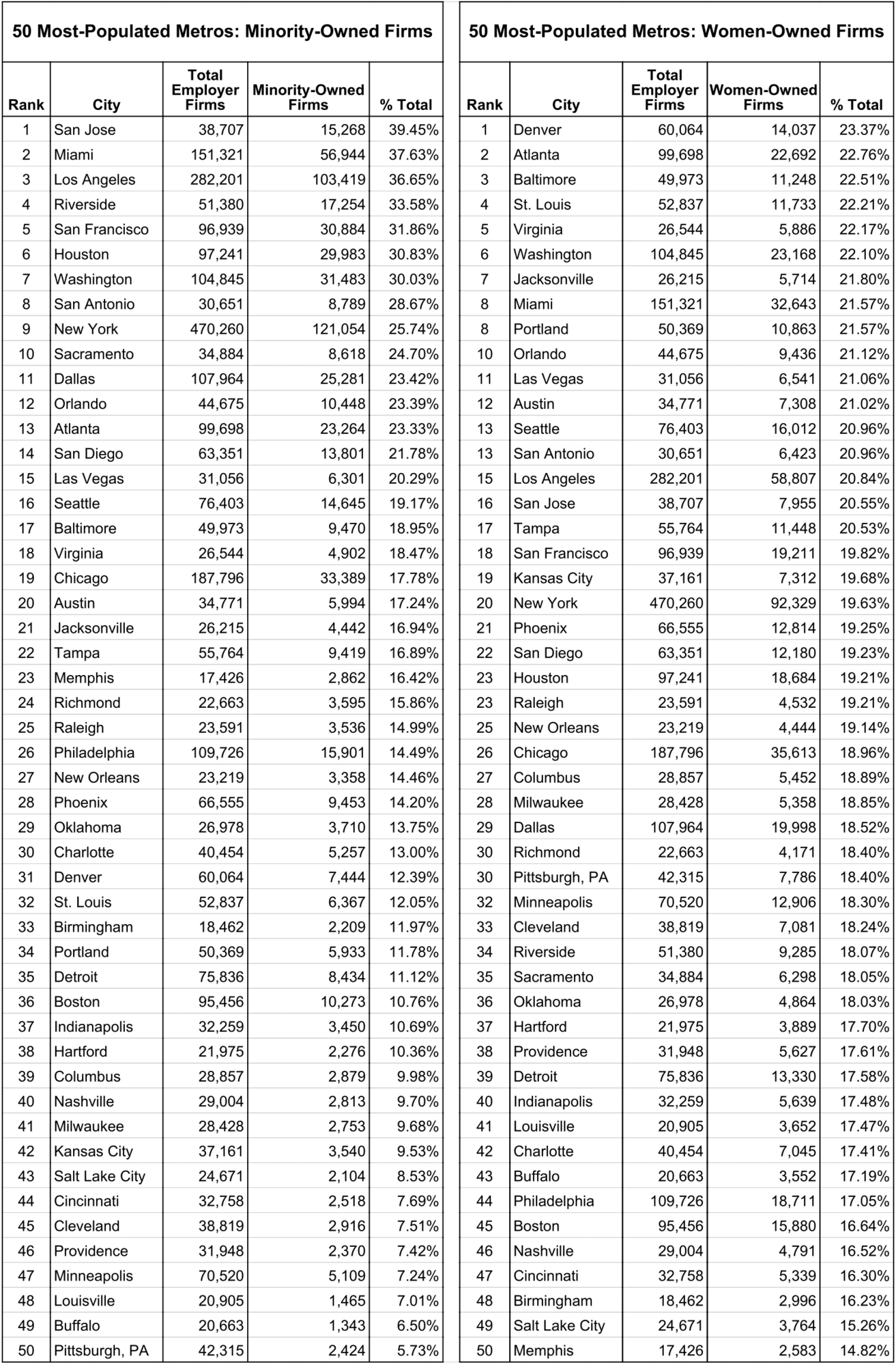
Of the 50 most-populated U.S. metros, Kansas City ranks a low 42nd in percentage of minority business owners. Minorities own only 9.5 percent of metro firms, compared to a national average of 17.5 percent.
The nation’s top-performing metros are San Jose at 39.5 percent and Miami at 37.6 percent. The worst are Buffalo at 6.5 percent and Pittsburgh, PA, which trails the nation at just 5.7 percent.
In addition to a deep-dive into business ownership and race, the results offer a wealth of insight into everything from business owners’ gender to profitability and industry sector.
Kansas City performed better in the number of women business owners, pulling a rank of No. 19. Women in the City of Fountains own almost 1 in 5 area businesses, coming in at 19.7 percent — just over the national average of 19.4 percent.
In the Midwest, Denver and St. Louis were the only metros to break the top 10 for women in entrepreneurship. According to the survey, Denver is the most women-friendly for business ownership at 23.4 percent. St. Louis came in at No. 4 with 22.2 percent of firms owned by women. The nation’s worst performer was Memphis at 14.8 percent.
Due to changes in methodology, demographic statistics are not directly comparable to past data from the Survey of Business Owners.
Other highlights from the Census Bureau’s findings include:
Most Kansas City businesses — 60.6 percent of the metro’s 37,161 employer firms — are between six and 15 years old. However, after these “golden years” ownership falls sharply: only 9.4 percent of local firms have passed the 16-year mark. Nearly one in ten companies are new; firms less than two years old make up 8.6 percent of area businesses.
Kansas City’s most-popular industry category is professional, scientific and technical services. Of the 19 categories presented the survey, 5,614 — or 15.1 percent — identified in this group. Healthcare was second with 12.1 percent.
As a further supplement to the Survey of Business Owners, the Annual Survey of Entrepreneurs each year will contain a module focusing on different entrepreneur topics. This year’s module is set to be released later this month, and will provide in-depth information on business innovation and research and development activities.
Click below for the ranks of the 50 most-populated U.S. metros by minority- and woman-owned firms.

Featured Business

2016 Startups to Watch
stats here
Related Posts on Startland News

Techstars firms to spread local roots via Brad Feld’s Kansas City home
More graduates of the Techstars-led Sprint Mobile Accelerator may be calling Kansas City home thanks to venture capitalist Brad Feld. Feld, co-founder of the international accelerator program Techstars, is making his Kansas City, Kan. home available to graduates of the local Techstars program rent free. “I’m very happy with how things have gone to date,”…

Subjective language is making your elevator pitch completely forgettable
Your elevator pitch is the single most important communication of you or your business and why you are relevant. Last month I wrote about how you can use your elevator pitch — or 20-second summary of your business — as a litmus test to determine if you are creating your own market or if you…

Kansas City dishes on diversity in the entrepreneurial community
It’s often said that two heads are better than one. But what if those two “heads” have the same socioeconomic, gender and racial compositions? What if their life experiences mirror one another so closely that they arrive at the same conclusions or generate the same general ideas? It’s no secret that diversity can foster the…

Funding roundtable (part II): Entrepreneurs compare KC investment scene to other cities
Welcome back to part two of our roundtable discussion on the early-stage investment sector in Kansas City. For a more formal introduction on this series and its five participants, please refer to part one on Kansas City’s investment culture and evolving economy. Check out the third and final installment of the series with the entrepreneurs’ advice for…