

5 glimpses into Uber VP Brian McClendon’s crystal ball
September 13, 2016 | Meghan LeVota
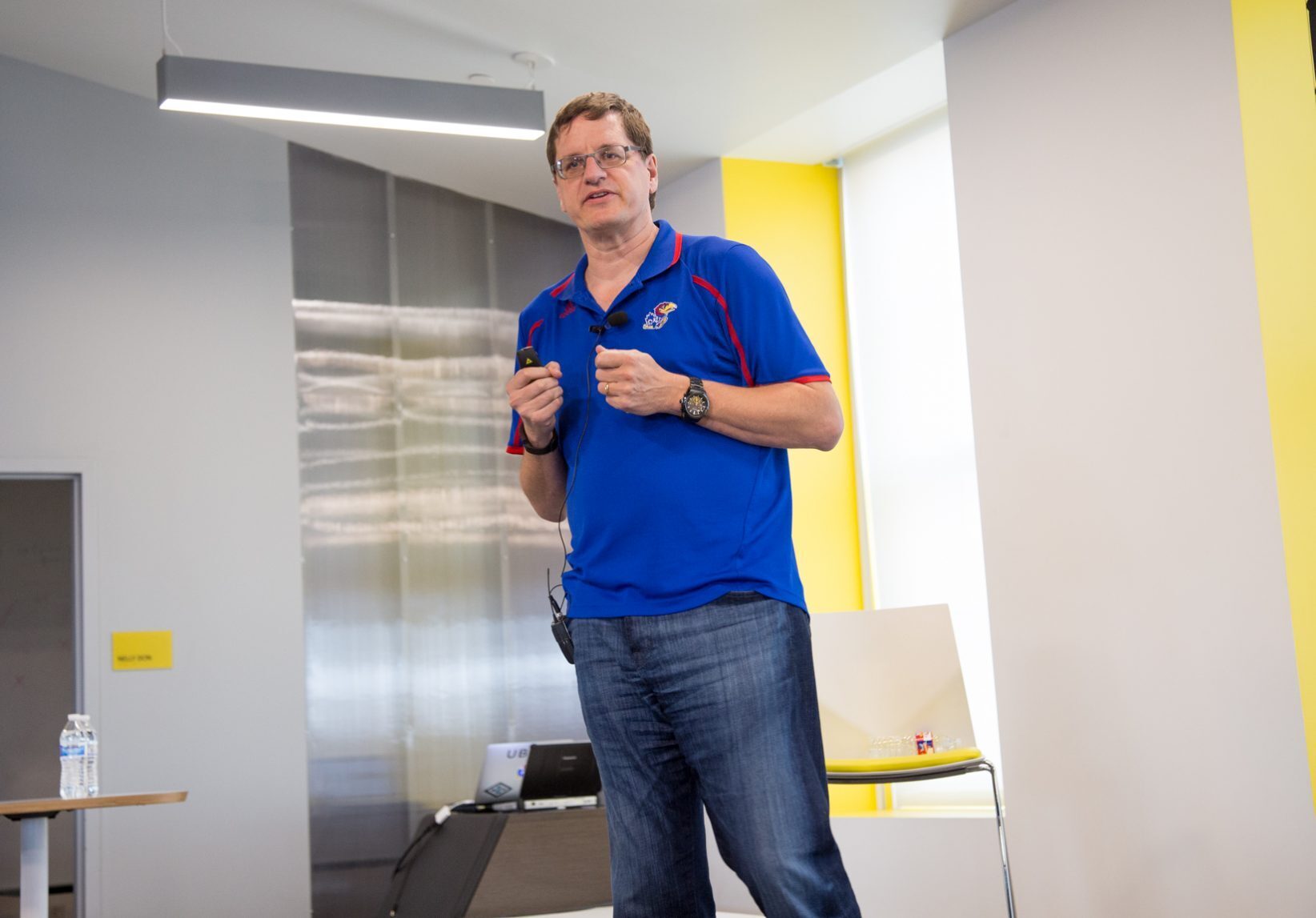
Brian McClendon — vice president of maps and business platform at Uber — may reside in Silicon Valley, but his roots are here in the prairie.
Originally from Lawrence, Kan., McClendon graduated from the University of Kansas with a degree in electrical engineering and now serves on several advisory boards for his alma mater.
Sporting a KU shirt, McClendon kicked off Techweek KC as the festival’s first keynote speaker Monday. McClendon founded Keyhole, Inc., a geospatial data visualization company that was purchased by Google in 2004. The firm would later become Google Earth and Maps. McClendon eventually went on lead Google’s mapping efforts for a decade before hopping to Uber.
In speaking to a crowd of about 200 people at the Sprint Accelerator Monday, McClendon made an array of predictions on what the future will look like thanks to technology.
Here are five glimpses into McClendon’s crystal ball:
Ridesharing will make a huge dent in car ownership.
McClendon said that 50 percent of San Francisco Uber rides are uberPOOL users, a carpooling offshoot of the ride-sharing giant. While uberPOOL riders snag a lower price, drivers have the opportunity to make more money. In some markets, if you drive 10,000 miles a year and pay urban parking prices, uberPOOL is cheaper than owning your own car, he said.
This uberPOOL model works better in larger cities, and will have more difficulty in rural areas or spread out cities like Kansas City — which has the most roads per capita in its urban core than any other city.
Despite these obstacles, McClendon predicts that Uber has real potential to tackle the 600 billion dollar auto industry.
“Some of you may have started to look at that second car in the family and wonder if it’s optional,” McClendon said. “But our goal is to retire the primary car; and to try and take on car ownership straight on.”
Self driving cars are the future of mass transit.
Uber currently has self driving cars on the market in Pittsburgh, providing what McClendon believes to be “the future of transportation.”
While the pilot testing operations in Pittsburgh includes safety drivers, McClendon believes significant headway will be made with autonomous vehicles in coming years. He expects that in the next five years, however, there will be more Uber drivers employed than there are today — so no need to be worried about robots replacing human workers.
“We need to get this going because these are far safer vehicles,” McClendon said. “It will be a much better experience on the road when you know that most of these vehicles are out there.”
“We need to get this going because these are far safer vehicles. [Self driving cars] will be a much better experience on the road.” – Brian McClendon
McClendon said that several people use Uber in order to travel from their homes to mass transit systems. He predicts that uber, particularly the self driving cars, will eventually link up with train, bus and subways.
“Self driving is the future of all transportation,” McClendon said. “These vehicles, someday, are going to take over basically all of car ownership and basically all of transit. They probably will merge with transit in some respects; self driving buses and so forth.”
“Ground truth” will allow machine learning to transform the world.
McClendon shared how he used machine learning to help train Google Street View interpret numbers in photos. He said that the more “true” data you have gathered from humans — for example via captcha tests — the easier it is to train a machine.
“Machine learning is about large amounts of input data and ground truth; truth where you are sure what the answer is,” McClendon said. “And sensory data where you think something might have happened. The more data you have, the more likely you are to be able to build a machinery algorithm that could solve that problem and blow away what’s possible with any kind of heuristic method.”
He said that those who think about ground truths when building devices will create a huge opportunity for machine learning in the future.
Virtual and augmented reality will go mainstream sooner than you think.
Although virtual reality is already here, McClendon said the industry is still struggling to find a valuable content that will kick VR over the edge. He said that once problems regarding motion sickness and latency are addressed, VR will be good to go for the future. And it’s coming sooner than you think.
McClendon said that the success of Pokemon Go created a real opportunity for augmented reality. Now consumers can envision what it looks like to view a computer generated image against the backdrop of the real world.
“In order to augment reality, you have to know reality.” – Brian McClendon
“In order to augment reality, you have to know reality,” McClendon said. “Having a semantic understanding of all the objects around you is critical.”
He added that the work he did with Google Street view helped augmented reality developers have an understanding of the world, so that they could then label it and augment it.
3D printing will be fast and ubiquitous.
McClendon said that although 3D printing may be limited in what material is used, it will not always be the slow machine you think of today. Touting the technology’s ability to print shoes, McClendon predicts that in the future 3D will become faster, and have more dynamic capabilities that will be incorporated into everyday items.

Featured Business

2016 Startups to Watch
stats here
Related Posts on Startland News
Student investors hope to make inroads with KC founders through pitch day
A group of student investors in the Kansas City University Venture Program are working to jump start deal flow and create relationships with Kansas City entrepreneurs. Launched in 2017, the student-led fund is hosting a pitch event to start a dialogue with area startups in hopes of finding their newest investment deals, said Nate Crosser, a…

NBA hires Alight Analytics to collect, analyze data from fans’ social engagement
The volume of data created within a professional sports team’s fan base is enormous, said Matt Hertig, chief executive officer of Alight Analytics. “Being able to see all of that data together across all of the popular social channels — from Facebook, Youtube, Twitter, Instagram, Snapchat — in one place and really understand the correlation…
Photos: LaunchCode christens KC’s newest techies with graduation celebration
An Afghan immigrant. A mother of six. An English grad turned techie. A man now able to provide for his family. They’re all among the graduates and inspirational stories highlighted during LaunchCode’s graduation ceremony that recognized the newest members of Kansas City’s tech community. LaunchCode on Wednesday graduated 60 students from its rigorous LC101 coding…

Christian entrepreneur hopes to convert believers to veganism
Kris Taylor’s inspiration for a vegan, Christian lifestyle traces back to the first book of the Bible, she said. Modern people eat meat because of original sin and the fall of man, as described in Genesis, Taylor said. “But if you go back to the creation story in Genesis, every seed-bearing plant was given to…