

Pennez wants to turn the page on youth illiteracy with AI app
August 9, 2016 | Meghan LeVota
If you’re reading this, congratulations, you’re literate.
Statistically, this is something to be proud of as 773.5 million people are illiterate around the world. It also means that you’re more likely to have a higher-paying job and be able to more fully participate in society.
Rebecca Dove, a former elementary school teacher, saw first-hand that when literacy issues go unnoticed, it creates a domino effect that will harm the child the rest of her life. Dove said that poor readers are more likely to get held back, funneled into special education or not graduate.
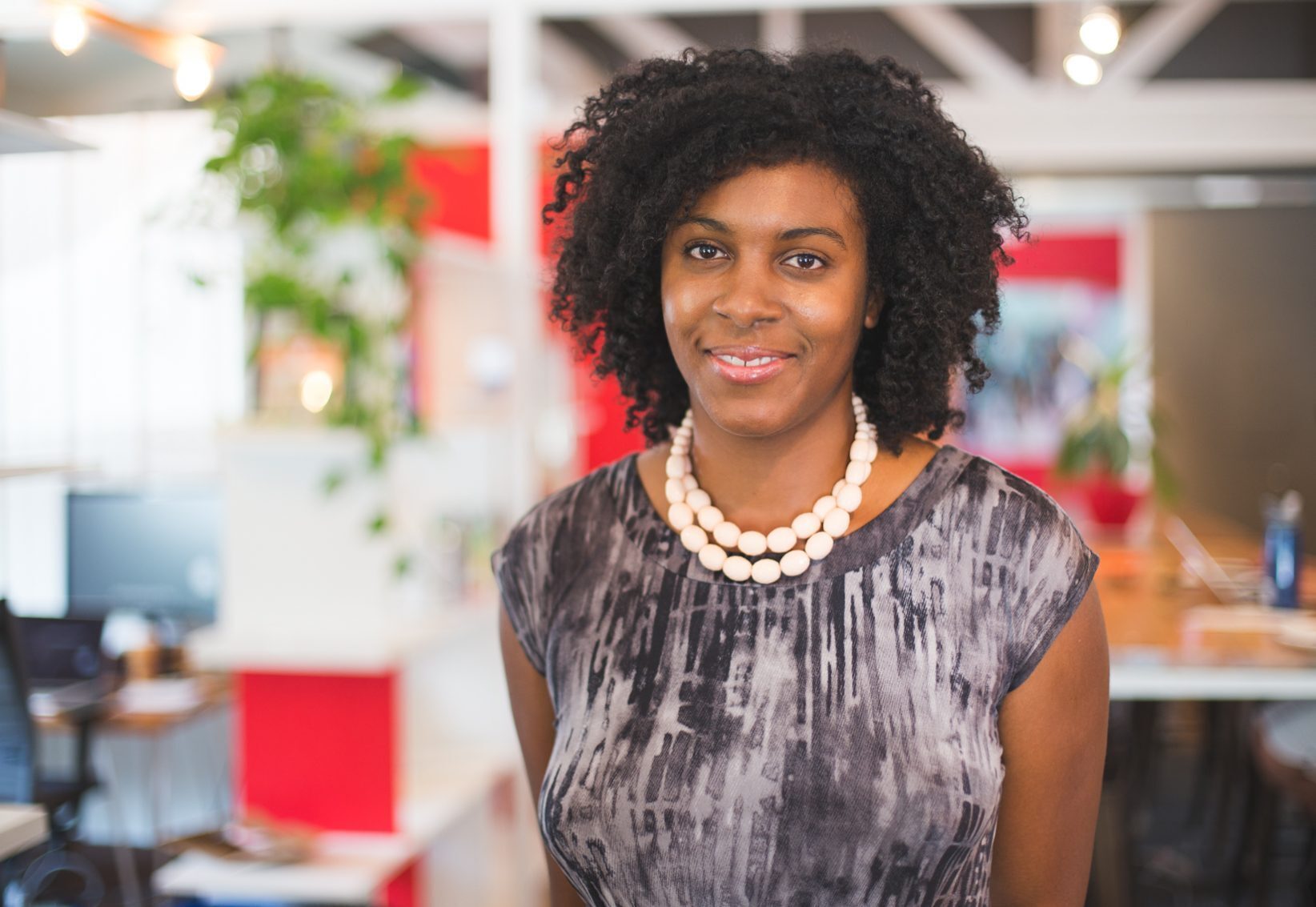
But now she’s working to change that as founder of Pennez, a company that’s building an artificial intelligence app to help students improve their reading abilities and comprehension.
Growing up as a black woman in Miami County Kan., Dove said she feels lucky for her education. She knows that the numbers disproportionately affect students depending on their race. Dove said that by the 4th grade, 82 percent African-American, 79 percent Latino, 72 percent American Indian, 54 percent Caucasian and 43 percent Asian students still struggle to read. Although this affects all students at a dramatic rate, Dove is passionate about evening the playing field.
“Right now [minority] children mostly see slavery, sports or musicians in their books,” Dove said. “If they don’t see themselves in the characters it leads them to believe that they aren’t important. This lack of engagement could slowly pull them out of society, which polarizes the community.”
Founded in 2014, Pennez is an online platform that produces content with the goal of helping struggling and diverse readers through a variety of educational tools. The platform also includes articles, lesson plans, activities and interviews of multicultural authors. Dove says that minority groups are misrepresented in children’s publishing and hopes that Pennez will help all kids love reading.
“If they [minority children] don’t see themselves in the characters it leads them to believe that they aren’t important. This lack of engagement could slowly pull them out of society, which polarizes the community.”- Rebecca Dove
In September, the company plans to launch a free, web-based application called Read2Think. The app is an artificial intelligence tool that will evaluate the reading habits of students and give teachers and parents deeper understanding. People can also register as beta users online to test the app’s features.
The child will read into the computer or tablet, and the software will listen to the child, evaluate the recording and then give a score. Children are scored by a letter grade A through Z and are given a reading level upon evaluation. The system looks at vocabulary, fluency, reading speed and phonics. Once the application has passed its first rounds of testing, the team plans to add a feature that will match the child up with books to read based on their reading level, culture and interests.
Dove works part-time as an adjunct professor at Avila University, and has bootstrapped most of the funds for Pennez, which now employs seven people. Pennez received a $25,000 grant from IBM, $24,000 from Mozilla’s Gigabit Community Fund and $1,500 from UMKC’s Venture Creation Challenge.
Dove says that the transition from teacher to entrepreneur hasn’t been easy.
“Getting funded really helped a lot because people began to see my vision as a viable product,” Dove said. “I definitely started as someone who wasn’t sure whether I belong, but now I feel like I have to be here.”
This fall, Pennez plans to pilot the app Read2Think with first- through eighth-grade students at four Kansas City-area schools and one in Chattanooga, Tenn. In total, 250 kids will test Read2Think.
Pennez CTO Quest Taylor said the focus of the pilot is to collect the voices of children so that the technology can be trained to learn with them.
A developer for over 15 years, Taylor said that besides the popularity of Siri, Skype and Google Voice, few firms have had a reason to include kids’ voices in their natural language processing algorithms.
He said Read2Think aims to offer a solution that learns how kids naturally speak.
“So far, all artificial intelligence solutions to this problem currently on the market have failed,” Taylor said. “We had to learn to create our own.”
Aside from artificial intelligence, the app uses natural language processing and artificial neural networks. It is designed to work with up to 90 different English accents as well as Spanish speakers.
While Taylor said that Pennez is focused on minority students, he hopes it will help all illiterate youth. However, he said he feels as if he has to constantly prove that the poor literacy rate is a problem.
“If there are this many children who can’t read, then it’s an issue,” Taylor said. “It’s pretty pathetic.”
Taylor says he used to advocate for teaching children how to code at an early age, but after he became aware of children’s literacy statistics he changed his tune a bit. Taylor now maintains that reading should be the top priority for students and that those in the startup community should worry about teaching children to code once we’ve solved this problem first.
“The Kansas City startup scene is both inclusive and exclusive,” Taylor said. “Only some of us are willing to help each other. … The money is here; the talent and designers are here. We all need to come together.”

Featured Business

2016 Startups to Watch
stats here
Related Posts on Startland News

Small biz makers worry Trump tariffs could be ‘recipe for recession’; Economists, farmers share concerns about trade war
An enthusiastic smile spreads across Katie Mabry Van Dieren’s face as three small groups of new customers flow into her Brookside Plaza shop — a space filled as high as the Shop Local KC owner can reach with colorful, off-beat, and functional goods and gifts from Kansas City makers. “We smelled something wonderful from outside…

Sustainable data center near downtown KCMO to help power capacity with $143M investment
Kansas City is building on its reputation as a hub for partners looking to tap into a region rich with infrastructure built for the future, said Steven Anthony, announcing the grand opening of another major, sustainable data center in KCMO. Edged — a vertically integrated global platform of on-demand data centers with operations designed to…

Potato Potatas grows the business of comfort food from the ground up (and in a pot pie)
Two years ago, Trine’ce Brown took note of restaurant chains like Chipotle and Qdoba, and wondered why there wasn’t already a fast-casual potato bar concept. She decided to start her own — but taking small steps, first working out of a Northland kitchen commissary, the Culinary Center at the Mid-Continent Public Library, starting in May.…

KC2026 team hires cybersecurity, explosives expert for key World Cup ops-planning role
In its latest high-profile move, the team behind Kansas City’s 2026 World Cup planning has tapped a former U.S. Secret Service special agent — notably the veteran of a years-long United Nations General Assembly assignment — to lead KC2026’s safety and security efforts. Kyle Postell already has led critical infrastructure protection efforts, conducted comprehensive vulnerability…