

Joshua Montgomery: KC poised to be IoT-powered smart city leader
July 5, 2016 | Joshua Montgomery

Editor’s note: The opinions expressed in this commentary are the author’s alone.
Most of the people I ask about the Internet of Things — or IoT — respond with visions of network-connected light bulbs or water sensors for their basements. They talk about fitness trackers or connected thermostats that help reduce energy costs.
To me, these uses are hardly inspiring. We were promised robot maids and self piloting personal aircrafts. What happened to the Jetsons revolution? The simple answer is: it’s coming. And thanks to investments by Google, Cisco, Sprint and our own municipality, Kansas City will be one of the first cities to experience the full power of IoT.
To reap the full benefits of an IoT future, a community needs comprehensive wireless coverage, high capacity fiber trunks, a commitment to open data, an active tech scene and visionary leadership. Kansas City already has all of these things, making it possible to leap into the future faster.
A snapshot of what an IoT-powered smart city might look like …
A man walking south down Baltimore St. has sudden chest pains. He collapses and bystanders call 911.
Dispatchers send an ambulance, but the nearest unit is more than 15 minutes away. In an emergency where every second counts, 15 minutes is too long, so dispatchers open a local drone company’s application and mark the site of the emergency. The software automatically files a Notice to Airmen with the FAA and launches an emergency medical drone in less than 60 seconds.
The dispatchers are able to alter the timing of the traffic signals serving that section of Baltimore so the drone has a place to land. The new timing stops incoming traffic while allowing outbound traffic. This quickly clears block of vehicles.
Dispatchers then pull up a video feed from a nearby traffic camera. They verify that the road is clear in time for the emergency drone to land near the victim. The drone carries an automated external defibrillator (AED), which the original 911 caller grabs from the cargo compartment. Dispatchers then walk the caller through the process of connecting the AED to the victim. Total time between the victim’s heart attack and help arriving? Four minutes. IoT saves his life.
And here’s the really cool part …
All of the technology involved in this process is already available. Drones are plentiful, traffic cameras monitor most intersections, AEDs are commonplace and traffic signals are programmable.
What must change is our ability to tie these devices together and get them to work in concert. In this scenario alone, the 911 dispatcher would need a connection to traffic cameras, signals and to the drone provider. Software would need to be in place and tested, and the regulatory hurdles would need to be conquered well in advance.
Finally, why KC may be the first to make an IoT smart city a reality …
I believe it’s because Kansas City has the willingness to take risk. It has leadership that is committed to leading the adoption of new technology, tying together legacy systems and integrating them for the benefit of our community.
These are the types of risk that the public sector should be taking. Will there be challenges along the way? Certainly. Will some initiatives fail? Absolutely. But that is one role of government — taking risks that no private company can afford to take. And that is where Kansas City is leading not only in the U.S., but globally as well.
Kansas City was the first city to successfully land Google Fiber. Our community built the Startup Village. Through Sprint, our community was one of the first to attract a Techstars corporate program. We’ve been leaders in taking risks with everything from Think Big to Launch KC to a revitalized streetcar system with integrated network connectivity. All of these efforts have had some level of financial, marketing or in-kind support from our local government.
Is the next decade going to bring us fleets of autonomous cars? Personal jetpacks? Medical hibernation? Maybe — or maybe not — but if these technologies do appear, I’m confident that Kansas City will be one of the cities ahead of the margin due to its openness to innovation and willingness to take risk.
Joshua Montgomery is the founder of Mycroft AI, the maker of an open-source, natural language platform, and a member of the 2016 Sprint Accelerator cohort.

Featured Business

2016 Startups to Watch
stats here
Related Posts on Startland News

Think branding: The importance of internal marketing
In this Think column, hr-haven founder Belinda Waggoner dissects the imperative of a coherent, thoughtful internal identity within one’s company. The Think column helps entrepreneurs to stop and think about the various aspects of starting and running a business. If you haven’t unlocked the secrets or even considered the benefits of internal branding, here’s a little story we tell…

Schukman: 5 ways to fuse a social mission in your company
I’ve recently been exploring ways in which traditional companies have been retroactively becoming social entrepreneurs. Recall from my last piece that social entrepreneurship is a businessperson that creates a profit and purpose-driven organization in which the business and social missions run in tandem. Our social mission, therefore, becomes a key component of our marketing, branding,…

Think IP: 3 IP rights your startup should know
In this Think column, Venture Legal attorney Andrew McGhie explores the complex world of intellectual property and how to protect your company. The Think column helps entrepreneurs to stop and think about the various aspects of starting and running a business. The most valuable assets for startups often include some type of intellectual property. What protection is…
RECAP: 1 Million Cups panel offers decision-making advice
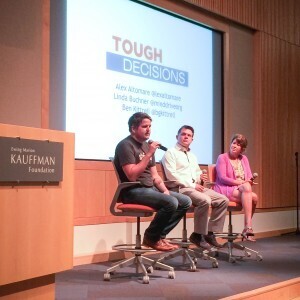
Three entrepreneurs took the stage at 1 Million Cups this week to offer advice on navigating the tough world of entrepreneurship. Alex Altomare, co-founder of BetaBlox, Linda Buchner, co-founder and president of Minddrive, and Ben Kittrell, co-founder and CTO of Doodlekit, all spoke about the variety of hard choices entrepreneurs face. On handling tough decisions……