

Conner Hazelrigg’s Sunshine Box lights up the dark in Haiti
July 27, 2016 | Meghan LeVota
Conner Hazelrigg, 23, never considered herself an entrepreneur.
A few years ago, she was a student at William Jewell College, keeping herself busy playing tennis and basketball, and working towards a double major in physics and math.
“I always wanted to do something with engineering and architecture — I loved science,” Hazelrigg said. “But I also enjoy the hands on part; the building something the working with something, the creating something.”
In 2012, a friend came back from a trip to Haiti and shared a shocking statistic: Almost 70 percent of people in Haiti own cell phones, yet only 12 percent have access to electricity. After hearing this problem, an idea to help was born.
The Sunshine Box was Hazelrigg’s solution. The device is designed to narrow the gap for mobile-first technology users and allow them to access reliable and safe electricity.
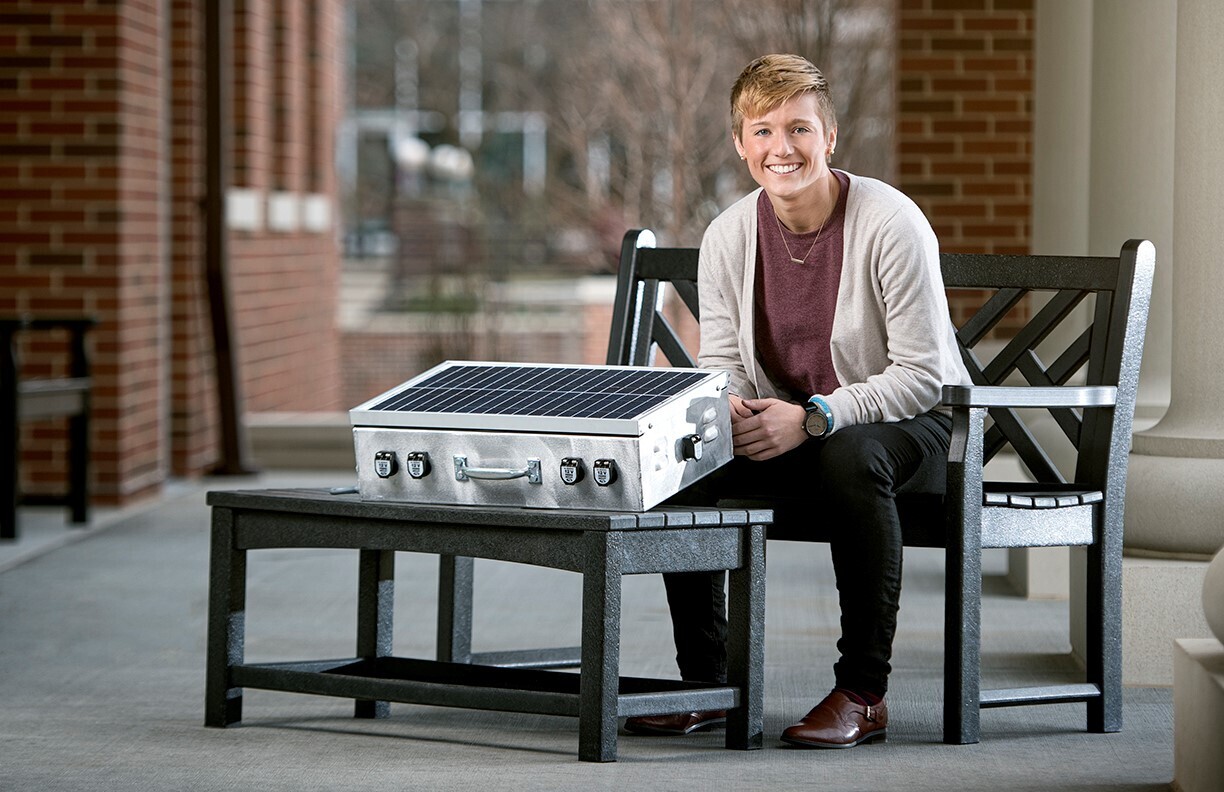
The Sunshine Box is portable solar-charging station that can charge 10 devices at a time. The waterproof box — which looks like a two-foot wide, metal briefcase — is powered by 20-watt solar panels and features 10 electrical outlets. A UL safety certified electronic device, the box also comes with a light and fan.
During college, Hazelrigg worked part time at Sunshine Electronic Display in St. Joseph Mo. helping to manufacture electronics. After creating a first prototype, she took her idea of the Sunshine Box to the the firm’s CEO, Kendall Randolph, who became an angel investor for the idea. With the funding, Hazelrigg created three of the boxes that she took to Haiti to be installed in different villages.
The creation of Hazelrigg’s device also prompted new rules for entrepreneurial students at William Jewell college. The Sunshine Box was the first commercialized product created by an active student at William Jewell college and before then, there was no written agreement on securing Intellectual property rights for students.
That was one of Hazelrigg’s biggest challenges in creating the Sunshine Box, she said. Without these rights to protect her, research and products that she developed would belong to the university. Hazelrigg says she was lucky to have her mentors at William Jewell who understood the situation and protected her. She joined the organization called University for Innovation Fellows, which helped ensure that entrepreneurial students at William Jewell would have a law protecting them.
“I love creating this business. I love expanding it,” she said. “ I love thinking about all the different ways it could go — and the ways to have a bigger impact on so many people.”
While please she helped institute change at her school, Hazelrigg said giving a gift to people in need is the most rewarding part of her business.
“When we were in Haiti, that whole experience completely molded my life in a matter of seven days,” Hazelrigg said. “I found out things about myself that I didn’t know that I cared about, and just understood more of what I was supposed to do with my knowledge and talents. It was all just as simple as traveling around the world and meeting a bunch of people.”
In January, Hazelrigg installed a Sunshine Box in a Haiti church. Soon after, the pastor called her to express the community’s gratitude.
“When everyone went up to church that night, the lights came on, and people started crying and children started dancing on the street,” Hazelrigg said. “They were there for hours just looking and playing with the light because they’ve never had an experience of light in the dark before. … Just hearing that story of that situation was a reward for me.”
Currently, there are Sunshine Boxes in the Bahamas, Haiti, Honduras, Malawi, Papua New Guinea, Peru and Uganda. The company has sold 10 boxes since 2015, and Hazelrigg hopes to bring the device to seven more countries by year’s end.
After graduating in December 2015, Hazelrigg wanted to continue her journey in entrepreneurship. Formerly referred to as Sollular Connections, Hazelrigg re-launched her business early this year with the new name, 17° 73° Innovation Co. Inspired by the coordinates of Port au Prince, Haiti, she felt that this name didn’t limit her creativity.
“We wanted to create a product platform to not just target one problem and one solution but to propose different solutions to different problems that might not even be related,” she said.
Currently, 17° 73° Innovation Co. has a team that works on a volunteer basis. Although they’ve generated revenue by selling a few boxes, Hazelrigg and her team has applied for some grants to help accelerate the business. She hopes that 17° 73° Innovation Co. will make sustainable traction soon so that she can employ more people.
“I love creating this business. I love expanding it,” she said. “ I love thinking about all the different ways it could go — and the ways to have a bigger impact on so many people.”

Featured Business

2016 Startups to Watch
stats here
Related Posts on Startland News

Candidates: Unchecked property crime against businesses driven by prosecutor’s failure to hold offenders accountable
Melesa Johnson, Tracey Chappell share their solutions for combatting recent uptick in break-ins at Kansas City businesses Editor’s note: Jackson County Prosecutor Jean Peters Baker is not seeking re-election, so it’s an open race for her countywide seat. Democrat Melesa Johnson and Republican Tracey Chappell are running in the 2024 general election with a vote…

A simple sauce passed down six generations is headed to your table; Lenexa man says that’s his family’s great legacy
Jack Williams’ dream of seeing his great-grandmother’s picture in every grocery store across the country is one step closer to reality as the Lenexa entrepreneur’s jars of Grandma Morrelli’s pasta sauce — emblazoned with her photo — hit Kansas City shelves. “I’m trying to honor her and family traditions,” he said, describing how the venture…

Here’s how a new data dashboard could help KCMO redirect funds to small businesses
A new data dashboard built to better understand Kansas City’s business needs — and guide the city’s response — is not only revolutionary for the metro, said Nia Richardson, it could be the first of its kind, period. Small business advocates already are calling it a win. “I don’t know of any other city or playbook…

Modern world requires entrepreneurs to think like creatives, says KU’s Innovator in Residence
Editor’s note: The University of Kansas’ School of Business is a partner of Startland News. LAWRENCE, Kansas — Building a skill set around creativity is critical to entrepreneurship — especially at a time when careers can be short-lived, said Josh Wexler. “Jobs are no longer for life,” explained the Innovator in Residence at the University…