

The red carpet, garageband and laboratory of funding models
April 22, 2016 | Larissa Uredi

Editor’s note: The opinions expressed in this commentary are the author’s alone.
“Funding! Funding! Funding!”
It’s the warrior’s cry of the startup community.
In the world of entrepreneurship, there’s an incredible amount of pressure to run a startup that can be described as “disruptive,” “innovative” and “scalable.” Those descriptions come with a hefty price tag, however. So, what’s a startup to do? It depends.
Like most things, startups run on money. To solve the money question, you ultimately have three paths to consider, which I’ll refer to as the red carpet, garageband and laboratory methods.
Venture Capital: the red carpet of funding
Venture capital steals the spotlight as the “best” route to becoming an all-star startup. Raising capital through VC has the perception of being the red-carpet route to success, fame and fortune, because it says people with the big bucks think you’re brilliant.
To have a chance at walking that carpet, you, the entrepreneur, take the time to build the idea, the team and to gain proof-of-concept traction. You take the work you’ve done and present it to a group of people with more money and experience than you. You show them that your company is a great fit for their portfolio because your idea fits those descriptions of “disruptive,” “innovative” and “scalable.”
It’s a tough approach to win, especially in Kansas City. The local venture capital market is extremely conservative, and although things are looking up, we’re a long ways away from Silicon Valley.
Then, if you do gain entrance to the red carpet by raising a bunch of capital, you’re no longer completely your own boss. Your investors want a return on their investment, which sometimes means changing your vision, approach and product to fit someone else’s goals.
The takeaway: Pursuing venture capital funding is a great way to find the money you need to aggressively scale your company. The downside is that you run the risk of your business morphing into someone else’s vision while joining an aggressive playing field.
Play in a garageband with bootstrapping
Bootstrapping is often pigeonholed as “what you do until you can get funding.” It’s the option entrepreneurs hold onto when they can’t raise capital and are still unwilling to give up their dream.
Bootstrappers fund their business ideas themselves and work like a fiend until they’re profitable. They don’t borrow excess money and don’t compromise their venture or vision because an investor tells them it’s a bad idea. They don’t pivot their business every time they lose a sale. They have the ability to scale their business at their own pace and have the time to avoid common — and dangerous — growing pains.
The takeaway: If you have the savings and the guts to put your money where your business idea is, this is a great route to go. You call the shots and run the business you want to run. The downside is that all of the risk is yours and the safety net is small or nonexistent.
A lean startup model is the startup laboratory
If your startup doesn’t fit the VC model or you hate the idea of answering to investors, the lean startup model may be for you.
Instead of building a complete idea, the lean startup team builds parts of the whole. They test those parts by drumming up as many sales as possible and then use the proceeds to restart the cycle. The idea, per serial entrepreneur Eric Ries, is to constantly adapt your business to fit the needs of your customers, and when something doesn’t work for them, get rid of it.
It’s worth noting, however, that lean startup methodology can be implemented within both the bootstrapping and venture capital model. It’s not so much a funding model, as much as a method to quickly and inexpensively test ideas.
The takeaway: For those of us with a restless entrepreneurial spirit, the lean startup is a great way to decide what kind of business to run. You have virtually no costs to get started and you get a quick sense of market demand. The flipside? Without a solid plan in place and a roadmap to follow, it’s easy to get off track and end up in an endless pivot loop where you never quite nail down your business model or goals.
While the choices on how to run your business are difficult, how you choose to fund your business can define the success of your company. It’s one of the biggest decisions you will make. Choose carefully, while keeping an eye on the kind of business you want to run and the amount of control you want to have.
Larissa Uredi is the marketing and sales director for The DeviceShop, a small business accelerator out of Shawnee, Kan. that offers office space, workshops, and manufacturing and prototyping services. The DeviceShop considers itself to be a community of innovators aiming to develop successful and profitable entrepreneurs. Uredi is also the business developer for No-Where Consultants.

Featured Business

2016 Startups to Watch
stats here
Related Posts on Startland News
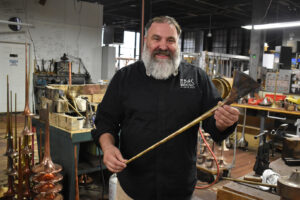
KC’s ‘Horn Doctor’ handcrafts jazz preservation, keeping soul, tradition alive on Vine Street
Across the historic intersection at Kansas City’s 12th and Vine streets, B.A.C. Musical Instruments operates as one of the few remaining American factories handcrafting professional brass instruments. “This is where all the musicians would hang out back in the day,” said founder Mike “Horn Doctor” Corrigan, gesturing toward the Paseo sunken garden beside his shop.…

Autotech startup revs after patent stall; signature tech removes emissions, waste from diesel logistics
Fresh fuel is pumping into NORDEF after the Kansas City autotech company finally received patent approval for its signature product, co-founder William Walls said, pushing the pedal on its mission to disrupt the automotive fluid industry. Four years after applying for a provisional patent for its technology to produce diesel exhaust fluid on-demand — and…

rOOTS KC grows into third location, planting shop in River Market ahead of World Cup
Initially setting its roots as a pop-up plant shop in 2020, Dee Ferguson’s leafy business has grown to three Kansas City locations. The secret is in the soil, she said, describing a strategy for cultivating customers through free, evergreen plant care support and “community-rooted spirit.” [pullquote] The name rOOTS comes from Dee Ferguson’s surname: Oots.…
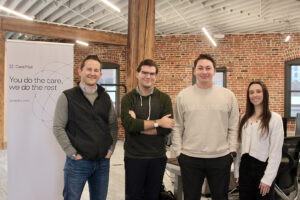
Summer funding pushes CarePilot to team hires, AI accolades, healthtech product launch
Fresh off its summer capital infusion, a Kansas City-built AI startup that helps doctors focus on patients instead of administrative tasks is earning industry recognition and dropping another new product, said Joseph Tutera, sharing credit for the milestones with behind-the-scenes talent. “We have a young team and they don’t have the encumbrance of a prior…