

Overland Park startup Member Jets crowdsources private flights to cut costs, save time
April 14, 2016 | Bobby Burch

An Overland Park tech firm is bringing charter flights to the masses with its crowdsourcing platform that reduces the costs to fly in swanky private jets.
Founded in 2015, Member Jets created a private aviation community that connects travelers to discounted private flights by aggregating available seats and travel opportunities. Now used at Kansas City’s Charles B. Wheeler Downtown Airport and the Johnson County Executive Airport, Member Jets is accepting members for its club, which targets businesses and entrepreneurs that highly value their time.
“We’re trying to create a trading environment for aviation,” Member Jets CEO Ty Carter said. “We bring the price point down so you’re not buying an entire airplane — you buy a seat like you would on a commercial airline. But instead of a commercial flight, you’re on a private jet without all the hassles.”
To use the service, a would-be traveler buys a Member Jets membership and creates a profile, indicating preferences and frequent domestic destinations. For safety, the user also must go through a background check and be in good standing with the TSA.
A member can then search, request, select, book and, if desired, share the aircraft with other members, driving down costs. The platform also can notify users of travel opportunities to a desired locale.
A pilot for more than 25 years, Carter said that Member Jets not only reduces private flight costs but also drastically cuts down on travel time when compared to a commercial flight. In addition to skipping security and check-in lines and the option to park on a nearby tarmac, private flights are direct to the desired location.
For example, Carter said that Member Jets can cut off about five hours of travel time on a round trip flight to Denver, six hours to New York City and eight hours to Los Angeles.
And in a world where time is money, Carter said the efficiencies are significant to a business’s bottom line.
“For an entrepreneur whose time is extremely valuable — every minute is important,” Carter said. “Standing in line at airports and the commercial hassles are not efficient. … I’ve seen the advantages of what private air allows you to do — it’s like a time capsule. Your productivity is much higher.”
While still more expensive when compared to commercial flights, Carter said Member Jets’ flights are cheaper than chartering an entire plane. For example, a private one-way flight to Austin, Texas costs about $800 for a 1-hour-and-40-minute flight.
The company is currently only operating out of the Kansas City area but is looking to expand to Denver and Atlanta. Some of its common destinations include St. Louis, Omaha, Dallas, Oklahoma City, Austin, Cincinnati, Atlanta, Wichita, New York City, Denver and other.
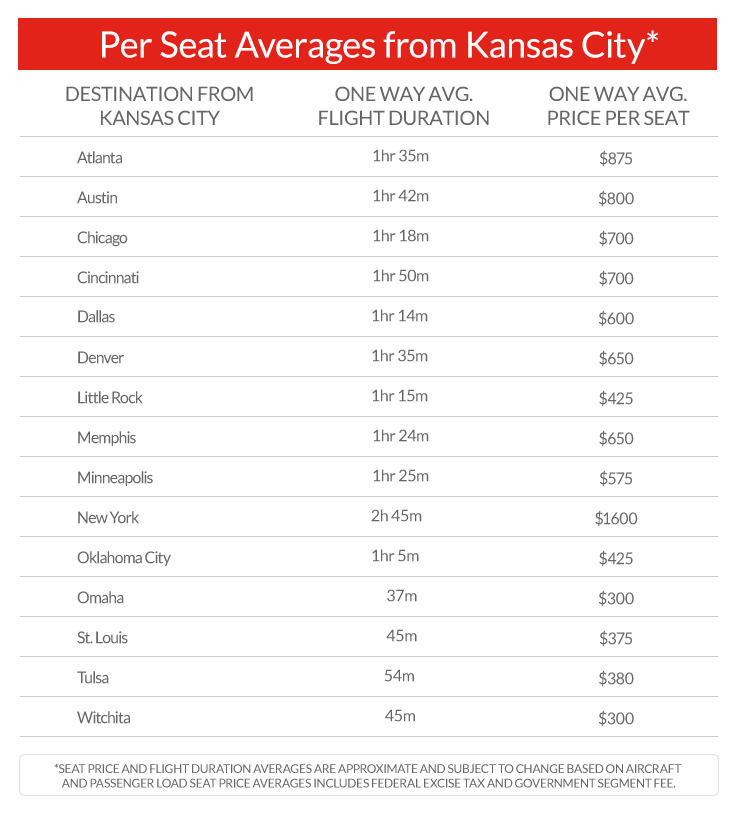
Image by Member jets

Featured Business

2016 Startups to Watch
stats here
Related Posts on Startland News

Survey: Most regional investors want a better due diligence process
For investors, investigating deals isn’t always an easy process. From examining an industry’s opportunity to loads of legal analysis, the amount of work in the due diligence process is often enough to deter financiers from investing in a firm. That’s why in a recent survey, a majority of regional investors said they’d love a better…

ScaleUP! KC wants ambitious startups to top $1M
Looking to surpass $1 million in revenue? The immersive, mentor-led business program ScaleUP! Kansas City has opened up applications for its sixth cohort. “ScaleUP! Kansas City continues to fill a key and vital gap in our entrepreneurial ecosystem,” said Jill Meyer, program director of ScaleUP! KC. “Building a business is hard and lonely work and…

Godfather of content marketing joins the DivvyHQ team
Kansas City-based tech firm DivvyHQ just snagged an industry pioneer in content marketing for its board of directors. The Chief strategist for the Content Marketing Institute, Robert Rose recently joined the DivvyHQ team to lend his years of content marketing expertise. A nationwide speaker and author, Rose has developed content customer experience strategies for such…

Missouri named Hyperloop semifinalist, offering 760 mph alternative to I-70
Missouri is in the running to land a futuristic transportation system that would move people between Kansas City and St. Louis in only 23 minutes. On Wednesday, transportation tech firm Hyperloop One announced 11 semifinalist routes in the U.S. that could receive its system that propels vehicles at speeds of about 760 miles per hour.…