

The WTF Series: Encryption and Apple’s predicament
March 21, 2016 | Ben Kittrell

For those of you who have been living under a rock the last month, there’s a “little” snafu going on between Apple and the FBI. The FBI handed Apple a court order demanding access to the password-protected iPhone of a mass shooter.

Ben Kittrell
In an open letter to customers, Apple CEO Tim Cook explained that the company had and would continue to deny the order. It would require Apple to build a backdoor into the iPhone’s encryption, compromising the security of all iPhones, he said.
“The implications of the government’s demands are chilling,” Cook wrote. “If the government can use the All Writs Act to make it easier to unlock your iPhone, it would have the power to reach into anyone’s device to capture their data.”
So, what is encryption anyway?
All of your data is stored on a hard drive somewhere. Without encryption, a hacker could bypass your passcode to see anything stored on your phone, such as photos, location history, credit card information and emails.
Encryption basically jumbles up your data so that it’s unreadable to anyone with direct access to it. Even if someone physically pulled out your phone’s hard drive, the data would be useless without a special key that only you own — in the iPhone’s case, your password. This key is used to jumble up the data, so it’s the only way to make it readable again.
In iOS 8, the software that runs the iPhone, Apple decided to encrypt your data automatically. Without your passcode, even Apple can’t access your data.
Is encryption safe?
For more from a security expert, I spoke with my friend Chris Cooley, director of business development for SpiderOak. The Kansas City-based tech firm uses encryption to provide secure backup and communication tools. I asked Cooley his opinion on whether encryption really works. His response? Sometimes.
“It’s important to know that the strength of encryption depends a great deal on how it is applied,” Cooley said. “It’s not a simple yes or no check box.”
Encryption technology is as secure as it gets. But most hackers don’t look for flaws in tech; they look for flaws in humans.
“We’ve all seen the images of little Johnny using his secret decoder ring to turn random letters into a secret message,” Cooley continued. “In the digital age, much of the encryption happens server-side, meaning that that decoder ring (the key) is on the server. As you can imagine, a coded message in the same box as the decoder ring is less than ideal.”
“Some companies use a single set of keys, just one decoder ring, for all encryption,” he added. “If it gets copied or stolen, everyone now has a problem. Other organizations will create a new decoder ring for each user.”
Encryption is safe, as long as your keys are managed properly. As Cooley says, “A military-grade front door is near worthless if you’re just leaving the key under the front mat.”
Where else is encryption used?
We all know that you shouldn’t enter private information on a website unless you see the secure “lock” icon in the address bar, right? Right?! That lock means that all of the information that travels from your computer to the website is encrypted, and no one can read it along the way.
This technology is called Secure Socket Layers or SSL and is becoming a standard for all websites, even if you’re not collecting credit card data. Without it, anyone at the coffee shop could hijack your Facebook login and take those quizzes for you.
Encryption is increasingly incorporated into almost every electronic device that stores valuable personal information. Apple isn’t just fighting for the security of one iPhone, or even for the security of all its iPhones. It’s fighting to prevent a legal precedent of government requiring a backdoor to every device you own. And if you think that’s scary for the government to have control of, imagine if those “keys” eventually fell into the wrong hands.
Ben Kittrell is the co-founder of Doodlekit and an advisor for startups and small businesses. Kittrell also is host of Spare Room Radio, a podcast that features Kansas City entrepreneurs.

Featured Business

2016 Startups to Watch
stats here
Related Posts on Startland News

How Trump’s views on climate raise questions for Kansas’ biggest bet: a $4B Panasonic plant in De Soto
Editor’s note: This story was originally published by Kansas City PBS/Flatland, a member of the Kansas City Media Collective, which also includes Startland News, KCUR 89.3, American Public Square, The Kansas City Beacon, and Missouri Business Alert. Click here to read the original story. Headwinds don’t dampen enthusiasm of company executives, government officials The mammoth $4 billion…

Kansas student’s mobility tech for visually impaired users wins Congressional App Challenge
An Overland Park eighth grader’s app idea — using object detection and text-to-speech technology to help visually impaired individuals navigate their surroundings — earned him a visit to the principal’s office, then an opportunity to showcase his innovation in Washington, D.C. “I actually came across a video online, and it was about this blind woman…

TikTok ban would mean an ‘astronomical’ change for these Kansas City content creators
Editor’s note: The following story was published by KCUR, Kansas City’s NPR member station, and a fellow member of the KC Media Collective. Click here to read the original story or here to sign up for KCUR’s email newsletter. Video creators around Kansas City are concerned about their livelihoods and Congress’ ability to limit free speech if the Supreme Court…
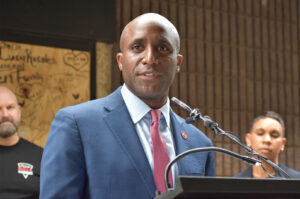
Mayor proposes $1M in off-duty LEO pay; River Market eyes ‘witching hours’ security to combat crime wave
An ordinance pushed by Mayor Quinton Lucas would fund extra security services in KCMO business districts through collaboration with regional law enforcement agencies — a move aimed at preventing more thefts, break-ins and vandalism incidents targeted at Kansas City small businesses. Lucas’ proposal would invest up to $1 million to increase the presence of off-duty deputies…