

Police offer behind-the-scenes insight on Royals’ World Series parade
March 31, 2016 | Kat Hungerford
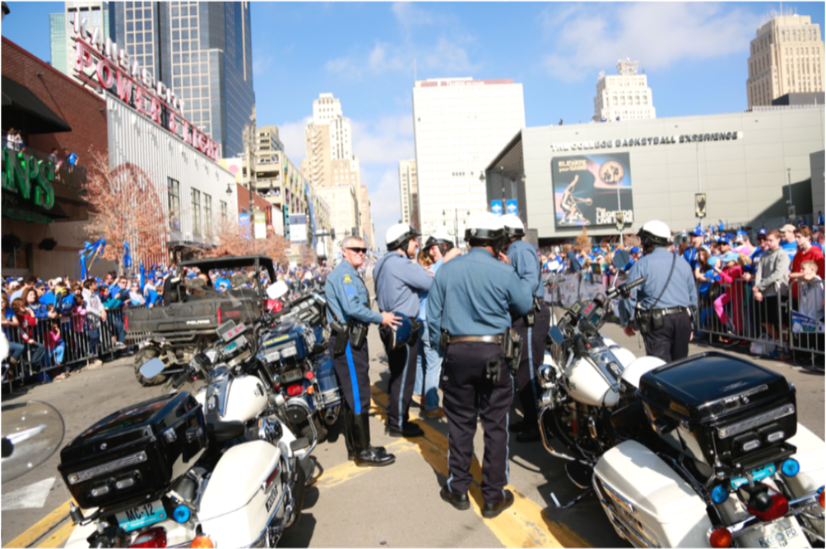
It’s November 3, and the Kansas City Royals have just won the World Series after a surprisingly short five games.
The last time the Royals brought home a trophy that size was 1985. Fans are ready to party — a crazy, once-every-30-years kind of party.
How does a police department ensure the safety of an entire city’s worth of fans celebrating along a 2.3 mile parade route?
That’s a question Capt. Daniel Gates, tactical response teams commander for the Kansas City Police Department, and Mike Grigsby, IT director for the KCPD, answered during a behind-the-scenes discussion on the 2015 World Series celebration.
The Wednesday discussion, taking place during the Smart City Tech Summit at Union Station, explored challenges and successes of planning and executing a large-scale public safety plan.
One of the first challenges, Gates said, was creating a functional protocol on very short notice.
“When a team wins the World Series, if the city that hosts that team wants to have a parade, per the players’ contract you only have 48 hours to get that parade done,” Gates said. “We thought we might potentially have to host a parade if we ended up winning, but we didn’t think we’d win it in five games. We had some preliminary talks, but when we did end up winning in such a short amount of time we had to put it together quickly.”
Of course, all the planning in the world doesn’t make it easier when the actual number of fans attending the parade is more than double the estimated number.
“We were anticipating for the World Series Parade celebration somewhere between 300,000 to 325,000 people,” Grigsby said. “I think our numbers swelled to over 800,000.”
Thankfully, they had the support of a total of more than 500 officers from the KCPD and surrounding jurisdictions. Also lending a hand for the parade was the National Guard and FBI.
Both Gates and Grigsby credit recently implemented technology protocols for helping deploy public safety personnel much more quickly and in a highly targeted manner.
Real-time surveillance let them see potential issues immediately to deploy public safety personnel where they were needed most, said Gates, rather than blanketing everything and hoping for the best.
“We had the ability to not only place cameras around the community from KCPD, we had the ability to tap into public cameras,” Gates said. “So we were able to view from our forward command post almost all the (parade) route, almost all the Union Station area. … That real-time intel was vital, because we had our teams deployed out on the (parade) route and we would tell them what (what was happening and where).”
Another important technology was the Metropolitan Area Regional Radio System, which let the myriad police departments, National Guard and FBI communicate with each other directly, said Grigsby. Before the implementation of the tech, personnel could only easily radio people in their own department.
“Some of the incidents that we’ve had have over time have forced our hand prior to this event to help us build the infrastructure (the Regional Radio System) … to allow us to have communication that spans multiple agencies, jurisdictions, offices and geographic locations,” Grigsby said. “So there wasn’t this level of panic when we started seeing the crowd swell (more than expected). And that’s a huge bone to the technology to communicate from one side to the other and really have a good, smooth, fluid movement of personnel.”
Together, these two technologies helped mitigate several potentially dangerous situations. For example, in an attempt at a better view of the parade, more than 50 people had climbed a low gas station overhang, with still more scaling the building’s roof.
“There was no way (the overhang) was going to support the entire crowd,” said Gates. “We were not only able to see it right away at the command post, we were able to contact the gas station to let them know what was going on and that we were on our way to help.”
The results of such efforts were an unqualified success considering the number of people in attendance, Gates said, especially in arrest numbers.
“From a demonstration or protest perspective, we’ll always have a number of arrests,” he said. “In a group of 200 to 300 people, we’ll have anywhere from five to twenty (arrests). For a group of 800,000, we only had four.”
Here are other public safety outcomes from the parade:
- 800,000 attendees
- 500 officers
- 180+ lost kids (all returned)
- 160 medical calls
- 50+ people transported to local hospitals
- 4 arrests
- 1 fatality from a heart attack

Featured Business

2016 Startups to Watch
stats here
Related Posts on Startland News

Pitch event matches queer singles with dates, but there’s a catch: It’s a bestie behind the mic
Singles within Kansas City’s queer community are about to experience a fresh take on matchmaking, said Tiffany Watts, detailing plans for a pitch event this week where lonely hearts could find connections with help from people who already see them best: their friends. The interactive Where to Find Us event is set for Thursday, Nov.…
KC-built Raven Space Systems awarded $1.8M contract via Air Force’s innovation arm
A LaunchKC alum’s latest stratospheric news: a hefty U.S. defense contract to produce 3D-printed reentry aeroshells for hypersonic flight testing — a breakthrough technology that’s expected to address some of the of most pressing challenges faced by today’s Air Force. Raven Space Systems on Monday announced the $1,800,000 STTR (Small Business Technology Transfer) Phase II contract.…
SafetyCulture names new CEO as founder moves into new strategic executive role
A global tech company with its U.S. headquarters in Kansas City is transitioning to American leadership. Kelly Vohs, a New York-based executive and former Green Beret in the U.S. Special Forces, is set to become CEO of the Australian company SafetyCulture Jan. 1 Founder Luke Anear, who long served as the rapidly scaling business’ CEO…
GEWKC adds full day of Spanish programming to serve growing community of entrepreneurs
Editor’s note: This story was originally published by Missouri Business Alert, a member of the Kansas City Media Collective, which also includes Startland News, KCUR 89.3, American Public Square, Kansas City PBS/Flatland, and The Kansas City Beacon. Click here to read the original story. Para leer una versión de esta historia en español, haga clic aquí. When Ana…