

Equity Donation: A “secret trick” of successful entrepreneurs
February 1, 2016 | Landon Young and Tina Sterling

You’ve probably heard about Facebook founder Mark Zuckerberg giving away his wealth.
Sure, he cares about the world, but he’s using a special strategy to make even more money. In this article we take a peek into how to make more money through business donation.
We’ve worked with many founders and investors in Kansas City and across the nation who have reaped the benefits of giving — from entrepreneurs pledging equity through Pledge 1% to innovators who give through local foundations such as the Greater Kansas City Community Foundation and the National Christian Foundation.
Let’s look at three common business scenarios: The Big Exit, The Zombie, and The Trenches. All three can make more money through planned donations.
The Big Exit
You are killing it!
Buyers are in the wings and now it’s time to think about all that revenue and the taxes that may cut your payout in half. Savvy entrepreneurs are donating equity prior to the sale. Doing this means they can receive the maximum tax deduction allowed by law for the donation, avoid capital gains tax and possibly generate a lifetime income stream.
Here’s a scenario to drive home the point. Let’s just take a look at the impact of donating a 20 percent, non-voting interest in a $5 million C-corp prior to selling the company.
If you donate equity then sell your company, the capital gains taxes are reduced by about 20 percent — $980,000 compared to $1,225,000. The savings on income taxes are also substantial. You pay the government about 25 percent less on your income taxes — a savings of more than $100,000 in our above scenario.
Remember, this is an illustration based on a set of assumptions. So check with your financial people.
The Zombie
Sometimes it happens. You gave everything you had but, well, the company is a zombie.
The founders, employees and investors have worked tirelessly with the hope that someday the company will turn around. It doesn’t happen. Exiting seems impossible. Liquidity seems hopeless.
This “living dead” startup is in the most dangerous position because it continues to suck the life out of everyone involved. But a failed company does not mean worthless assets. The cool tech, the intellectual capital, and social connections and users you acquired could be worth hundreds of thousands or millions of dollars to someone else.
In this case, entrepreneurs get the assets appraised (yes, it works much like your house) and donate the assets to charitable organizations who want them. The tax deduction is the full appraised value of the assets.
In the Trenches:
So you are still busting your butt toward building the company of your dreams. It’s growing, maybe even getting soft interest from potential acquirers. You can “pledge” to donate at any time and wait to actually give until later. “Pledge 1%” is one example of this and it’s the model that Techstars has adopted.
Each of these scenarios offers an opportunity to have a greater impact and reduce taxes. Whether you are killing it or looking for an alternative form of acquisition, consider giving. So go take risks, build amazing stuff and impact the world.
Landon Young and Tina Sterling are co-founders of DonateEquity, a charitable marketplace for professional advisors, fund managers and charitable organizations.

Featured Business

2016 Startups to Watch
stats here
Related Posts on Startland News

Schukman: 5 ways to fuse a social mission in your company
I’ve recently been exploring ways in which traditional companies have been retroactively becoming social entrepreneurs. Recall from my last piece that social entrepreneurship is a businessperson that creates a profit and purpose-driven organization in which the business and social missions run in tandem. Our social mission, therefore, becomes a key component of our marketing, branding,…

Think IP: 3 IP rights your startup should know
In this Think column, Venture Legal attorney Andrew McGhie explores the complex world of intellectual property and how to protect your company. The Think column helps entrepreneurs to stop and think about the various aspects of starting and running a business. The most valuable assets for startups often include some type of intellectual property. What protection is…
UMKC, Digital Sandbox KC partnership to maximize resources, create jobs
The University of Missouri-Kansas City’s E-Scholars program has partnered with a business incubator program to provide resources and capital to student entrepreneurs. The program has partnered with Digital Sandbox KC to offer inroads to students to further develop their business projects with additional funding. “The UMKC Entrepreneurship Scholars program has a very specific goal –…
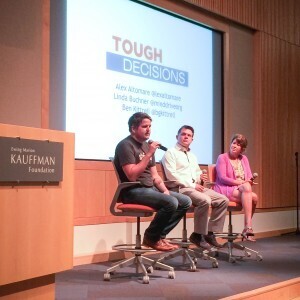
RECAP: 1 Million Cups panel offers decision-making advice
Three entrepreneurs took the stage at 1 Million Cups this week to offer advice on navigating the tough world of entrepreneurship. Alex Altomare, co-founder of BetaBlox, Linda Buchner, co-founder and president of Minddrive, and Ben Kittrell, co-founder and CTO of Doodlekit, all spoke about the variety of hard choices entrepreneurs face. On handling tough decisions……