

Ahead of Valentine’s, e-commerce floral shop Zinnia prunes itself to grow
February 9, 2016 | Kat Hungerford
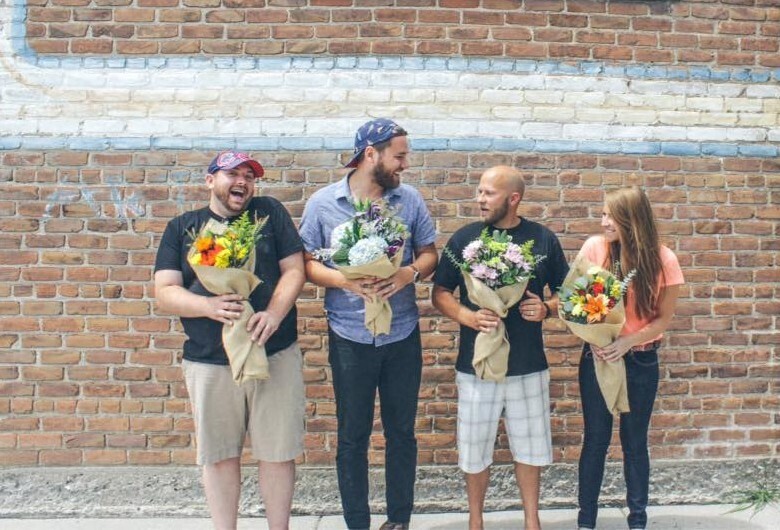
Zinnia is not your mom-and-pop local florist — although the company did have a brief iteration as one lasting about a blink last year.
It’s also not your big-box, online flower retailer — although their ecommerce site is a beautiful example of what a website focused on the customer experience can look like.
The company instead attempts to carefully harmonize local quality with the efficiency and ease of online. Grown from what the founders see as a void in the $8 billion-a-year floral industry, Zinnia’s history reads like a manual on why risk and experimentation are essential building blocks of business.
Thanks to several failures and successful transformations, the company recently expanded to Kansas City to offer its services. With Valentine’s Day around the corner, Zinnia co-founder Andy Holz spoke with Startland News about the company’s challenges, rebirth and next steps.
How is Zinnia different than other online flower retailers?
“If you had told me a year ago, ‘You’re going to quit your job and be a florist’ I would have told you you’re insane.” – Andy Holz
We’re keeping the buying process simple. For example, 1800-Flowers wants you to add-on, add-on, add-on. And then at the end there’s a delivery fee, taxes and so much clutter with way too many options on a cumbersome platform.
People come to our site to buy flowers; they don’t need hundreds of options. They’re happy with four or five. The buying process is simple — no add-ons, just a few simple questions of where it’s going, who is it going to and what you want it to say.
What was the initial idea for Zinnia?
Our first business was an app. If you opened up the app and entered in your location, it would connect you to all the mom-and-pop, brick-and-mortar shops around you. And those florists would be on our marketplace and would have a few arrangements for each category, like ‘I love you’ bouquets.
The feedback we were getting from customers was that: one, they didn’t need another vase; and two, it was just too expensive. The florists were advertising $75 flowers … if you’re going to spend $75 you’re not going to open up an app, you’re probably going to just drive down the road to the florist.
How did you get to today’s model?
Nathan and I for that last month of the (Straight Shot) accelerator basically became florists. We bought wholesale flowers, we designed them, we put burlap on them, we delivered them — the whole thing. If you had told me a year ago, ‘You’re going to spend a month being a florist, you’re going to quit your job and be a florist’ I would have told you you’re insane, you’re being ridiculous. Almost immediately, we started getting orders and good feedback. Our price points were good; people liked the burlap look. We found we could make money.
How’d you scale your concept?
Our accelerator taught us two things: solve a problem, and then figure out how to scale it. The idea of Nathan and I being florists was not scalable. It was not a good solution long term, but it really helped us figure out what we were doing.
It took us back to our original model of outsourcing to the local florist, providing a viable alternative to 1800-Flowers. We kept control of the designs and pricing, and let the florists do what they do best, which is managing inventory, creating flower arrangements and delivering the product.
Why’d you expand to Kansas City?
A local Kansas City florist reached out to us and was interested in working with us. We launched our partnership with them in November. Honestly, it was mostly just an opportunity we didn’t want to turn down, even if we wouldn’t have sought it at that point in our journey. … What has hit home in Omaha has been a local focus. We have to figure out how to maintain that local feel in Kansas City.
In less than a year, you created an app and scrapped it. You started a floral shop and scrapped it. And then you created an ecommerce store and expanded to Kansas City. What’s next?
Right now we’re experimenting with Valentine’s Day boxes that we’re curating, filled with products that you can only get in Omaha. Most people buy flowers three to four times a year. How can we make that six or seven? The challenge is expanding that. How do we include these other options like gift boxes and keep that simplicity? As customers, we’re buying a lot of things online — everything is going is online. How can we be a gifting platform for other things besides flowers while still keeping the customer experience uncomplicated?


2016 Startups to Watch
stats here
Related Posts on Startland News
Feds award KCK college $745K+ to boost 30 low-income STEM students working toward biology degrees
A National Science Foundation grant is expected to support the retention and graduation of high-achieving, low-income STEM students, said U.S. Rep. Sharice Davids, announcing the award. Kansas City Kansas Community College (KCKCC) is set to receive $745,635 to fund scholarships — over the next five years — for 30 full-time students who are pursuing a…
How this homegrown leader is steering a $2B Australian startup’s KC HQ (and 100+ workers) deeper into the Americas
Kylie Uvodich quickly wondered if she’d made a mistake after joining SafetyCulture in 2017, she said. “When I first came over [to SafetyCulture], I thought, ‘What the hell am I getting myself into? I’ll sit here and learn some things for a couple months, and then I’ll get on to my next thing,’” Uvodich recalled.…
CoMo Startup Weekend winner closes $750K seed round; EquipmentShare co-founder joins executive team
Startland News’ Startup Road Trip series explores innovative and uncommon ideas finding success in rural America and Midwestern startup hubs outside the Kansas City metro. This series is possible thanks to the Ewing Marion Kauffman Foundation, which leads a collaborative, nationwide effort to identify and remove large and small barriers to new business creation. COLUMBIA,…
Make48 reality TV series plans maker competition at School for the Blind in KCK
Make48 might be entering its sixth season, but the Kansas City-based, maker-focused reality series is still evolving, said Tom Gray. For the first time, the Make48 competition is set to take place in the makerspace at the Kansas State School for the Blind in Kansas City, Kansas. The teams in this year’s last City Series…