

A vibrant arts culture leads to innovation and why hometown investors are vital
January 28, 2016 | Kat Hungerford

Here’s this week’s dish on why the arts community shouldn’t be a benched player on the sidelines of a city’s economy game; the importance of hometown investors to thriving startup communities; and what universities are doing to keep the talent pipeline strong for an entrepreneurial future. Check out more in this series here.
The Atlantic CityLab: How the arts add to urban economies
The arts might seem like a sideline industry when it comes to innovation, with its boom in big cities often attributed to the fact that larger economies have more money for artists. A new study reverses that assertion: a healthy arts culture and community not only grow economies faster, they boost talent feeding into a well-educated employee pool.
The study analyzed the change in “knowledge-class” workers in more than 350 U.S. metros between 2000 and 2010. It found that all together the 118 metros that had at least one performing arts organization generated an additional $60 billion in annual income and a cool half-million knowledge-class jobs in other industries.
So the next time you buy tickets for an event at Kauffman Center for the Performing Arts, feel free to tell your date that you’re also doing it for the economy.
Tomasz Tunguz: The importance of hometown investors for startups
Tomasz Tunguz, a partner with Redpoint Venture, mined Crunchbase data to uncover insights in hometown investment shares in 10 major cities across the U.S. The data, which looked at hometown dollars in fundraising stages from seed through Series C round, distilled three tiers of behavior.
- San Francisco, with $0.53 of every $1.00 bankrolled by local investors
- Austin, Boston, Chicago, New York and Washington each had approximately $0.24 of every $1.00 bankrolled locally
- Atlanta, Denver, Los Angeles, Portland, San Diego and Seattle each had a low $0.11 of every $1.00 invested locally.
Tunguz notes that hometown dollars are universally more crucial in the seed stage, with at least 15 to 25 percent of dollars invested locally in all 10 cities. The tier gap between cities widens as startups progress through fundraising stages.
Tunguz doesn’t attempt to draw further insights into why No. 1 San Francisco has a greater share of dollars invested locally than cities in lower tiers. Instead, he notes that the important takeaway is that “… it’s the hometown investors in each of these cities that provides the capital to get startups off the ground …”
Looking to these major cities as examples, that means that Kansas City’s startup community can only continue to grow and thrive with an equally robust hometown investment core.
The New York Times: Universities race to nurture start-up founders of the future
With a challenging job market, nearly $1 trillion in student loan debt and rags-to-riches billion-dollar startup success stories, students are demanding more from their universities than Business Strategy 101.
The demand has spurred an innovation arms race among the nation’s top universities. Among many more, Harvard opened its I-Lab, New York University has its Leslie e-Lab, and now Northwestern University founded The Garage.
Several educators have expressed concerns with these models. Skeptics claim the centers copy the Silicon Valley “innovate and disrupt” mindset without addressing underlying business fundamentals or morality. They also assert that the institutions adhere to the premise that innovation is simply “I thought of something that nobody ever thought of before.” It’s more complex than that.
That’s something to keep in mind as we develop our own student innovation centers at UMKC, KCKCC, Wichita State, William Jewell, The University of Kansas, and K-State.

Featured Business

2016 Startups to Watch
stats here
Related Posts on Startland News
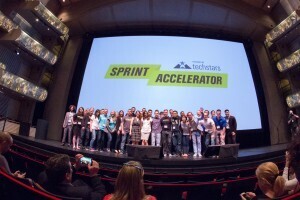
Gallery: Sprint Accelerator Demo Day
The Sprint Mobile Health Accelerator held its Demo Day event Thursday at the Kauffman Center for the Performing Arts. Ten startups that specialize in mobile health technology graduated from the Techstars-led accelerator, which conducts a three-month, mentor-led program designed to quickly advance businesses. Check out photos from the event by scrolling below.

Think IP: 3 IP rights your startup should know
In this Think column, Venture Legal attorney Andrew McGhie explores the complex world of intellectual property and how to protect your company. The Think column helps entrepreneurs to stop and think about the various aspects of starting and running a business. The most valuable assets for startups often include some type of intellectual property. What protection is…
UMKC, Digital Sandbox KC partnership to maximize resources, create jobs
The University of Missouri-Kansas City’s E-Scholars program has partnered with a business incubator program to provide resources and capital to student entrepreneurs. The program has partnered with Digital Sandbox KC to offer inroads to students to further develop their business projects with additional funding. “The UMKC Entrepreneurship Scholars program has a very specific goal –…

KC smart city ‘an invitation’ to innovators, entrepreneurs
The City of Kansas City, Mo., has signed an agreement with Sprint and Cisco to create the largest smart city in North America in the City of Fountains. Sprint will be building a network of connectivity worth up to $7 million dollars while Cisco will be providing smart city infrastructure worth upwards of $5 million. The…