Smart City board discusses data privacy concerns, kiosks’ content
November 30, 2015 | Bobby Burch

Creating value for citizens and openness to adaptive but privacy-conscious data policies were at the forefront of Kansas City’s Smart City board meeting Monday morning.

About 20 people attended the year’s final meeting of the Smart City Advisory Board, which was formed in August to guide the $15.7 million, public-private tech project in downtown Kansas City. Kansas City signed an agreement with Sprint and Cisco in June to create the largest smart city in North America, building a massive public Wi-Fi and sensor network to collect citizens’ data to improve municipal services.
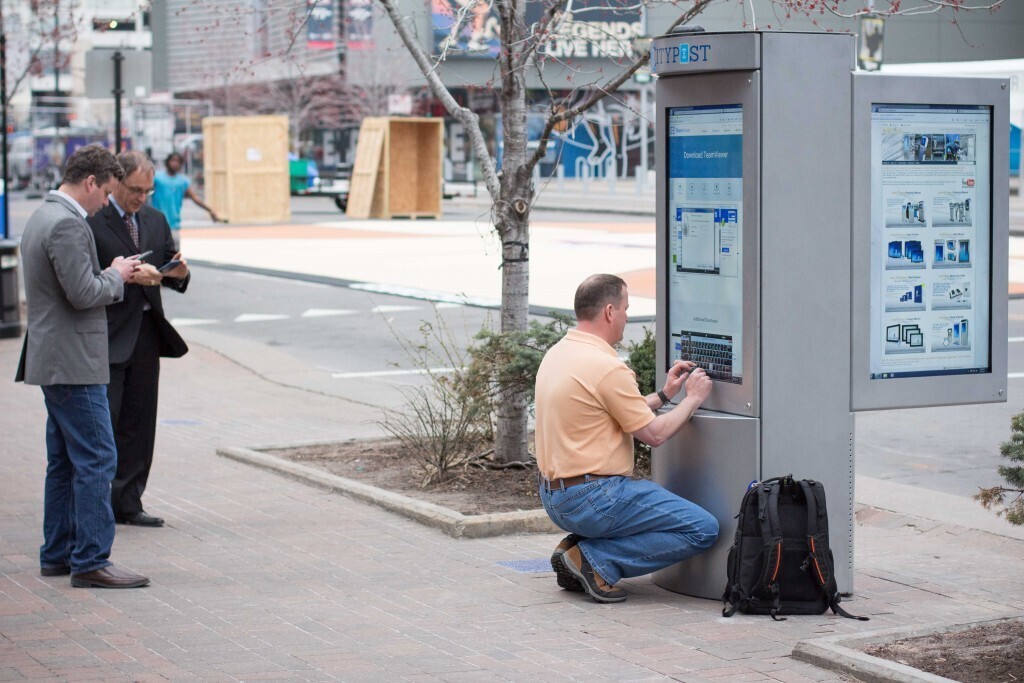
Led by chairman Tom Gerend, the board discussed at length the content that will be featured on 25 digital kiosks to be installed by February along and nearby Kansas City’s 2.2-mile streetcar line. The kiosks, whose aesthetic design has yet to be finalized, will provide details on city services, nearby restaurants and real time information collected from smart city sensors. Kiosks also will provide the information in a variety of languages and allow users to call 911 for emergency services.
The city has for weeks been collecting input from citizens on what additional content and functions the kiosks should offer. While nothing is yet formalized, ideas include info on: local events; transportation options; the streetcar’s schedule; weather; crime maps; rain gauge information; city history; Department of Motor Vehicles check-in; and snow plow routes. The kiosks are being built by CityPost.

Digital interactive kiosks
The city will continue to collect content ideas from the public via Kansas City-based tech firm mySidewalk for the next two weeks.
In addition to kiosks’ content, the board mulled over privacy concerns on data collection of citizens tapping into the smart city. The board has yet to receive a list of what types of data Cisco plans to collect via the project, but now has in place general guidelines on how data can be collected, what it can be used for and its intentions to respect and protect citizens’ privacy. The guidelines — which can be read in their entirely here — have yet to be adopted as formal city ordinances.
Eric Roche, chief data officer of Kansas City, Mo., said that the guidelines were modeled after similar rules at the Massachusetts Institute of Technology’s Media Lab and rules proposed by the White House. In general, Kansas City’s guidelines hope to ensure privacy while also remaining open enough for startups and businesses to access to create new technologies.
The board voiced no concerns with the guidelines as written, and Gerend issued kudos to the city on its track record of innovative municipal uses of data via such programs as KC Stat. Gerent also expressed the desire to share with the public that the city wants to remain transparent with its collection methods and uses. The city plans to create an “effective and responsive mechanism” for exercising privacy complaints if violations of privacy occur.
Kansas City announced the smart city project in the summer of 2014 and has since been a lightning rod for discussion around technology civic innovation.
Sprint will be building a network of connectivity worth up to $7 million while Cisco will be providing smart city infrastructure worth upwards of $5 million. The Kansas City Council approved in April roughly $3.7 million to spend on the project, bringing the total cost of the Smart City effort to more than $15.7 million.
Kansas City Mayor Sly James previously said that the project is an open invitation to innovators from around the world to test various technologies on Kansas City’s smart city framework. James previously challenged entrepreneurs in Kansas City to develop smart city technology that will save the city and its taxpayers money, including efficiencies for Kansas City’s troubled sewer system.
“This is an invitation to the entire world to come to Kansas City to see what we’re doing, participate in it, bring ideas and test them out,” James said previously. “We expect to have more people from around the country and world for cultural tourism to take advantage of all the things that we have to offer, and to bring their knowledge, ideas and thoughts on innovation to Kansas City to play with what we’ve got so we can build on what they bring to us and continue to build our infrastructure. This sets us apart from other cities.”
To learn more about the project, go to kcmo.gov/smartcity