

(S)heStarts: Do tech startups need a techie founder?
November 4, 2015 | Elizabeth Usovicz

Welcome to our new series exploring news and views on men, women, start-ups and the entrepreneurial experience.

Elizabeth Usovicz
Do tech startups need a techie founder? Yes. No. Maybe?
Three Kansas City startup founders provided three perspectives on the technical expertise question. While their backgrounds and development paths differ, they all agree that end users are an important variable in the technology equation.
Technical expertise: yes or no?
“Technology products are less about the technology, and more about the problem they’re trying to solve for end-users. Technology is the means to that end.” – Elizabeth Usovicz
Steward believes that a CEO must express a crystal-clear vision to the technical side of the business.
“I have an open line of communication to my technical resources. I represent the target end user: a female market. I have male developers, so I defend the perspectives of my end users, which can be different from what the development team thinks.”
Chris Cheatham, CEO of ClaimKit, brings his knowledge expertise as a claims attorney to the company’s insurance claims document management solution. Being a domain expert is essential, but he doesn’t believe that being a techie is a must-have.
“I see myself as identifying the different elements that make the software work for the end user,” he said. “I’m the connection between our customers and our coders.”
iShare Medical CEO Linda Van Horn has a viewpoint shaped by her computer science and MBA degrees, and her combination of software and healthcare expertise. In the compliance, certification and regulation-driven world of interoperable electronic medical records software, being a techie is a must-have.
“You need a technical background – and you also need to understand the end product and market,” she said. “Many of the tools in the healthcare marketplace today don’t flow well. They’re designed by tech people who don’t understand healthcare. A founder needs to understand both the software and the healthcare context.”
Software development: in-house or outsourced?
A startup’s software development path also depends on the company’s founder and target market. Steward and Cheatham each worked with an outsourced development partner, but each led the development of the blueprint for their software.
“I mapped out the interface I wanted, and then asked, who can build it?” Steward said.
Cheatham took a similar approach, outsourcing to an agency and then a development shop before hiring in-house expertise.
“I take on the onus of design,” he said. “I’m intimately involved in developing the wireframe.”
iShare’s custom platform was built in-house from the beginning. Van Horn led the complex data modeling and database development with an internal team that includes both men and women developers.
“Every data element in every field on every screen is critical to this medical records exchange infrastructure,” she said. “I needed talented people who understood both healthcare and software. It didn’t matter to me if they were men or women.”
Techie or non-techie, all three founders agree: technology products are less about the technology, and more about the problem they’re trying to solve for end-users. Technology is the means to that end.
Elizabeth Usovicz is a topline revenue strategist and principal of WhiteSpace Consulting. Her career includes leadership roles in corporate, startup and consulting environments. She can be reached at elizabeth@whitespacerevenue.com or @eusovicz on Twitter.
Editor’s note: In July of 2015, Startland News collaborated with WhiteSpace Consulting to conduct a whiteboard conversation with women entrepreneurs in the Kansas City region. Women entrepreneurs shared their perceptions about launching and leading companies, and identified topics for ongoing discussion. As a result of this conversation, Startland News and WhiteSpace Consulting have developed (S)heStarts, a blog series that explores the entrepreneurial experience that women and men share, as well as perspectives on how their experiences are unique.


2015 Startups to Watch
stats here
Related Posts on Startland News
Technologists discuss what developers should be learning now
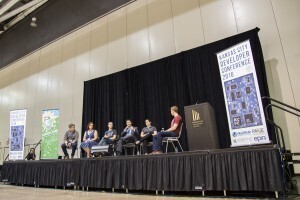
What’s the most-asked question at the Kansas City Developers Conference? According to conference organizers, it’s “What should I be learning now?” To help answer the query, Startland News curated a panel of experienced software developers, moderated by editor-in-chief Bobby Burch. Among many nuggets of information from panelists, priority No. 1 needs to be Javascript, according…

Gallery: The Kansas City Developers Conference
More than 1,500 developers from around the Midwest converged on the City of Fountains Thursday as part of the Kansas City Developers Conference Center. Now in its eighth year, the KCDC has steadily grown over the years into one of the area’s largest techie gatherings. With a focus on building the Kansas City community, the conference features…

KC Social Innovation Center kicks off with $100K
Education in Kansas City is receiving an innovative boost. Village Capital, a global entrepreneurial development organization, recently announced that Kansas City will be one of its pioneer “VilCap communities.” The KC Social Innovation Center, or KCSIC, will manage Kansas City’s VilCap community. The organization — launched by Think Big Partners in May — focuses on education…

How local founders manage startup disappointment
Editor’s note: The opinions expressed in this commentary are the author’s alone. Fail fast. Fail forward. Startup failure may be educational, but it’s a lesson delivered by a very expensive teacher who exacts a steep emotional and economic price. The space between the Big Success and the Big Failure is where entrepreneurs live and…