

The WTF Series: Artificial Intelligence
October 27, 2015 | Ben Kittrell

On a daily basis, Ben Kittrell translates the jargon-filled world of technology for clients of his tech consultancy. The Words that Frustrate (WTF) series aims to offer readers some clarity in an industry dominated by techies’ confusing argot.
Last week I went to my favorite event of the year, Compute Midwest.

Ben Kittrell
The last four years of this conference has brought world-class speakers in technology and other fields to Kansas City to talk about innovation and the future. Throughout this year’s talks the topic of artificial intelligence, or “AI,”seemed to be a fairly common thread.
Most of us probably think of The Matrix, The Terminator or Ultron when we think of AI but the reality isn’t so scary. In fact there’s some level of it behind most of the software you use every day. GPS mapping, Apple’s Siri, Google and Facebook all use some type of AI to make predictions and bridge the gap between computers and humans.
“Expect to see an AI explosion over the next ten years. … Technology is improving at an exponential rate and before you know it, you’ll be talking to your phone, car, house and everything else.“
What is Artificial Intelligence?
The field actually goes back decades and covers many diverse sub-topics. At its root, the goal of AI is to make a computer behave more like a human brain. One example is natural language processing, which attempts to decode and understand a human’s voice. Using older, standard programming techniques, you would attempt to match pre-determined sounds with words. This would be far too cumbersome, and it would not account for subtleties like dialect, accent and mispronunciation.
Natural language processors like Siri are based on scientific research that studies how the brain processes and stores sound. The software itself can’t do very much at all without teaching it, much like you would teach a child. The more it learns, the better it can understand language.
Should I be worried?
Nobody can predict the future, but other than Sci-Fi movies there’s nothing to indicate that we should be concerned about AI. Most researchers aren’t actually interested in recreating a complete human brain. Why would we need that? We’ve got plenty of those already. To be helpful, AI may need to understand human traits like emotion, but it does not and should not exhibit them.
As long as we don’t create a giant titanium humanoid robot that has access to heavy firepower and a figurative chip programmed on his shoulder, we should be just fine.
What about the future?
Get enough whiskey in me and I’ll go on for hours about pseudo-scientific — almost cultish — theories about what lies ahead, but I’ll try to keep it pretty straightforward.
Expect to see an AI explosion over the next ten years. IBM Watson, the computer that won Jeopardy, is already aiding professionals all over the world. Watson is currently helping oncologists research potential treatments for patients. Also, through a program called Watson Chef, it has analyzed recipes from culinary institutes and figured out what tastes good together. Now it can synthesize tasty combinations like mushrooms and cherries, something most humans wouldn’t think of.
The technology is improving at an exponential rate and before you know it, you’ll be talking to your phone, car, house and everything else. But it won’t just be “Set an appointment reminder.” It will be a true back and forth. Your AI will understand who you are, your interests and your pet peeves. It will ask you clarifying questions like “Are you sure you want to set an appointment for 7 a.m. on Wednesday? The Royals are going to win Game 1 Tuesday night.”
Ben Kittrell is the co-founder of Doodlekit and an advisor for startups and small businesses. Kittrell also is host of Spare Room Radio, a podcast that features Kansas City entrepreneurs.


2015 Startups to Watch
stats here
Related Posts on Startland News

OP prescription software firm lands $2.7M
An Overland Park software company recently wrapped up a hefty funding round, according to its founder and CEO. Rx Savings Solutions, a business that works with other companies to manage employees’ monthly medications, secured $2.7 million in funding. Kansas City investors Dan Henry, CEO of NetSpend Corp., and Jeffrey Brown, chairman at StoreFinancial, led the…
LaunchKC winners reflect on ‘massive opportunity’
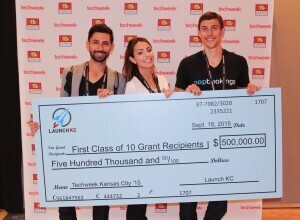
Once the dust settled on the LaunchKC grant recipient announcement, the champagne bottles popped. Founders from the 10 winning companies — parred down from a list of 500 — had reason to celebrate Friday afternoon between the promise of $50,000 and the chance to land some office space. Of the 10 recipient companies, six come…

Set your watch: 90 seconds with local innovators, entrepreneurs
It’s coming! Set your watch as we team up with FlatlandKC to highlight Kansas City’s innovators and entrepreneurs, all in 90 seconds. “90 on the Clock” premieres Wednesday, Sept. 23, with Callie England, founder of Rawxies, as she talks about her East Bottoms business and its raw, vegan, and gluten- and soy-free treats. The five-part series continues each Wednesday as the 90-second…
Meet the 10 startup winners of LaunchKC’s $50K
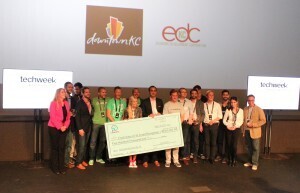
LaunchKC announced the winners of 10, $50,000 grants Friday during a celebration at the inaugural Techweek Kansas City conference. More than 40 judges evaluated pitches from 20 contest finalists, who pitched their companies Friday morning at Union Station before a crowd of about 100 people. LaunchKC kicked off in February and nabbed nearly 500 total applicants…