

7 endearing facts about the founder of H&R Block
October 29, 2015 | Bobby Burch
Update: Henry Bloch passed away April 23, 2019. Click here to read business leaders’ salutes to the Kansas City icon.
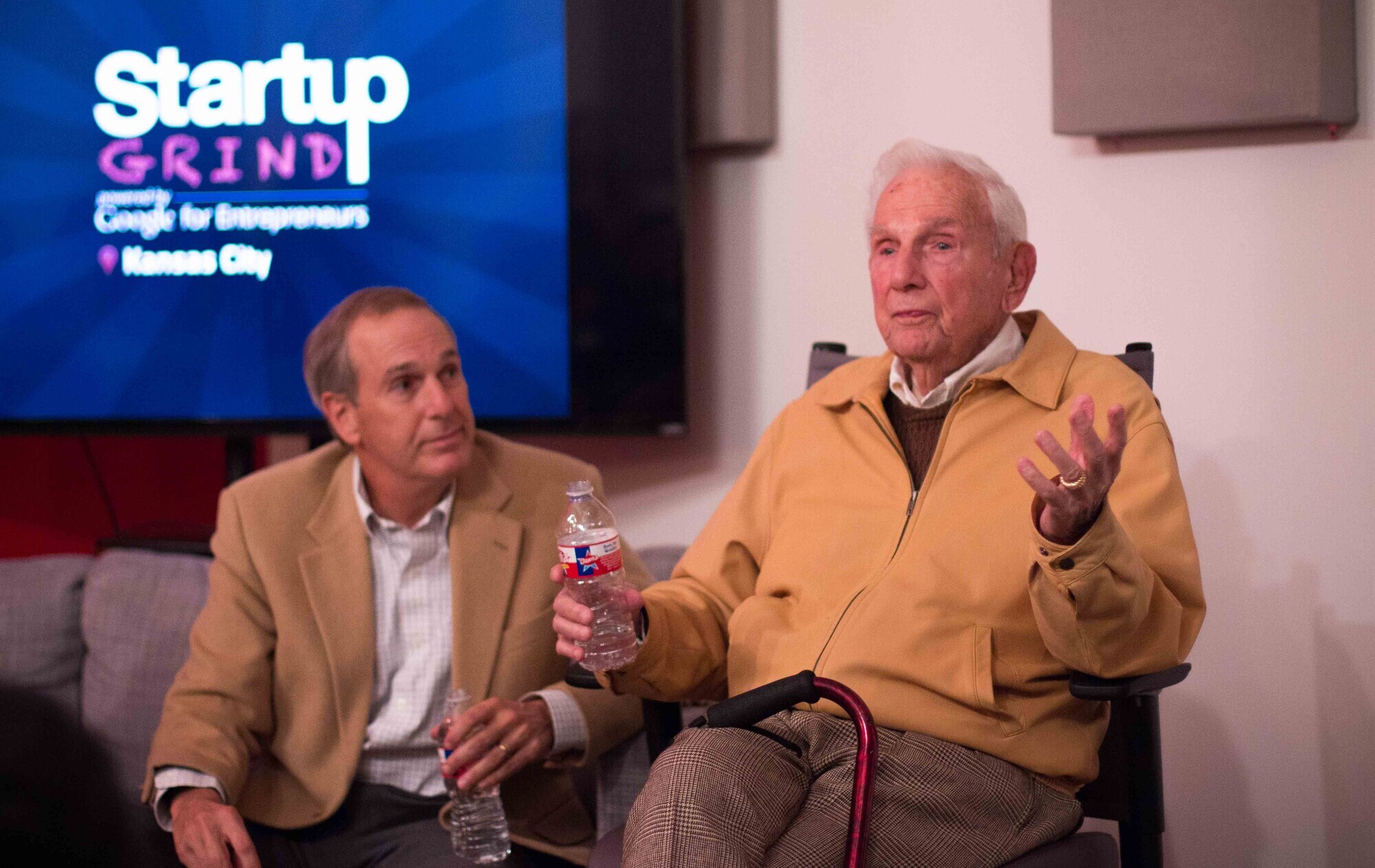
Henry Bloch, the co-founder and former CEO of tax prep giant H&R Block, recently spoke with a small group of Kansas City entrepreneurs during Startup Grind.
The 93-year-old Kansas City legend shared an array of personal and business stories, including many facts that may surprise you. Here are seven tidbits from the talk.
1) Henry Bloch is a bit of a momma’s boy.
At the encouragement of his mother, Bloch went into business with his brother, Dick (Richard). In 1946, the two started their first firm, the United Business Company, which eventually would grow to become H&R Block. Like with most siblings, fights between the two weren’t uncommon, which is when momma Bloch stepped in.
“Without the people that live in Kansas City, there’d be no H&R Block.” – Henry Bloch
“We’d argue once in a while and my mother would say ‘You come right over.’ She’d find out because one of the wives would call her,” Bloch said. “She was the boss. She’d sit us down and say ‘Henry what’s going on? Dick what’s going on? What’s your side? And what’s yours?’ She was the mediator. We’d go back and forth and then it was fine.’”
2) He somehow survived WWII to start H&R Block.
Bloch joined the Army Air Corps during WWII as a navigator of B-17 bombers. His plane, “Heaven Can Wait,” flew 31 combat missions over Germany, including three over Berlin.
Bombers in WWII faced staggering casualties — more than 4,000 planes were lost out of about 10,600 missions. It’s remarkable that Bloch survived at all, let alone lived to create the largest consumer tax preparation company in the U.S. He was awarded the Air Medal and three Oak Leaf Clusters.
3) Bloch regrets taking H&R Block public.
Bloch said that in the 1960s, going public was vogue. He was following the trend of the day by going public. He said that it was a challenge to maintain family values in such a large enterprise.
“When we went public, it was the thing to do,” Bloch said. “We didn’t need the money. If I look back on it, it was a terrible mistake. If I had to do it all over again, I would have kept the whole thing (private). … Your life is an open book (as a public company). It’s wide open. We thought a while back about going private, but it’s very expensive to buy all of the stock back.”
4) H&R Block was born out of a cubicle in what’s now a bar.
Paying $50 a month for rent, Bloch and his brother started their small business services firm, United Business Company, in a single cubicle in what’s now Harling’s Upstairs at 39th and Main streets.
After publishing two ads in The Kansas City Star, the cramped office quickly filled when the brothers first publicly offered tax prep services. There’s now a plaque in the sidewalk outside the bar commemorating the former office space.
5) Bloch experienced a lot of failure.
At United Business Company, Bloch offered 50 services to small businesses, including everything from window decorating to secretarial help.
The Kansas City market didn’t give a hoot about 49 of those services, Bloch said, and only wanted the company’s bookkeeping services. So Bloch obliged his clients and managed their books before trying the wild idea of handling people’s income taxes. At the time, Bloch only offered tax prep as a courtesy to friends and family.
6) He loves Kansas City — a lot.
Bloch said that without Kansas City, H&R Block wouldn’t have been possible.
The Marion and Henry Bloch Foundation is a way to give back to Kansas Citians what they gave to him. Its primary focuses are support of the UMKC Henry W. Bloch School of Management, the Nelson-Atkins Museum of Art and St. Luke’s Hospital.
“Without the people that live in Kansas City, there’d be no H&R Block,” Bloch said. “If we had run those ads and nobody answered, we would be nothing. I feel like we owe the people of Kansas City a debt.”
7) H&R Block didn’t raise prices for more than a decade.
Despite manhandling the tax prep market, Bloch refused to raise H&R Block’s prices for 12 years after the company’s founding in 1955.
And when Bloch decided to hike up the tax prep prices from $5, he bumped it up to $6. Bloch said the company’s low prices allowed it to grow a massive consumer base. He was more concerned with offering quality service than making money.
“We just wanted to satisfy people,” Bloch said. “We never tried to make the most money, we just wanted them satisfied and to keep them coming back. Your customer is always right, even when he’s wrong. In his mind, he’s right.”


2015 Startups to Watch
stats here
Related Posts on Startland News

Big wins up the odds: KC’s standing among Midwest peer cities rises in new M25 ranking
Headline-grabbing success stories and newly boosted state funding for startup support are a powerful combination, said Victor Gutwein, detailing Kansas City’s higher 2022 spot on M25’s annual ranking of Midwest startup cities. Kansas City rose to No. 11 of 59 in the deep dive report — which explores how micro-environments in the Midwest are performing…

They told him to build it in California; this agtech founder came back to Kansas instead
When it came time to plant Trevor McKeeman’s agtech startup, he refused to farm the groundbreaking company’s future out to the coasts — specifically California where potential funders said he could find “money and talent.” “I was actually in Boston at the time,” explained McKeeman, founder and CEO of HitchPin, a digital marketplace for farmers…

Stream smarter, safer: Former Cisco engineer aims to replace Zoom as top video conferencing platform
Kenneth Yancy has been live streaming since the early 2000s — a time when not many were interested in the technology, he said. But 20 years later, a virtual-hybrid work model featuring video conferencing is the norm. “In 2001, I was working for Cisco as an engineer. My team and I built the first live…

‘Fan favorite’ among KC startups joining Wichita cohort; the prize: a playbook for reaching corporate customers
Startland News’ Startup Road Trip series explores innovative and uncommon ideas finding success in rural America and Midwestern startup hubs outside the Kansas City metro. This series is possible thanks to the Ewing Marion Kauffman Foundation, which leads a collaborative, nationwide effort to identify and remove large and small barriers to new business creation. WICHITA…