

7 endearing facts about the founder of H&R Block
October 29, 2015 | Bobby Burch
Update: Henry Bloch passed away April 23, 2019. Click here to read business leaders’ salutes to the Kansas City icon.
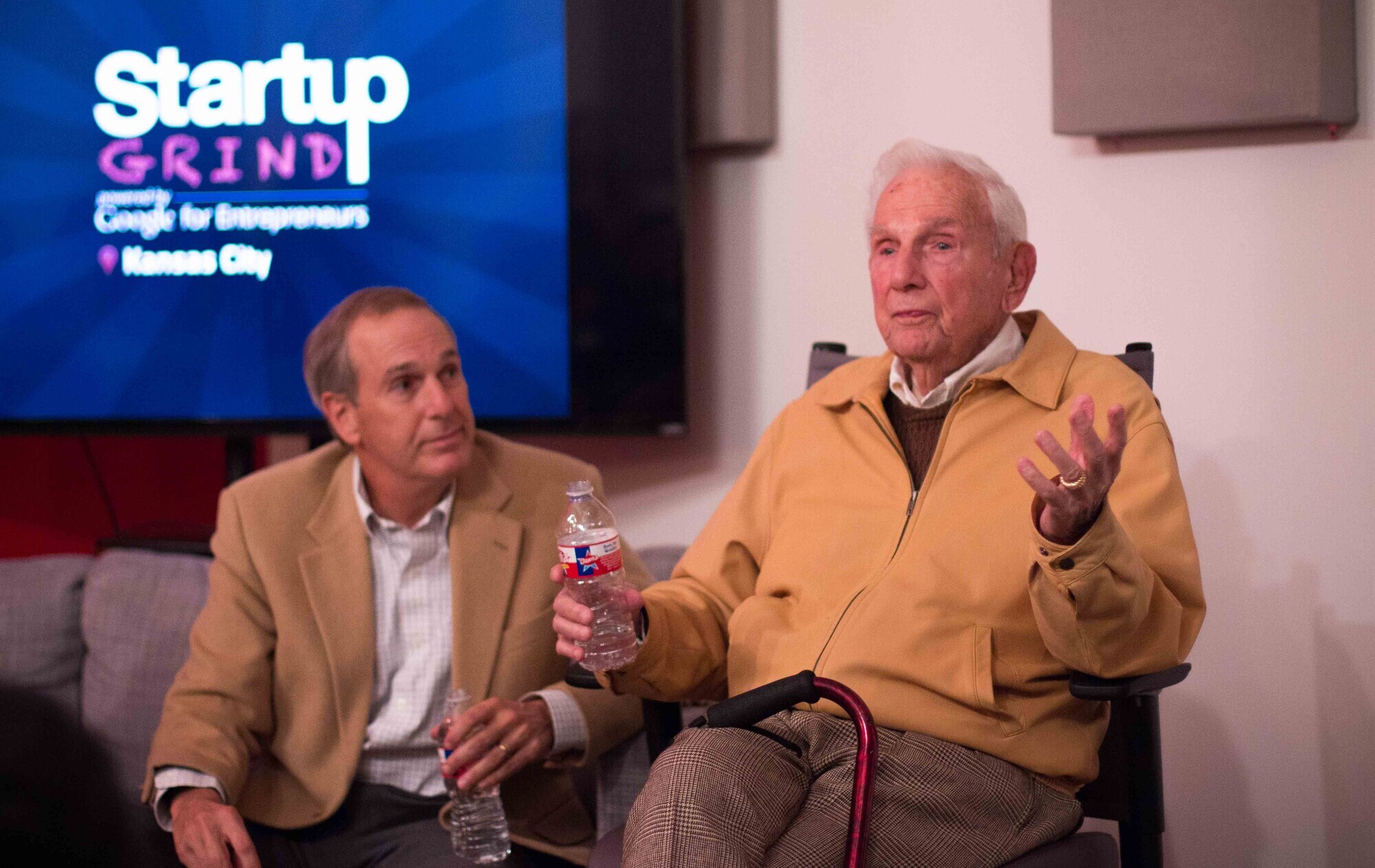
Henry Bloch, the co-founder and former CEO of tax prep giant H&R Block, recently spoke with a small group of Kansas City entrepreneurs during Startup Grind.
The 93-year-old Kansas City legend shared an array of personal and business stories, including many facts that may surprise you. Here are seven tidbits from the talk.
1) Henry Bloch is a bit of a momma’s boy.
At the encouragement of his mother, Bloch went into business with his brother, Dick (Richard). In 1946, the two started their first firm, the United Business Company, which eventually would grow to become H&R Block. Like with most siblings, fights between the two weren’t uncommon, which is when momma Bloch stepped in.
“Without the people that live in Kansas City, there’d be no H&R Block.” – Henry Bloch
“We’d argue once in a while and my mother would say ‘You come right over.’ She’d find out because one of the wives would call her,” Bloch said. “She was the boss. She’d sit us down and say ‘Henry what’s going on? Dick what’s going on? What’s your side? And what’s yours?’ She was the mediator. We’d go back and forth and then it was fine.’”
2) He somehow survived WWII to start H&R Block.
Bloch joined the Army Air Corps during WWII as a navigator of B-17 bombers. His plane, “Heaven Can Wait,” flew 31 combat missions over Germany, including three over Berlin.
Bombers in WWII faced staggering casualties — more than 4,000 planes were lost out of about 10,600 missions. It’s remarkable that Bloch survived at all, let alone lived to create the largest consumer tax preparation company in the U.S. He was awarded the Air Medal and three Oak Leaf Clusters.
3) Bloch regrets taking H&R Block public.
Bloch said that in the 1960s, going public was vogue. He was following the trend of the day by going public. He said that it was a challenge to maintain family values in such a large enterprise.
“When we went public, it was the thing to do,” Bloch said. “We didn’t need the money. If I look back on it, it was a terrible mistake. If I had to do it all over again, I would have kept the whole thing (private). … Your life is an open book (as a public company). It’s wide open. We thought a while back about going private, but it’s very expensive to buy all of the stock back.”
4) H&R Block was born out of a cubicle in what’s now a bar.
Paying $50 a month for rent, Bloch and his brother started their small business services firm, United Business Company, in a single cubicle in what’s now Harling’s Upstairs at 39th and Main streets.
After publishing two ads in The Kansas City Star, the cramped office quickly filled when the brothers first publicly offered tax prep services. There’s now a plaque in the sidewalk outside the bar commemorating the former office space.
5) Bloch experienced a lot of failure.
At United Business Company, Bloch offered 50 services to small businesses, including everything from window decorating to secretarial help.
The Kansas City market didn’t give a hoot about 49 of those services, Bloch said, and only wanted the company’s bookkeeping services. So Bloch obliged his clients and managed their books before trying the wild idea of handling people’s income taxes. At the time, Bloch only offered tax prep as a courtesy to friends and family.
6) He loves Kansas City — a lot.
Bloch said that without Kansas City, H&R Block wouldn’t have been possible.
The Marion and Henry Bloch Foundation is a way to give back to Kansas Citians what they gave to him. Its primary focuses are support of the UMKC Henry W. Bloch School of Management, the Nelson-Atkins Museum of Art and St. Luke’s Hospital.
“Without the people that live in Kansas City, there’d be no H&R Block,” Bloch said. “If we had run those ads and nobody answered, we would be nothing. I feel like we owe the people of Kansas City a debt.”
7) H&R Block didn’t raise prices for more than a decade.
Despite manhandling the tax prep market, Bloch refused to raise H&R Block’s prices for 12 years after the company’s founding in 1955.
And when Bloch decided to hike up the tax prep prices from $5, he bumped it up to $6. Bloch said the company’s low prices allowed it to grow a massive consumer base. He was more concerned with offering quality service than making money.
“We just wanted to satisfy people,” Bloch said. “We never tried to make the most money, we just wanted them satisfied and to keep them coming back. Your customer is always right, even when he’s wrong. In his mind, he’s right.”


2015 Startups to Watch
stats here
Related Posts on Startland News

Fans packed Chiefs rally, one didn’t come home; citywide trauma from shooting won’t heal quickly, grief expert says
Trauma and grief come in waves, said Mindy Corporon, foreshadowing a long road ahead for those impacted — directly and indirectly — by Wednesday’s shooting near the Kansas City Chiefs’ Super Bowl victory rally. Like many across the region, Corporon, co-founder of the Merriam-based nonprofit SevenDays foundation, was watching the Chiefs parade on TV when…

Black leaders need to earn a ‘thriving wage’ before they can help others; an Evergy-backed cohort could help them ascend
A new program backed by entrepreneur support groups and Evergy aims to raise household income by at least 30 percent for participating Black professionals, nonprofit founders, and entrepreneurs, said Craig Moore II. “The ultimate goal is making sure you’re a leader who can do more than show up and talk about community — you have the…

Last to know, first to go: ‘Out of touch’ ballpark plan leaves Crossroads small biz owners feeling betrayed
Unlike many of her Crossroads neighbors — hoping to draw in crowds of football fans still riding high from Kansas City’s Super Bowl win — Jill Cockson’s business wasn’t open during Wednesday’s Chiefs victory parade. Candidly, jersey-clad sports enthusiasts aren’t really within her typical customer profile, the James Beard-nominated owner of Chartreuse Saloon said, and…

Royals want Crossroads ballpark open by 2028, calling up ‘generational’ impact on newly linked arts district, downtown
A late-to-the-game East Crossroads site is expected to take shape as the new home of the Kansas City Royals if voters approve the extension of a stadium sales tax that would help support the $2 billion downtown ballpark project. Ending months of speculation, majority owner John Sherman and team officials announced on Tuesday the ball…