

7 endearing facts about the founder of H&R Block
October 29, 2015 | Bobby Burch
Update: Henry Bloch passed away April 23, 2019. Click here to read business leaders’ salutes to the Kansas City icon.
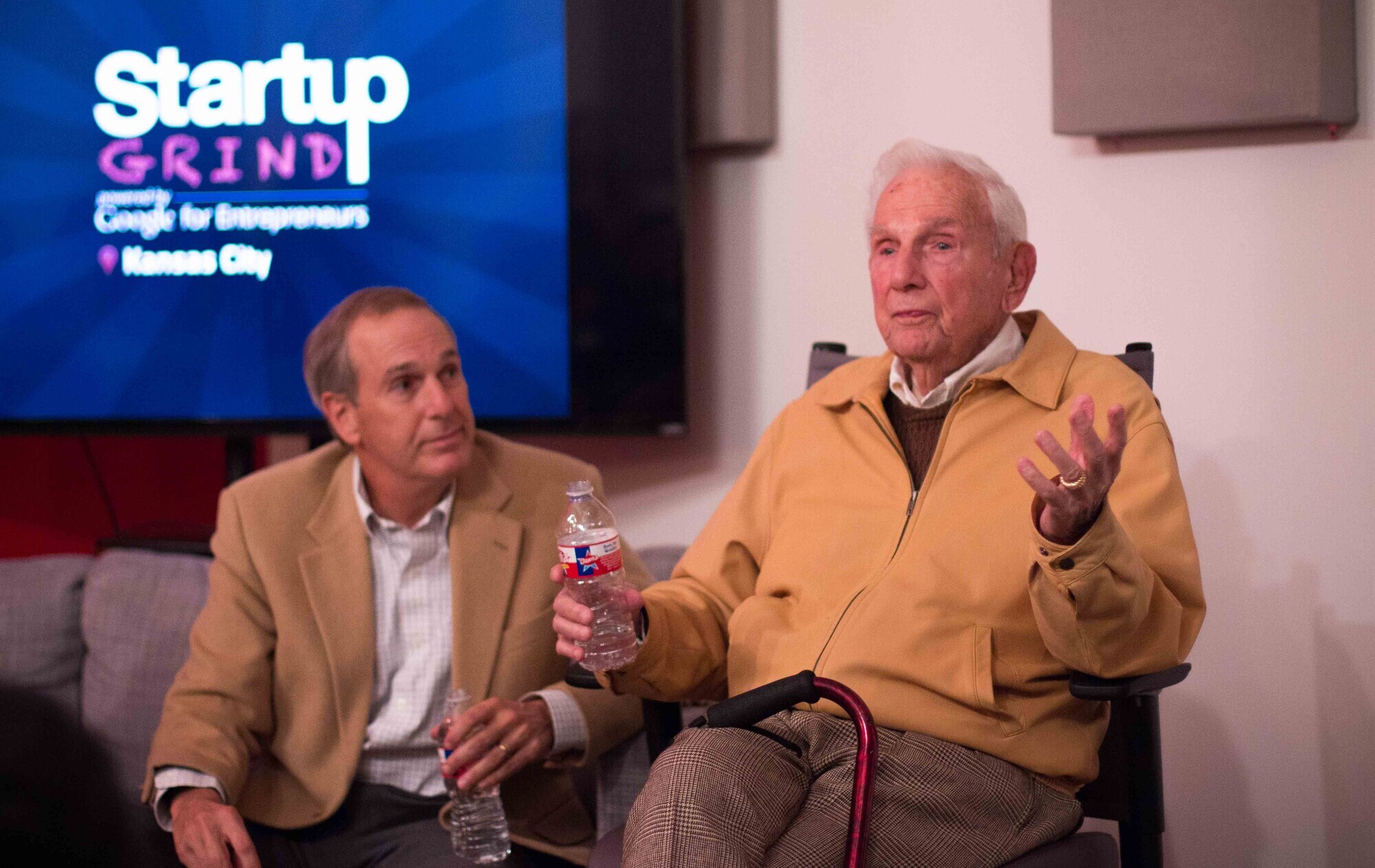
Henry Bloch, the co-founder and former CEO of tax prep giant H&R Block, recently spoke with a small group of Kansas City entrepreneurs during Startup Grind.
The 93-year-old Kansas City legend shared an array of personal and business stories, including many facts that may surprise you. Here are seven tidbits from the talk.
1) Henry Bloch is a bit of a momma’s boy.
At the encouragement of his mother, Bloch went into business with his brother, Dick (Richard). In 1946, the two started their first firm, the United Business Company, which eventually would grow to become H&R Block. Like with most siblings, fights between the two weren’t uncommon, which is when momma Bloch stepped in.
“Without the people that live in Kansas City, there’d be no H&R Block.” – Henry Bloch
“We’d argue once in a while and my mother would say ‘You come right over.’ She’d find out because one of the wives would call her,” Bloch said. “She was the boss. She’d sit us down and say ‘Henry what’s going on? Dick what’s going on? What’s your side? And what’s yours?’ She was the mediator. We’d go back and forth and then it was fine.’”
2) He somehow survived WWII to start H&R Block.
Bloch joined the Army Air Corps during WWII as a navigator of B-17 bombers. His plane, “Heaven Can Wait,” flew 31 combat missions over Germany, including three over Berlin.
Bombers in WWII faced staggering casualties — more than 4,000 planes were lost out of about 10,600 missions. It’s remarkable that Bloch survived at all, let alone lived to create the largest consumer tax preparation company in the U.S. He was awarded the Air Medal and three Oak Leaf Clusters.
3) Bloch regrets taking H&R Block public.
Bloch said that in the 1960s, going public was vogue. He was following the trend of the day by going public. He said that it was a challenge to maintain family values in such a large enterprise.
“When we went public, it was the thing to do,” Bloch said. “We didn’t need the money. If I look back on it, it was a terrible mistake. If I had to do it all over again, I would have kept the whole thing (private). … Your life is an open book (as a public company). It’s wide open. We thought a while back about going private, but it’s very expensive to buy all of the stock back.”
4) H&R Block was born out of a cubicle in what’s now a bar.
Paying $50 a month for rent, Bloch and his brother started their small business services firm, United Business Company, in a single cubicle in what’s now Harling’s Upstairs at 39th and Main streets.
After publishing two ads in The Kansas City Star, the cramped office quickly filled when the brothers first publicly offered tax prep services. There’s now a plaque in the sidewalk outside the bar commemorating the former office space.
5) Bloch experienced a lot of failure.
At United Business Company, Bloch offered 50 services to small businesses, including everything from window decorating to secretarial help.
The Kansas City market didn’t give a hoot about 49 of those services, Bloch said, and only wanted the company’s bookkeeping services. So Bloch obliged his clients and managed their books before trying the wild idea of handling people’s income taxes. At the time, Bloch only offered tax prep as a courtesy to friends and family.
6) He loves Kansas City — a lot.
Bloch said that without Kansas City, H&R Block wouldn’t have been possible.
The Marion and Henry Bloch Foundation is a way to give back to Kansas Citians what they gave to him. Its primary focuses are support of the UMKC Henry W. Bloch School of Management, the Nelson-Atkins Museum of Art and St. Luke’s Hospital.
“Without the people that live in Kansas City, there’d be no H&R Block,” Bloch said. “If we had run those ads and nobody answered, we would be nothing. I feel like we owe the people of Kansas City a debt.”
7) H&R Block didn’t raise prices for more than a decade.
Despite manhandling the tax prep market, Bloch refused to raise H&R Block’s prices for 12 years after the company’s founding in 1955.
And when Bloch decided to hike up the tax prep prices from $5, he bumped it up to $6. Bloch said the company’s low prices allowed it to grow a massive consumer base. He was more concerned with offering quality service than making money.
“We just wanted to satisfy people,” Bloch said. “We never tried to make the most money, we just wanted them satisfied and to keep them coming back. Your customer is always right, even when he’s wrong. In his mind, he’s right.”


2015 Startups to Watch
stats here
Related Posts on Startland News

A night for knock-outs: Pipeline gala adds glitz to the hard-fought battles of entrepreneurship (Photos)
Midwest means resilience, Melissa Vincent told a black-tie crowd of entrepreneurs gathered Friday evening in the Grand Hall at Union Station, ultimately sharing the stage with not one, but two Innovator of the Year honorees. “When they get knocked down, knocked out, they get back up and they stay in the ring,” continued Vincent, CEO…

Topeka startup hub launches diverse entrepreneur community (with fintech help on loan from KC’s Cyphr)
TOPEKA — An initiative aimed at boosting early to mid-stage entrepreneur development in the heart of Kansas launched Friday, said Michael Odupitan, noting the effort by Topeka-based Omni Circle to redefine the startup journey — and who’s allowed to join it — comes with a Kansas City assist. “Omni’s goal is to unite and strengthen…

How an east side community garden gives Ruby Jean’s namesake her storybook ending as juice brand goes national with Whole Foods
While market expansion for Ruby Jean’s harvests the big headlines, Chris Goode’s grassroots health initiatives are staying firmly planted in Kansas City’s east side, the juice brand’s founder said — announcing plans to launch a one-acre community garden this spring on Wabash Avenue. Budding out just blocks from where Goode grew up, the Ruby Jean’s…

Kauffman-backed tech coalition gains runway (and funding) to help fill KC’s talent pipeline, leader says
A new talent-focused coalition led by the KC Tech Council envisions a reality where all of Kansas City’s tech jobs can be filled by Kansas City, said Kara Lowe, unveiling new details of an initiative made possible by the Kauffman Foundation’s new “Collective Impact” funding pathway. KC Tech Council on Friday publicly announced its employer-led…