

Meet KC’s Cisco Smart City leaders
August 7, 2015 | Bobby Burch

Kansas City Mayor Sly James announced on Friday 11 people to serve on the city’s Smart City Advisory Board.
With a mixture of corporate, non-profit and civic experience, the board will manage and guide policies for Kansas City’s public-private Smart City project. Announced in the summer of 2014, the project will turn downtown into a lab of connectivity with corporate partners such as Sprint and Cisco.
“This advisory board is charged with guiding a very unique and innovative project that, once again, makes Kansas City a leader in technology,” James said in a release “We have selected individuals who have the skills, expertise and leadership to make this project the success we envision.”
Tom Gerend, Executive Director, Kansas City Streetcar Authority, will serve as chair of the board. Mark Irvin, founder of non-profit Social Impact Technology and Engineering, will serve as vice chair.
The other board members are:
- Kevin McManus, Sixth District City Councilman.
- Mike Grigsby, Director, Information Services, Kansas City Police Department.
- Cady Bean-Smith, Associate Director, Experience Design, Moonshot Lab at Barkley.
- Chuck Miller, Senior Project Manager, HNTB Corporation.
- Andy Shively, Deputy Director or engineering officer, Water Services Department, City of Kansas City.
- Sherri McIntyre, Director, Public Works Department, City of Kansas City.
- Lee Hinkle, IT Supervisor or Business Solutions Manager, General Services Department, City of Kansas City.
- Wes Minder, P.E., Engineer Section Head, Infrastructure Specialist, City Manager’s Office, City of Kansas City.
- Drew Solomon, Vice President, Business Development, Economic Development Corporation of Kansas City.
The board will recommend steps on how to expand the Smart City portion of the city’s technology plan, or KC Digital Roadmap. In addition, it will establish metrics for evaluating the implementation of Smart City technology and applications that create efficiencies for the city, save it money, generate new revenue and improve citizens’ lives.
Kansas City signed an agreement with Sprint and Cisco in June to create the largest smart city in North America. Sprint will be building a network of connectivity worth up to $7 million dollars while Cisco will be providing smart city infrastructure worth upwards of $5 million. The Kansas City Council approved in April roughly $3.7 million to spend on the project, bringing the total cost of the Smart City effort to more than $15.7 million.
James previously said that the project is an open invitation to innovators from around the world to test various technologies on Kansas City’s smart city framework. James previously challenged entrepreneurs in Kansas City to develop smart city technology that will save the city and its taxpayers money, including efficiencies for Kansas City’s troubled sewer system.
“This is an invitation to the entire world to come to Kansas City to see what we’re doing, participate in it, bring ideas and test them out,” James said previously. “We expect to have more people from around the country and world for cultural tourism to take advantage of all the things that we have to offer, and to bring their knowledge, ideas and thoughts on innovation to Kansas City to play with what we’ve got so we can build on what they bring to us and continue to build our infrastructure. This sets us apart from other cities.”
Kansas City hopes the project will be complete in conjunction with its streetcar line and ahead of the 2016 Men’s Big 12 Basketball Tournament in March. Kansas City began soliciting nominations to serve on the Smart City Advisory Board in May.
Kansas City announced the smart city project in the summer of 2014. The city already has developed a prototype of digital kiosks that will be placed along the streetcar line in downtown Kansas City. The city expects more than 20 digital kiosks that will provide information on city services and real time information from smart city sensors.
Kansas City has installed smart lighting in its downtown with which it expects to save millions of dollars. The city will spend $1.5 million on smart traffic lighting throughout downtown provided by Lenexa-based Rhythm Engineering.

Featured Business

2015 Startups to Watch
stats here
Related Posts on Startland News
A chat with Tinder co-founder Jonathan Badeen
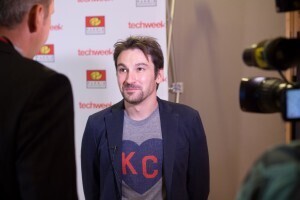
Tinder co-founder Jonathan Badeen’s roots run deep in the Kansas City area. A native of Leawood and a graduate of Barstow High School, Badeen stopped by Techweek Kansas City Thursday to discuss the popular app — Tinder — that he helped create. Badeen, who’s also a fan of the University of Kansas Jayhawks and Kansas…
Nixon announces $1.2M in grants to KC programs
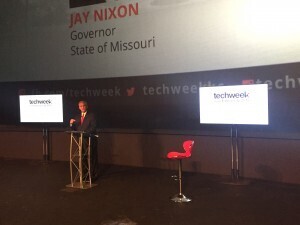
Missouri Gov. Jay Nixon made an appearance at Techweek Thursday to announce $1.19 million in grants to three Kansas City organizations through the Missouri Technology Corporation. Of the $1.19 million, $565,000 is going to LaunchKC, $500,000 is going to the Digital Sandbox KC and $125,000 is going to the Independence Economic Development Council. The 2016 Missouri…

One-on-one with Square co-founder Jim McKelvey
Startland News reporter Ashley Jost sat down with Jim McKelvey, co-founder of Square and LaunchCode, during his visit to Techweek. Here’s a bit of the conversation. On Kansas City’s strengths as a tech hub … You’ve got the classic things – it’s mostly talent. Kansas City is a town that very few people want to…
Gallery: Techweek Kansas City expo
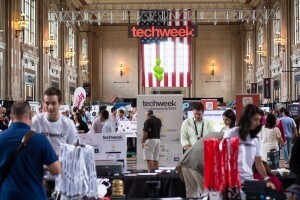
Hundreds of techies, innovators and entrepreneurs converged on Union Station on Thursday for Techweek’s expo. With startups and large corporations, the expo featured dozens of company’s technologies. Attendees at the inaugural Techweek Kansas City arrived to soak up their pitches. Below is a photo gallery from the event. Enjoy!