

Meet KC’s Cisco Smart City leaders
August 7, 2015 | Bobby Burch

Kansas City Mayor Sly James announced on Friday 11 people to serve on the city’s Smart City Advisory Board.
With a mixture of corporate, non-profit and civic experience, the board will manage and guide policies for Kansas City’s public-private Smart City project. Announced in the summer of 2014, the project will turn downtown into a lab of connectivity with corporate partners such as Sprint and Cisco.
“This advisory board is charged with guiding a very unique and innovative project that, once again, makes Kansas City a leader in technology,” James said in a release “We have selected individuals who have the skills, expertise and leadership to make this project the success we envision.”
Tom Gerend, Executive Director, Kansas City Streetcar Authority, will serve as chair of the board. Mark Irvin, founder of non-profit Social Impact Technology and Engineering, will serve as vice chair.
The other board members are:
- Kevin McManus, Sixth District City Councilman.
- Mike Grigsby, Director, Information Services, Kansas City Police Department.
- Cady Bean-Smith, Associate Director, Experience Design, Moonshot Lab at Barkley.
- Chuck Miller, Senior Project Manager, HNTB Corporation.
- Andy Shively, Deputy Director or engineering officer, Water Services Department, City of Kansas City.
- Sherri McIntyre, Director, Public Works Department, City of Kansas City.
- Lee Hinkle, IT Supervisor or Business Solutions Manager, General Services Department, City of Kansas City.
- Wes Minder, P.E., Engineer Section Head, Infrastructure Specialist, City Manager’s Office, City of Kansas City.
- Drew Solomon, Vice President, Business Development, Economic Development Corporation of Kansas City.
The board will recommend steps on how to expand the Smart City portion of the city’s technology plan, or KC Digital Roadmap. In addition, it will establish metrics for evaluating the implementation of Smart City technology and applications that create efficiencies for the city, save it money, generate new revenue and improve citizens’ lives.
Kansas City signed an agreement with Sprint and Cisco in June to create the largest smart city in North America. Sprint will be building a network of connectivity worth up to $7 million dollars while Cisco will be providing smart city infrastructure worth upwards of $5 million. The Kansas City Council approved in April roughly $3.7 million to spend on the project, bringing the total cost of the Smart City effort to more than $15.7 million.
James previously said that the project is an open invitation to innovators from around the world to test various technologies on Kansas City’s smart city framework. James previously challenged entrepreneurs in Kansas City to develop smart city technology that will save the city and its taxpayers money, including efficiencies for Kansas City’s troubled sewer system.
“This is an invitation to the entire world to come to Kansas City to see what we’re doing, participate in it, bring ideas and test them out,” James said previously. “We expect to have more people from around the country and world for cultural tourism to take advantage of all the things that we have to offer, and to bring their knowledge, ideas and thoughts on innovation to Kansas City to play with what we’ve got so we can build on what they bring to us and continue to build our infrastructure. This sets us apart from other cities.”
Kansas City hopes the project will be complete in conjunction with its streetcar line and ahead of the 2016 Men’s Big 12 Basketball Tournament in March. Kansas City began soliciting nominations to serve on the Smart City Advisory Board in May.
Kansas City announced the smart city project in the summer of 2014. The city already has developed a prototype of digital kiosks that will be placed along the streetcar line in downtown Kansas City. The city expects more than 20 digital kiosks that will provide information on city services and real time information from smart city sensors.
Kansas City has installed smart lighting in its downtown with which it expects to save millions of dollars. The city will spend $1.5 million on smart traffic lighting throughout downtown provided by Lenexa-based Rhythm Engineering.

Featured Business

2015 Startups to Watch
stats here
Related Posts on Startland News

Bringing grub to KC food deserts, Rollin’ Grocer to expand impact after contest win
While he takes pride in his roots, Priest Hughes said it saddens him to see a staple of life — fresh food — become so difficult to attain in parts of Kansas City. Over the course of a decade, Hughes has noticed several grocery stores in his neighborhood close at an alarming rate. Purchasing fresh,…
Truck-sharing app Bungii hauling early success, eyeing expansion
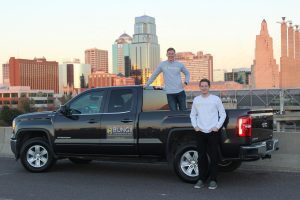
Less than a year after its launch, Kansas City-based truck-sharing app Bungii is gaining significant traction. In addition to expanding its platform from only Kansas City to include Lawrence, Bungii has tapped hundreds of users that temporarily need a truck to haul their stuff. Led by two recent college graduates, Ben Jackson and Harrison Proffitt, Bungii’s on-demand…

Kauffman Foundation: National startup activity continues to improve
National startup activity grew slightly in 2016, a consecutive three-year improvement that reached pre-Great Recession levels, according to the Ewing Marion Kauffman Foundation. However, in the long-term view startup activity is still in decline when compared to the 1980s, the 2017 Kauffman Index of Startup Activity found. Victor Hwang, vice president of entrepreneurship at the…

Kauffman report: KC startup momentum builds for 3 years running, improves national rank
It’s not just a feeling. Momentum in Kansas City’s startup community continues to grow, according to new data from the Ewing Marion Kauffman Foundation. The Kauffman Index of Startup Activity found that for the third consecutive year, entrepreneurial activity in the Kansas City metro has grown. The index — which presents entrepreneurial trends nationally, at…