

Schukman: 5 ways to fuse a social mission in your company
June 8, 2015 | Josh Schukman

I’ve recently been exploring ways in which traditional companies have been retroactively becoming social entrepreneurs.

Josh Schukman
Recall from my last piece that social entrepreneurship is a businessperson that creates a profit and purpose-driven organization in which the business and social missions run in tandem. Our social mission, therefore, becomes a key component of our marketing, branding, and success metrics.
Interestingly, many large companies fit the first half of this definition, yet fall short on the latter by failing to tell the story of their social impact. Timberland, for example, is one of the greatest social entrepreneurs of our time. It outfits the uniforms for thousands of City Year corps members, pays their employees for 40 hours of volunteer time annually, and uses its product channels to empower sustainable suppliers. I’m sure you knew of Timberland, but did you know about its social mission? My guess is no.
Traditional companies can no longer afford not to have a story like Timberland’s. We know that 69 percent of millennial consumers want to know the story of businesses using their influence for social good. This, plus the fact that millenials have over $200 billion of buying power at their disposal, should be enough for any business to make the case for telling their cause-based story.
Here are five simple ways that an established company can become a retroactive social entrepreneur:
1.) Develop a social mission that aligns with your business mission. For example, Kansas City-based Affinity Enterprise Group specializes in supporting residential real estate investors, and a key part of their social mission is supporting efforts that restore blighted residential neighborhoods in cities like Detroit and Kansas City. Affinity’s charitable arm also works with River of Refuge, which provides free temporary housing to working families.
2.) Create a shared vision with your team. This begins at the very top. The leadership of an organization must be unified on the social mission that will be branded as part of its core business. That story and the strategies for telling it must be communicated to all teams within the organization so customers receive a consistent story that is apparent with every interaction. Patagonia is an exemplary retroactive social entrepreneur because they tell their story of sustainable fashion and corporate good at every touch point.
3.) Don’t bury your story. I can’t tell you how many times I go to an established company’s website, try to find more about its social mission, and have to dig through 20 pages before I find the soup kitchen it donates to. Don’t do this. Business is too powerful a force for good to not have its story more loudly told. Find a way to authentically tell the story of the good your company is creating for the world.
4.) Get ‘B-Corp.’ certified. B-Corp Certification is essentially the ‘certified organic’ sticker for social entrepreneurs. There are some big companies — Etsy, Ben & Jerry’s, Patagonia and Warby Parker to name a few — who’ve sought this out because it’s a trusted way of telling consumers that you’re part of a new class of business leader. It’s an affordable certification, and a quick way to show customers you take sustainability and social good seriously.
5.) Be authentic. While today’s consumers are more likely to remain loyal to a cause-driven brand, it is also true that the Internet allows us to spot fakers from a mile away. In this article, I’ve shared several compelling business reasons to become a retroactive social entrepreneur, but if you do this strictly for that purpose, you will not succeed in the long run. You must genuinely believe in the story you’re telling and the change you’re creating for it to resonate.
Josh is the founder of Social Change Nation, whose mission and passion is to provide startup social entrepreneurs with the best possible resources and tools for growing their ventures. He hosts a podcast featuring interviews with the world’s leading change agents and creates online content to help startups make a dollar AND a difference.

Featured Business

2015 Startups to Watch
stats here
Related Posts on Startland News

Gator, shrimp po’boys made to order, but Chef Esra has more than sandwiches plated for KC’s East Side
Opening a restaurant is just one phase of Esra England’s vision for Kansas City’s East Side. “I’m looking at a restaurant as an anchor point. Once you have a restaurant in the area, the community will be able to do different things like host meetings or classes — and hopefully, other businesses will start to…

KC investors power $4.5M round for OP startup poised to ‘unlock billions’ for its customers
Overland Park-based Realto has closed a $4.5 million funding round — thanks in large part to the backing of Kansas City-based investors. “We’re excited to welcome these important investors as we continue to expand our robust trading capabilities across the universe of alternative products,” Brian King, co-founder and CEO, said in announcement of the funding round which…
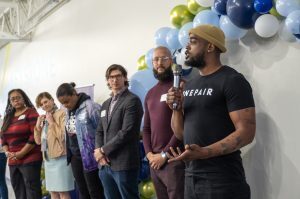
Meet seven founders hoping to pay their bills while changing the world; LaunchKC Social Venture Studio unveils first cohort
Dr. Shelley Cooper held back tears during a nearly four-hour introductory session to the new LaunchKC Social Venture Studio earlier this spring, she said. She’d already found her calling with Diversity Telehealth; now the startup founder had discovered truly mission-aligned colleagues within her cohort. “My focus has always been to bring healthcare to underserved areas…

Kauffman anchors $100M fund to boost minority-led ventures, access to capital
Editor’s note: The Ewing Marion Kauffman Foundation is a financial supporter of Startland News. A $100 million fund is expected to help close the wealth gap and better fund BIPOC-led ventures — thanks in part to Kansas City’s own Ewing Marion Kauffman Foundation. Joining forces with Living Cities, the Kauffman Foundation has committed $10 million to…