
Locally-made drone designed to save servicemen, civilians’ lives
February 19, 2016 | Kat Hungerford

An injured soldier is miles away from medical help, holed up in a countryside village.
Reaching him by medevac helicopter isn’t an option and ground Humvee ambulance will take hours. The soldier doesn’t have hours.
Usually, it’s a scenario that unfortunately results in death. But Pulse Aerospace, based in Lawrence, Kan., is working to change the frequency of such events with unmanned aircraft technology.
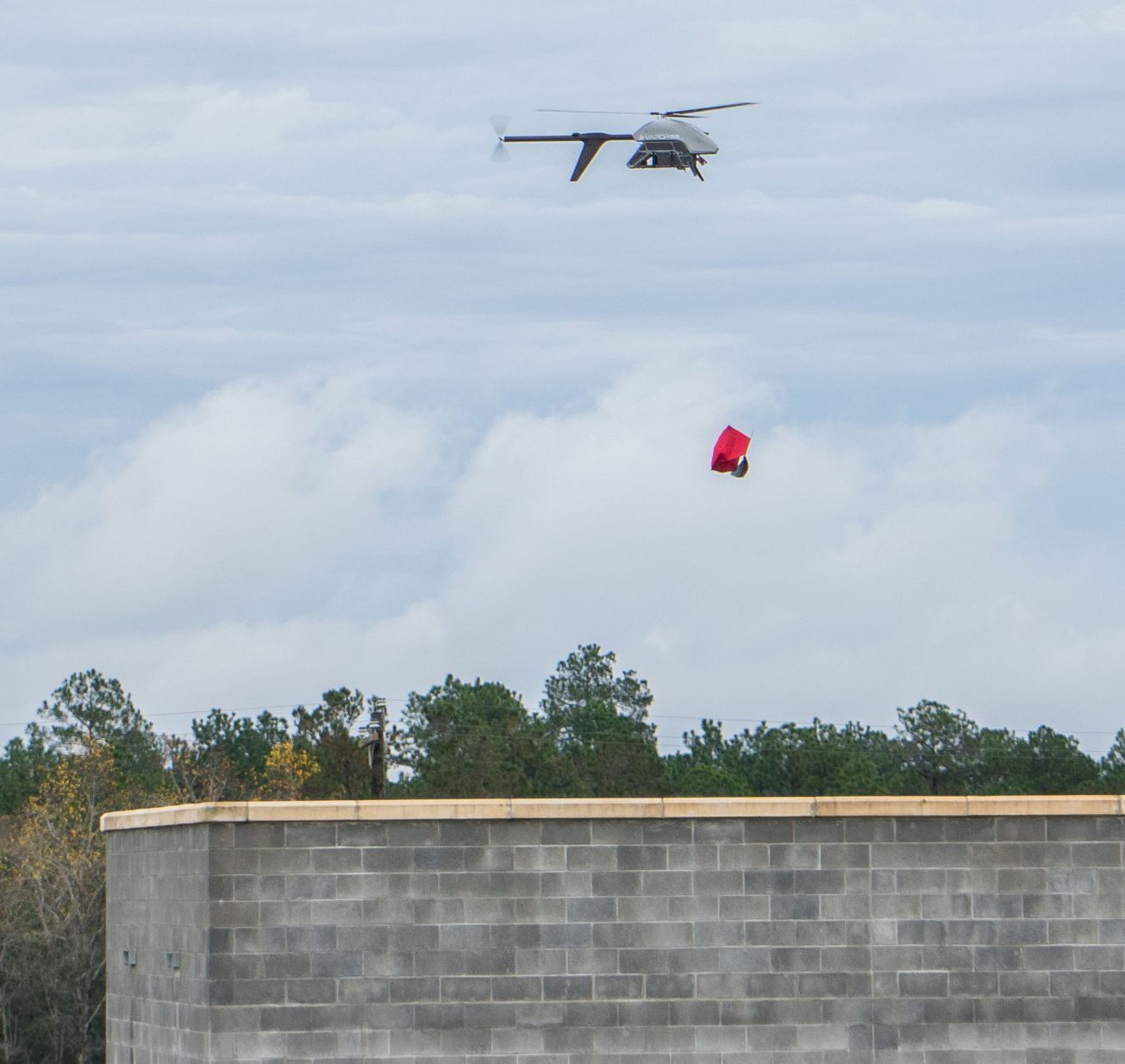
Pulse Aerospace’s Vapor 55 in action
Pulse, in partnership with Phoenix Air Group and Verizon, has developed an unmanned aerial system (UAS) designed to provide medical relief more than one hundred miles away from help. Founded in 2004, Pulse Aerospace develops flight systems and unmanned vehicles for military operations.
But the military is only the beginning of where the company has applied its new technology.
“We’re actually doing shark watch in Australia — we’re flying along the coast looking for sharks,” Pulse CEO Aaron Lessig said. “The market is massive. …We’re working on the military side, but we also do mining, geospatial and electrical utilities, too.”
Pulse began developing its medical UAS after a U.S. Army official approached the company in late 2014. Lt. Col. David King, also a professor of surgery at Harvard Medical School, was one of the first responders to the 2013 Boston Marathon bombing.
“What struck (Dr. King) was that if the victims hadn’t been so close to his hospital, then a lot of those people would have perished,” Lessig said. “The limited access that rural communities or soldiers in the field have to certain types of medical devices or blood really begs the question of how you can you get those materials to them faster so that it increases survivability.”
As a result of the meeting, Pulse modified its existing Vapor 55, a 55-pound, 6-foot-long aircraft with a seven-foot rotor blade. The UAS can deliver up to 12-pounds of medical supplies like blood, hemorrhage instruments and combat gauzes. For humanitarian applications, the aircraft can also transport medicine, water, and other supplies.
Once a pilot inputs a flight plan, she need only hit the launch button. The automated aircraft, which can travel up to 50 miles per hour, handles transportation and landing, Lessig said.
Lessig sees the technology as a giant step forward for emergency medical response.
“Less people can do more from a centralized location and be out of harm’s way while they do it,” Lessig said. “For the U.S. Military, you’ve got overtaxed medical personnel who now have the ability to serve more soldiers faster. You have the ability to customize material for soldiers in the field, so they don’t have to use the wrong medical devices to treat a downed soldier.”
Pulse partnered with Phoenix Air to pilot missions. Phoenix Air has performed more 40 flights with quarantined Ebola patients from Western Africa to Europe and the U.S.
Verizon entered the partnership to extend the program’s reach to situations where secure military communication systems aren’t available. A “Mobile Command Center” allows organizations to quickly plan and execute UAS missions, including in natural disaster situations and for relief efforts.
While Lessig expects the U.S. military to tap the UAS soon, he said commercial adoption will be slow due to Federal Aviation Administration regulations.
“The FAA has to allow special circumstances to exist for first responders,” Lessig said. “Right now, it requires that unmanned aircraft always be within site of the pilot operating the system. Then there’s working out where UAS are allowed to operate, and national airspace matters. The FAA has to align regulation to different capabilities so emergency responders can take advantage.”
Despite his belief in expanded regulations for drone operators, Lessig said the FAA should maintain stringent oversight.
“The controls on UAS need to be very strict because you don’t want operators or vehicles that aren’t capable,” he said. “That’s why we partnered with Phoenix Air. We brought them into this project because of their extreme level of professionalism. They’re an FAA-approved operator of our Vapor 55.”
Thanks to demand, the company plans to double its headcount in the next year and is hiring an additional 35 employees, Lessig said.

2016 Startups to Watch
stats here
Related Posts on Startland News
Blooom makes national TV debut
Overland Park-based financial tech firm Blooom hopes to seed new growth opportunities after a recent national TV appearance. Blooom CEO Chris Costello and President Greg Smith hopped onto Fox Business Tuesday to discuss 401(k) management and their company, which created an online 401(k) management tool that’s seen solid early traction. The tool uses a flower in various…
KC tech firms respond to ‘bleak’ millennial voter turnout
A meager millennial voter turnout in Kansas City’s recent municipal elections is compelling local organizations to combat apathy with technology. More Kansas Citians 90 and older cast ballots in the City of Fountain’s 2014 municipal elections than voters under 30, according to a study by Kansas City-based civic engagement company mySidewalk. A paltry 0.7 percent…
Lean Lab announces new, mature fellowship class
The Lean Lab, an education innovation incubator, announced its second cohort of fellows who hope to bring meaningful change to Kansas City education. In the 2015 class, 10 fellows with seven solutions for Kansas City’s urban education will be participating in the Lean Lab’s summer program. Fellows arrive at the program with ideas in various…
KC newbie Rex tops $1M in revenue, kicks off hiring
Surging growth at one of Kansas City’s newest startups is leading it to hire a staff six times its current size. Rex, an animal health tech company that recently graduated from the Techstars-led Sprint Accelerator, is hoping to quickly boost its headcount from two to 12. In the days following a pitch at the accelerator’s…